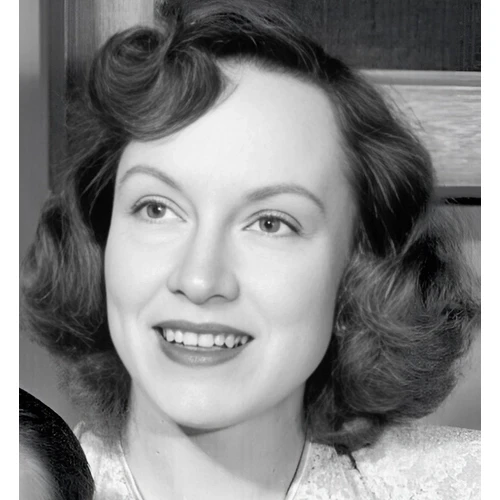
Virginia Lee Gregg possessed one of the most recognizable and versatile voices in American broadcasting history. Over a career spanning more than four decades, she became one of the most prolific performers in radio, television, and film, yet remained largely uncredited for many of her most iconic roles. Her journey from a young musician in Pasadena to a legendary voice actress represents a fascinating chapter in the golden age of broadcasting, demonstrating both the opportunities and overlooked contributions that characterized the era.
From Music to Radio Stardom
Virginia Gregg was born on March 6, 1916, in Harrisburg, Illinois, to musician Dewey Alphaleta (née Todd) and businessman Edward William Gregg. She had a stepsister named Mary. When she was five years old, her family relocated to Pasadena, California, where she would spend her formative years immersed in the arts. Her early education included attendance at Jefferson High School and Pasadena Junior College, followed by training at the Pacific Academy of Dramatic Art, establishing a foundation for her future in performance. Before entering the competitive world of radio acting, Gregg pursued a career in classical music. She played the double bass with the Pasadena Symphony and Pops, demonstrating musical talent that would complement her later work. Her transition into broadcasting came through her membership in the Singing Strings group, which premiered on KHJ in Los Angeles in 1937 and subsequently appeared on CBS and Mutual radio networks. This early exposure to radio production provided her with invaluable experience and connections that would launch her into a new phase of her career.
The Queen of Dragnet and Radio Dramas
Gregg became one of the most in-demand female radio actors of the 1940s, appearing on an astonishing array of programs that showcased her remarkable range. She became a prolific voice on classic radio dramas including The Adventures of Sam Spade, Dr. Kildare, Gunsmoke, The Jack Benny Program, Let George Do It, Lux Radio Theatre, One Man's Family, Yours Truly, Johnny Dollar, The Screen Guild Theater, CBS Radio Mystery Theatre, The Zero Hour, and Mutual Radio Theater. Her ability to portray diverse characters with authenticity and nuance made her invaluable to producers crafting multiple roles within single episodes. Perhaps most significantly, Gregg may be best remembered for her extensive work on Jack Webb'sDragnet, where Webb employed her in dozens of roles across both the radio and television versions of the show. This prolific collaboration extended into 1954 when she appeared in the film adaptation of Dragnet. Her work with Webb didn't end there—she continued performing in other productions by his company, Mark VII Limited, including Adam-12 and Emergency!, establishing herself as a trusted and reliable performer within Webb's creative circle. Her radio roles were remarkably varied. On the western series Have Gun–Will Travel (starring John Dehner as Paladin), she portrayed Miss Wong, the girlfriend of Hey Boy, and later appeared in different roles in the concurrent television series starring Richard Boone. On One Man's Family, she held the regular role of Betty Barbour, while on the detective series Richard Diamond, Private Detective (starring Dick Powell), she played Helen Asher, the wealthy girlfriend of the title character. These regular roles demonstrated her ability to anchor characters across multiple episodes, not merely provide voice work for incidental parts.
The Art of Invisible Performance
Gregg's career took a distinctive turn with her venture into voice acting, where she created some of her most memorable performances while remaining largely invisible to audiences. She provided the voice for Riabouchinska, the ventriloquist doll, in the 1956Alfred Hitchcock Presents television episode "And So Died Riabouchinska". However, her most legendary voice role came in 1960 when she supplied the distinctive, unsettling voice of Mrs. Bates in Alfred Hitchcock's masterpiece Psycho—one of cinema's most iconic performances, delivered entirely uncredited. The significance of this role extended beyond the original film. Unlike co-voice actors Jeanette Nolan and Paul Jasmin, who shared voice duties in Psycho, Gregg became the sole voice of the character in the sequels. She reprised Mrs. Bates as Norma Bates (voice, uncredited) in both Psycho II (1983) and Psycho III (1986), her final film role, providing continuity to one of horror cinema's most recognizable voices across three decades of films. This demonstrates the enduring value studios placed on her particular vocal talents. Beyond the Bates legacy, Gregg demonstrated her voice acting versatility in animated productions. She voiced Tarra on the 1967 animated television series The Herculoids, and reprised the role when the series was revived in 1981 as part of the Space Stars animated series. These voice roles showcased her ability to bring animated characters to life with conviction and personality, contributing to projects that entertained multiple generations of viewers.
Life Beyond the Microphone
Despite her professional success, Gregg's personal life contained both joy and hardship. She married producer Jaime del Valle in 1948 (though another source indicates the wedding occurred on October 15, 1947, in Las Vegas, Nevada). The couple had three children: Gregg, Jaime, and Ricardo. However, the marriage did not endure, and they divorced on December 22, 1959. The circumstances surrounding the dissolution of her marriage remain largely undocumented in available sources. Throughout her life, Gregg demonstrated a commitment to community service that extended far beyond her professional achievements. She was actively involved with Recording for the Blind, working as a volunteer to make recordings and serving on the organization's board of directors. This work aligned with her broader values and provided a meaningful way to contribute to society using the very talents that had made her famous in broadcasting.
A Legacy of Uncredited Excellence
Virginia Gregg's career presents a compelling paradox: despite being one of the most recognizable voices in American media for over forty years, she received remarkably little formal recognition or credit for her contributions. Her voice became synonymous with countless characters across radio, television, and film, yet her name rarely appeared in credits. This reflects the broader systemic issues of her era, when supporting performers—particularly women—were frequently uncredited for their work, regardless of the impact or memorability of their performances. Her influence on radio drama and voice acting proved substantial. She demonstrated that a performer could build an extraordinary career without anchoring themselves to a single character or persona, instead becoming invaluable through sheer versatility and professionalism. Her work ethic and reliability made her a producer's dream—someone who could step into any role, any accent, any character type, and deliver a polished, believable performance on short notice. This flexibility was revolutionary in an industry that often typecast performers into narrow categories. Gregg passed away on September 15, 1986, leaving behind an extraordinary body of work that continues to entertain audiences through film, television broadcasts, and radio archives. Her voice remains instantly recognizable to fans of classic cinema and broadcasting, even if her name is not. She represents a crucial chapter in broadcasting history—the skilled, dedicated professionals who shaped the golden age of radio and the early television era, often working in the shadows despite their immense contributions to popular culture.
Works and Appearances
Radio
- The Singing Strings (1937)
- The Adventures of Sam Spade
- Dragnet
- Dr. Kildare
- Gunsmoke
- The Jack Benny Program
- Let George Do It
- Lux Radio Theatre
- One Man's Family
- Yours Truly, Johnny Dollar
- The Screen Guild Theater
- CBS Radio Mystery Theatre
- The Zero Hour
- Mutual Radio Theater
- Have Gun–Will Travel
- Richard Diamond, Private Detective
- Nightbeat
- The Lone Ranger
Television
- Have Gun–Will Travel (concurrent television series with radio)
- Richard Diamond (television version, starring David Janssen)
- Dragnet (television series and 1954 film)
- Maverick (1961) "The Ice Man" episode
- Lawman (1962) "Clootey Hutter" episode
Cinema
- Crime in the Streets (1956)
- Psycho (1960)
- Operation Petticoat (1959)
- Gorath (1962)
Other Media
- Recording for the Blind – Volunteer recordings and board service