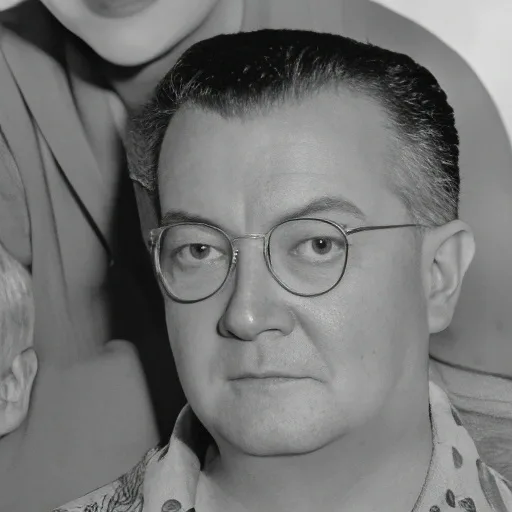
In the golden age of radio and early television, few performers could match the versatility and character range of Joseph Sherrard Kearns. A prolific actor who seamlessly transitioned between radio, film, and television, Kearns became a beloved figure in American entertainment, best remembered for his iconic role as the cantankerous George Wilson in the Dennis the Menace television series.
Early Life and Musical Roots
Born on February 12, 1907, in Salt Lake City, Utah, Joseph Kearns was the only child of Joseph Albert Kearns, a wool buyer, and Cordelia Marie Peterson, a concert pianist. His mother's musical passion would profoundly influence his life, instilling in him a deep love for music that would extend far beyond his acting career. Growing up in a devout Mormon family with pioneer ancestry, Kearns's early experiences would shape his future artistic endeavors. His first taste of performance came unexpectedly in 1916 when, at just nine years old, he joined "The Rising Generation", a vaudeville troupe of eleven children. This troupe toured for 14 months, providing Kearns with his initial exposure to the performing arts and laying the groundwork for his future career.
The Radio Years: A Master of Voices
Kearns's radio career began in 1930 when he joined a radio station in Salt Lake City. By 1936, he had moved to Los Angeles, where he would become a prominent radio actor. His versatility was remarkable; he could seamlessly transition between characters, from the Crazyquilt Dragon in serialized shows to hosting as "The Man in Black" on various programs. Throughout the 1940s, Kearns became a mainstay in radio broadcasting. He appeared on numerous shows, playing an incredible range of characters - from judges to kindly old-timers, from cowards to authoritative figures. His ability to bring distinct personalities to life made him a sought-after voice actor in the industry.
Expanding to Film and Television
Kearns's talents weren't confined to radio. He made his film debut in 1951 and became particularly notable for voicing the Doorknob in Disney's animated classic Alice in Wonderland. His film career, though not extensive, included memorable appearances in various productions. Television provided Kearns with some of his most memorable roles. He appeared in numerous series, often reprising characters he had previously played on radio. His most famous television role came in 1959 when he was cast as George Wilson in Dennis the Menace, a character that would become his most recognized performance.
Personal Passions and Final Years
Beyond acting, Kearns was passionate about music, particularly organs. He was musically trained by his mother and had played the pipe organ in a Los Angeles theatre during the 1930s. His love for organs was so profound that he designed and built a soundproof home around an 18-rank Wurlitzer organ, delighting in playing for his guests. Tragically, Kearns's life was cut short. On February 11, 1962, during the third season of Dennis the Menace, he suffered a medical event. Hospitalized in a coma, he never regained consciousness and passed away on February 17, 1962, at the age of 55. His death may have been related to an extreme diet during which he reportedly lost 40 pounds in just six weeks.
Legacy and Impact
Joseph Kearns represents the quintessential radio performer of his era - versatile, talented, and capable of bringing characters to life through voice alone. His work spanned radio, film, and television, making him a true multimedia performer of the mid-20th century.
Works and Appearances
Radio
- Various shows including serialized dramas and anthology series (1930s-1950s)
- Hosted as "The Man in Black"
- Played multiple characters across numerous programs
Television
- Dennis the Menace (1959-1962) - George Wilson
- Perry Mason - Various appearances
- Multiple guest roles in various series
Film
- Alice in Wonderland (1951) - Doorknob (voice)
- Several character roles in films throughout the 1950s
Other Media
- Pipe organ performances
- Vaudeville performances with "The Rising Generation" (1916)
Joseph Kearns's remarkable career serves as a testament to the incredible talent and adaptability of performers during radio's golden age, bridging the worlds of sound, screen, and stage with remarkable skill and charm.