Jack Webb
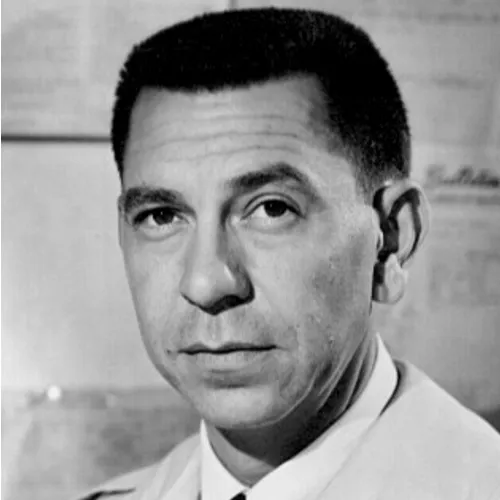
Jack Webb was a pioneering figure in radio and television who revolutionized the crime drama genre through his meticulous storytelling and groundbreaking approach to portraying law enforcement. His iconic portrayal of Sergeant Joe Friday in Dragnet would become a defining cultural touchstone of mid-20th century American media.
Early Life and Radio Beginnings
Born John Randolph Webb on April 2, 1920, in Santa Monica, California, Webb's early life was marked by financial challenges and a absent father. Growing up in Los Angeles, he attended Our Lady of Loretto Elementary School and Belmont High School, where he was elected student body president.
Webb's radio career began during World War II, when a wartime shortage of announcers led to his first broadcasting opportunities. His initial radio work included The Jack Webb Show, a half-hour comedy program on ABC radio in 1946, and One Out of Seven, a unique one-man program where he dramatized weekly news stories.
His early radio work demonstrated remarkable versatility. In shows like Pat Novak for Hire, Webb showcased his talent for hard-boiled dialogue, delivering lines that captured the noir sensibilities of the era. These early performances would later inform his distinctive narrative style.
The Rise of Dragnet
Webb's breakthrough came with Dragnet, a radio series he created in 1949 that would become his most enduring legacy. Inspired by a film called He Walked By Night, Webb sought to create a realistic portrayal of police work. With significant assistance from LAPD personnel, he developed a show that prioritized authenticity over dramatic embellishment.
The series' signature opening - "The story you are about to hear is true. The names have been changed to protect the innocent" - became instantly recognizable. Webb's portrayal of Sergeant Joe Friday was revolutionary: a no-nonsense, methodical detective who represented law enforcement with unprecedented respect and detail. When Dragnet transitioned to television in 1952, Webb's vision of portraying police work with unprecedented accuracy reached an even wider audience. His commitment to realism was so profound that he frequently recreated entire building floors on sound stages to ensure maximum authenticity.
Expanding Media Horizons
Beyond Dragnet, Webb proved to be a prolific producer and creator. He established Mark VII Limited, his production company, which would go on to create numerous successful television series including Adam-12 and Emergency!. His production style consistently emphasized meticulous detail and technical accuracy. Webb's respect for law enforcement was deeply personal. He frequently spoke about the challenging conditions faced by police officers, highlighting their long hours, low pay, and high injury rates. This genuine admiration translated into media that portrayed officers as dedicated professionals rather than stereotypical heroes or villains.
Legacy and Personal Life
While professionally celebrated, Webb's personal life was complex. A passionate jazz enthusiast with a collection of over 6,000 recordings, he was married four times and had two daughters. His marriages included a notable union with actress Julie London from 1947 to 1954.
Webb died on December 23, 1982, at the age of 62. In a remarkable tribute, Los Angeles Police Department retired badge number 714 - Joe Friday's iconic identifier - and the mayor ordered flags lowered to half-staff. His posthumous induction into the Television Hall of Fame in 1992 further cemented his cultural significance.
Works and Appearances
Radio
- Dragnet (1949-1957)
- Pat Novak for Hire (1949)
- One Out of Seven (1946)
- Pete Kelly's Blues (1951)
Television
- Dragnet (1952-1959, 1967-1970)
- Adam-12 (1968-1975, producer)
- Emergency! (1972-1976, creator)
- Project UFO (1978)
Film
- Sunset Boulevard (1950)
- Pete Kelly's Blues (1955, also director)
- The D.I. (1957, also director)
- -30- (1959, also director)
Jack Webb's contribution to American broadcasting transcended mere entertainment. He transformed how audiences perceived law enforcement, creating narratives that were simultaneously dramatic and deeply respectful of professional integrity.
Heard in