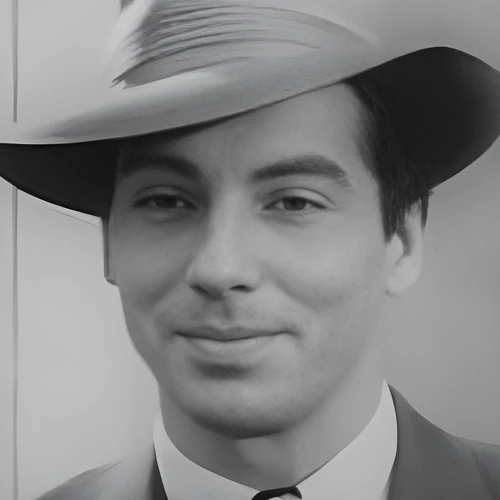
Carleton Young
In the golden age of radio and classic Hollywood, few performers could match the versatility and distinctive vocal presence of Carleton Young. A character actor with a deep, resonant voice that commanded attention, Young carved out a remarkable career that spanned radio, film, and television, leaving an indelible mark on mid-20th century entertainment.
Early Life and Roots in Performance
Born Carleton Scott Young on October 21, 1905, in Fulton, Oswego County, New York, he emerged from a family with professional challenges. The second and only surviving child of State Highway Civil Engineer Joseph Henry Young and Minna Emma Pauline Adler, Young's early life was marked by familial complexity. His elder brother, Reginald Adler Young, had tragically lived only 26 days, passing away from an acute infection. Young's path to entertainment was not immediate. By 1930, he was living with his divorced father, suggesting a childhood and young adulthood characterized by familial transitions. These early experiences likely contributed to the adaptability that would define his later professional career.
Breaking into Radio: A Versatile Performer
Young's radio career was distinguished by his remarkable ability to inhabit diverse characters. His most notable radio role came in The Whisperer (1951), a short-lived crime drama where he played Philip Gault, an attorney whose voice was destroyed in an accident. In this innovative show, Young portrayed a protagonist who developed a sardonic whisper, using this unique vocal technique to infiltrate the criminal underworld. Beyond The Whisperer, Young demonstrated extraordinary range across multiple radio programs. He portrayed iconic characters like Edmond Dantes in The Count of Monte Cristo, Ellery Queen in The Adventures of Ellery Queen, and David Farrell in Front Page Farrell. His ability to convincingly portray lawyers, detectives, and complex protagonists made him a sought-after radio performer.
Transition to Film and Television
While radio was his initial medium, Young seamlessly transitioned to visual storytelling. In cinema, he became known for supporting roles that leveraged his authoritative presence. He was the sidekick Jeff Travis in a series of films from 1940 to 1941. His film career included memorable appearances in movies like Reefer Madness (1936) and notable Westerns. Perhaps his most famous moment came in John Ford'sThe Man Who Shot Liberty Valance (1962), where he delivered one of Western cinema's most legendary lines: "No Sir, this is the West: When the legend becomes fact, print the legend."
Beyond Performance: A Quirky Entrepreneur
Demonstrating an entrepreneurial spirit that matched his creative talents, Young co-founded the Los Angeles Smog Corp. This whimsical venture sold canned "Genuine Los Angeles Smog" as a novelty item, capturing the humor and creativity that defined his generation of entertainers. The project, conceived with friends like Stan Goodman, allowed tourists to take home a "slice" of Hollywood's notorious pollution.
Legacy and Impact
Carleton Young represented a quintessential mid-20th century performer - adaptable, multi-talented, and capable of thriving across different entertainment mediums. From radio dramas to Western films, his deep voice and compelling screen presence made him a reliable character actor who enriched countless productions.
Works and Appearances
Radio
- The Whisperer (1951) - Philip Gault
- The Count of Monte Cristo - Edmond Dantes
- The Adventures of Ellery Queen - Ellery Queen
- Front Page Farrell - David Farrell
Film
- Reefer Madness (1936)
- The Man Who Shot Liberty Valance (1962) - Newspaper Editor
- Various Western and crime films (1940-1959)
Television
- Wagon Train (1960) - Dr. Craven
- Multiple television appearances (1951-1960)
Carleton Young passed away on November 7, 1994, in Burbank, California, leaving behind a rich legacy of performance that bridged radio's golden age and Hollywood's classic era.
Heard in