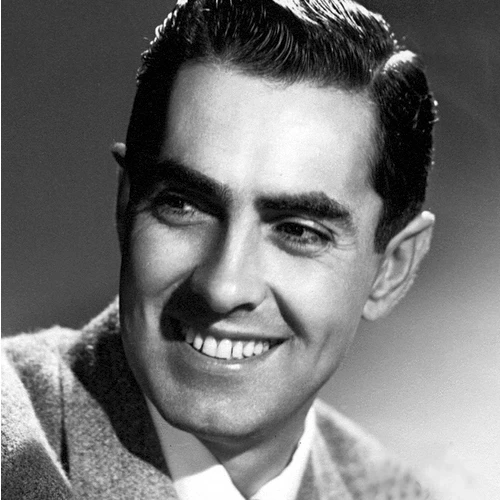
Tyrone Power
While Tyrone Power became best known as a Hollywood leading man whose striking good looks and commanding screen presence dominated cinema from the 1930s through the 1950s, his career extended well beyond the silver screen. Power's engagement with radio broadcasting represented an important yet often-overlooked dimension of his professional life, showcasing his versatility as a performer and his willingness to embrace diverse entertainment mediums. Though his primary fame rested on his film roles in swashbucklers and dramas, Power proved equally capable of captivating audiences through the disembodied medium of radio, where his deep, clear voice and dramatic talents could shine without reliance on his celebrated appearance.
From Cincinnati Streets to the Radio Microphone
Tyrone Edmund Power was born on May 5, 1914, in Cincinnati, Ohio, into a family with a theatrical legacy stretching back generations. His early years were steeped in drama and performance, though not through the glamorous path one might imagine. After graduating from Purcell Marian High School in 1931, Power left Cincinnati seeking opportunity and stability. His first genuine foray into the entertainment industry came not through film or prestigious theater, but through radio. Working in Chicago after his high school graduation, Power landed a position reading comic broadcasts on the radio on Sunday mornings. This early radio work was humble but formative—it taught him to depend upon his voice rather than his appearance, a skill that would serve him throughout his career. Power supplemented his modest radio income with various odd jobs, including working as an usher at the Walnut Hills Orpheum in Cincinnati and even pushing people around in rolling wicker chairs at the 1933 Chicago World's Fair. These experiences, though unglamorous, grounded him in the working world and instilled a work ethic that characterized his entire professional life. His early radio work represented not a stepping stone but rather a genuine means of survival and artistic development during the Depression era, before Hollywood discovered him.
The Hollywood Years and Radio Opportunity
After 20th Century Fox signed the young actor to a contract in 1936, Power's film career rapidly ascended. He appeared in dozens of films throughout the late 1930s and 1940s, often in swashbuckling roles or romantic leads. His better-known films included The Mark of Zorro, Blood and Sand, The Black Swan, Prince of Foxes, and Captain from Castile. From 1936 until 1943, when his career was interrupted by military service in the US Marine Corps, where he served as a flyer after the Japanese attack on Pearl Harbor in 1941, Power rocked hit after hit. However, even as his film career flourished, Power recognized the cultural importance and reach of radio broadcasting. In January 1939, Power took on a significant radio role, hosting and starring in NBC'sJergens' Hollywood Playhouse from January 1 to February 5, 1939. This was not merely a guest appearance but rather a hosting role, suggesting that networks and sponsors valued Power's presence and charisma enough to position him as a program anchor. This venture demonstrated that Power viewed radio not as inferior to film but as a legitimate and worthy performance medium.
Guest Star and Featured Performer on Prestige Programs
Following his return from military service, Power resumed his film career with renewed vigor, but radio remained part of his professional portfolio Beginning in 1940, Power made his first appearance on Lux Radio Theatre, performing in "The Rage of Manhattan" alongside co-star Annabella. This prestigious program, which dramatized Hollywood films and original stories for radio audiences, became a recurring venue for Power throughout the 1940s and 1950s. He returned to Lux Radio Theatre multiple times, including a 1941 performance in "Blood and Sand" with Annabella, a 1942 appearance in "This Above All" with Barbara Stanwyck, and a 1949 broadcast of "The Bishop's Wife" with David Niven. By the early 1950s, Power continued his radio work with appearances on Lux Radio Theatre in 1952 for "I'll Never Forget You" with Debra Paget and again in 1954 for "The Mississippi Gambler" alongside Linda Christian, who would become his wife. In 1954, he also appeared on the dramatic anthology program Suspense, performing in an episode titled "The Guilty Always Run" with Cathy Lewis. Beyond these documented dramatic performances, Power engaged in broader radio work that included variety and comedy programs as a guest star. His extensive work on radio demonstrated his versatility and his genuine commitment to the medium, not merely as a celebrity guest but as a serious performer.
Radio as a Window into Power's Artistic Soul
Power's radio work took on particular significance during periods when his film career underwent transitions. Throughout his life, Power fought against being typecast as merely a handsome romantic lead, seeking instead stronger roles with more substance. His work in Nightmare Alley became one of his personal favorites, representing the kind of substantial character work he craved. Radio allowed Power to explore dramatic material without the constraint of his physical appearance determining his casting. The medium demanded pure vocal performance, emotional authenticity, and dramatic skill—qualities Power possessed in abundance but could sometimes be overlooked in Hollywood's visual medium. By 1958, the year of his death, Power had completed 48 movies from 1936 to 1957 while maintaining his involvement in other performance mediums including radio and theater. His death on November 15, 1958, at age 44 from a massive heart attack came while he was sword in hand, engaged in theatrical performance. Power's commitment to radio, theater, and film until the very end of his life demonstrated an artist who refused to be confined to a single medium. Radio represented not an inferior alternative to film but rather an expression of his artistic integrity and his desire to challenge himself as a performer.
A Legacy Beyond the Silver Screen
Tyrone Power's involvement in radio broadcasting, while overshadowed by his legendary film career, constitutes an important thread in the broader tapestry of his professional identity. His work on radio demonstrated that major Hollywood stars of the 1930s, 1940s, and 1950s viewed broadcasting as a serious artistic endeavor rather than a mere novelty or career alternative. Power's transition between media—from early radio work in Chicago to film stardom to appearances on prestige anthology programs and back to theater—reflected the versatility expected of serious actors during Hollywood's golden age. Though posterity primarily remembers Power for his swashbuckling film roles and his striking appearance on screen, his radio work reminds us that his talents extended into the intimate and demanding medium of broadcast drama, where voice, timing, and emotional authenticity replaced visual spectacle. His legacy encompasses not just the films for which he became famous, but also the unseen performances that reached millions of listeners through their radios during the golden age of broadcasting.
Works and Appearances
Radio
- Early career work in Chicago on Sunday mornings reading comic broadcasts (early 1930s)
- Jergens' Hollywood Playhouse (NBC)
- Lux Radio Theatre – "The Rage of Manhattan" (1940)
- Lux Radio Theatre – "Blood and Sand" (1941)
- Lux Radio Theatre – "This Above All" (1942)
- Lux Radio Theatre – "The Bishop's Wife" (1949
- Lux Radio Theatre – "I'll Never Forget You" (1952)
- Lux Radio Theatre – "The Mississippi Gambler" (1954)
- Suspense – "The Guilty Always Run" (1954) with Cathy Lewis
Heard in