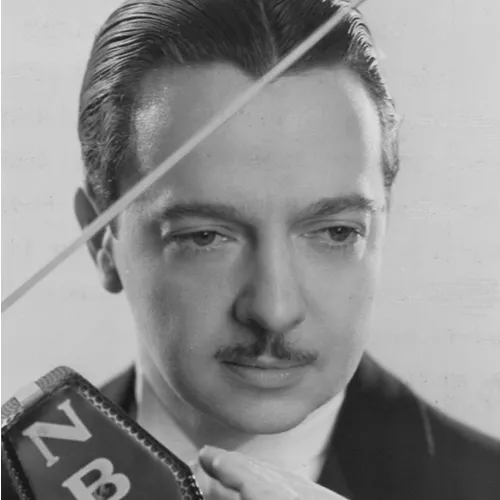
Robert Armbruster
In the vibrant world of mid-20th century American entertainment, Robert Armbruster emerged as a versatile and prolific musical talent who seamlessly navigated the complex landscape of radio, conducting, and composition. His remarkable career spanned multiple decades, making him a significant figure in the golden age of broadcasting and musical performance.
Early Musical Beginnings in Philadelphia
John Robert Sommers Armbruster was born on October 9, 1897, in Philadelphia, Pennsylvania, displaying extraordinary musical talent from an incredibly young age. At just eight years old, he made his professional debut as a pianist with the Philadelphia Orchestra, a remarkable achievement that hinted at his future success. His early years were marked by an intense passion for music and a prodigious ability that set him apart from his contemporaries. During his teenage years, Armbruster began recording for reproducing pianos, creating hundreds of classical and salon-style performances. This early work not only showcased his technical prowess but also demonstrated his versatility as a musician. He quickly gained recognition for unique compositions like "Western Ballet" and "Variations in Miniature on Chopsticks", which attracted significant attention in musical circles.
The Radio Years: Conducting and Composition
Armbruster's career truly blossomed during the 1940s when he became the conductor of the NBC Hollywood Orchestra. His musical leadership was sought after for numerous charitable specials, and he became a prominent figure in radio broadcasting. Throughout this period, he worked on an impressive array of radio programs, including Blue Ribbon Time, The Cass Daley Show, The Charlie McCarthy Show, and The Groucho Marx Show. A significant milestone in his radio career came in 1948 when he served as musical director, conductor, and solo pianist for the Kraft Music Hall program. During these performances, he was featured weekly in classical piano solos, leading an exceptional orchestra of approximately 35 musicians. Regular arrangers like Billy May and Nelson Riddle contributed to the program's high musical standards.
Versatility Across Musical Mediums
Armbruster was not content to remain in a single musical domain. He was a true Renaissance man of music, recording under multiple pseudonyms including Henri Bergman, Edwin Gabriel, Robert Romayne, and Robert Summers. This practice was common during his era and allowed musicians to explore diverse musical opportunities. In the 1960s, he reached another professional pinnacle by becoming the head of the music department at MGM Studios. This position solidified his reputation as a comprehensive musical professional who could excel in various entertainment sectors.
Legacy and Later Life
Throughout his extensive career, Armbruster demonstrated remarkable adaptability, transitioning from a child prodigy to a respected conductor, composer, and musical director. His ability to perform, compose, and lead across multiple platforms made him a unique figure in 20th-century American music. Robert Armbruster passed away on June 20, 1994, in Santa Monica, California, at the age of 96, leaving behind a rich musical legacy that spanned radio, film, and television.
Works and Appearances
Radio
- Blue Ribbon Time - Conductor
- The Cass Daley Show - Musical Director
- The Charlie McCarthy Show - Conductor
- Kraft Music Hall - Musical Director, Conductor, Solo Pianist (1948)
- The Groucho Marx Show - Conductor
Television
- Various MGM Studio productions (Head of Music Department, 1960s)
Compositions
- "Western Ballet"
- "Variations in Miniature on Chopsticks"
- Numerous classical and salon-style piano recordings
Pseudonyms
- Henri Bergman
- Edwin Gabriel
- Robert Romayne
- Robert Summers
Heard in