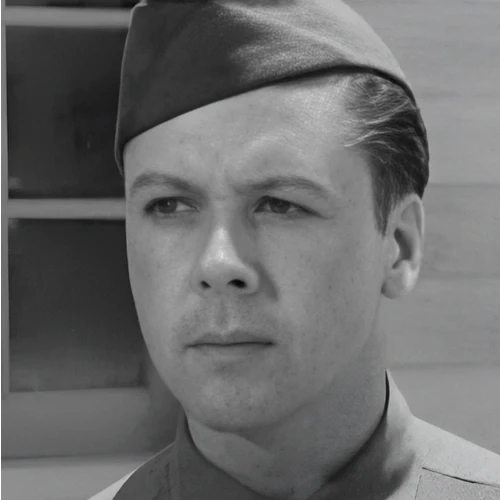
William Tracy
William Tracy carved out a distinct niche in American entertainment through his energetic screen presence, memorable character roles, and unusual ability to shift between comedy, drama, radio, and television. Though frequently cast as youthful, eager, or quick-witted personalities, he brought an unmistakable sharpness to every part he played. His performances throughout the 1930s, 1940s, and 1950s created a body of work that highlights both the versatility and the unpredictability of mid-century Hollywood careers.
Early Life and Entry into Film
William Tracy, born December 1, 1917, in Pittsburgh, Pennsylvania, entered the film industry during a period of rapid expansion and experimentation in Hollywood. While little is documented about his upbringing, the earliest available records place him on-screen by the late 1930s, already demonstrating a natural aptitude for character-driven performances. His youthful appearance and sharp comedic instincts positioned him well for roles that required a blend of innocence, cleverness, and expressive timing. Tracy’s early credits illustrate how quickly he adapted to studio demands. In 1938, he appeared in Brother Rat as Misto Bottome, marking one of his first notable film roles. That same year, he appeared in Angels with Dirty Faces as Jerry – as a Boy, demonstrating a capacity to fit seamlessly into dramatic narratives. His ability to work across genres so early in his career suggested a broad range that would become increasingly valuable as Hollywood’s tastes shifted. Throughout 1939, Tracy continued to secure steady work, including the part of Danny Regan in The Jones Family in Hollywood. His growing visibility allowed him to transition into more prominent roles, setting the stage for the defining performances that would follow in the early 1940s.
Breakthrough Roles and Wartime Comedy
Tracy achieved widespread recognition with his memorable portrayal of Pepi Katona, the spirited delivery boy in the beloved 1940 film The Shop Around the Corner. His agile, quick-talking performance left a strong impression on audiences and helped establish him as a standout character actor. In 1941, he continued building momentum with appearances in major productions, including John Ford’s adaptation of Tobacco Road and Alfred Hitchcock’s comedy Mr. and Mrs. Smith. That same year, Tracy entered what would become the signature chapter of his career: the role of Sgt. Dorian “Dodo” Doubleday. Debuting in Tanks a Million (1941), the character quickly became popular, pairing Tracy with Joe Sawyer as Sgt. Ames. Their dynamic—Tracy as the brainy, earnest military clerk and Sawyer as his gruff counterpart—struck a chord with wartime audiences seeking lighthearted escapism. Remarkably, Tanks a Million earned an Academy Award nomination for Best Musical Score. Tracy reprised Sgt. Doubleday in a total of eight films. The first six were produced as Hal Roach Streamliners, renowned for their compact, fast-paced storytelling. In 1942, he briefly stepped outside the Doubleday persona to star alongside Randolph Scott, John Payne, and Alan Hale Jr. in To the Shores of Tripoli. After returning to the Doubleday series at Hal Roach, the final two installments were produced by Lippert Pictures, culminating with Mr. Walkie Talkie in 1952—this time set during the Korean War. The longevity of the Doubleday character reflected both Tracy’s appeal and the enduring popularity of military-themed comedies.
Expansion into Radio and Television
As the film industry evolved during the 1950s, Tracy transitioned smoothly into television, a medium that suited his quick-paced, expressive acting style. His most notable television role emerged in 1953, when he portrayed Hotshot Charlie in the series Terry and the Pirates. This role carried special resonance, as Tracy had previously portrayed Terry Lee, the lead character, in the 1940 serial of the same name. His return to the franchise in a new character demonstrated both his adaptability and his ongoing association with adventure-driven storytelling. During this period, Tracy also made a memorable mark in radio. On June 14, 1951, he starred as the title character in the Suspense episode The Truth About Jerry Baxter. In the broadcast, the 33-year-old Tracy portrayed a troubled teenage marijuana addict—a dramatic and socially charged role that stood apart from his usual screen persona. Although framed as “drawn from actual events,” the narrative took on a sensationalized tone reminiscent of Reefer Madness, giving Tracy an opportunity to explore darker emotional territory. By the mid-1950s, Tracy’s presence across multiple media—film, radio, and television—reflected a performer who not only adapted to shifting entertainment landscapes but excelled in using each format’s strengths to enhance his craft.
Personal Life and Final Years
Beyond his professional achievements, Tracy experienced significant milestones in his private life. In 1945, he married actress Lois James, with whom he shared nearly a decade of marriage before their separation in 1954. While details of their relationship remain limited, the union marked an important chapter during the height of his professional visibility. Tracy’s later years were spent in California, where he continued to maintain ties to the entertainment industry. His life came to an early end when he died on July 18, 1967, in Hollywood, California, at the age of 49. He was interred at Valhalla Memorial Park Cemetery in North Hollywood, resting among many fellow performers of the classic Hollywood era.
Legacy and Cultural Impact
Although not among the era’s most publicized stars, William Tracy left an indelible mark on mid-century entertainment. His recurring Doubleday series showcased his distinctive comedic sensibility, while early dramatic roles demonstrated an emotional flexibility that allowed him to traverse genres with ease. His contributions to Suspense and Terry and the Pirates revealed a performer willing to embrace new media and experiment with new styles. Tracy’s work remains a testament to the essential character actors who formed the backbone of classic Hollywood storytelling. His legacy endures through a combination of beloved film appearances, noteworthy radio work, and television performances that continue to intrigue enthusiasts of vintage entertainment.
Works and Appearances
Radio
- Suspense — The Truth About Jerry Baxter (June 14, 1951)
Film
- Brother Rat (1938)
- Angels with Dirty Faces (1938)
- The Jones Family in Hollywood (1939)
- Million Dollar Legs (1939)
- The Shop Around the Corner (1940)
- Tobacco Road (1941)
- Mr. and Mrs. Smith (1941)
- Tanks a Million (1941)
- To the Shores of Tripoli (1942)
Television
- Terry and the Pirates (1953)
Serial
- Terry and the Pirates (1940 serial)
Heard in