Kenny Baker
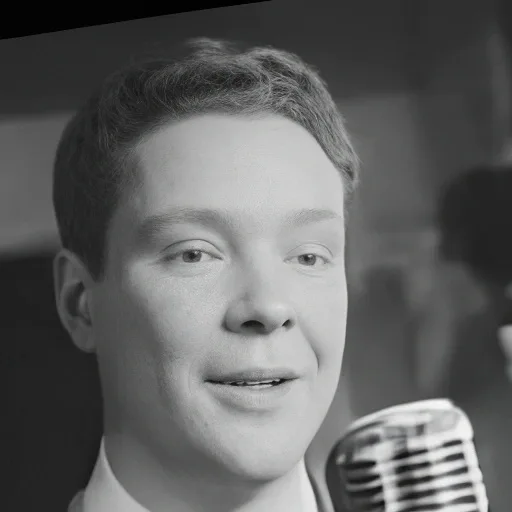
In the golden age of radio, few performers captured the hearts of listeners quite like Kenny Baker. A tenor with a distinctive high-pitched voice and an endearing on-air persona, Baker became one of the most recognizable radio personalities of the 1930s and early 1940s. His journey from a young chorus singer to a national radio star is a testament to the transformative power of entertainment during a pivotal era in American broadcasting.
Early Life and Musical Beginnings
Born Kenneth Laurence Baker on September 30, 1912, in Monrovia, California, Baker's musical talents emerged early in his life. Before becoming a radio star, he honed his skills as a chorus singer, laying the groundwork for his future success. His natural vocal abilities and charming stage presence would soon distinguish him in the competitive world of entertainment. Baker's entry into professional performance came at a time when radio was rapidly becoming the primary source of entertainment for millions of Americans. His timing was impeccable, and his unique vocal style would soon set him apart from other performers of his era.
The Jack Benny Program: A Career-Defining Moment
Baker's breakthrough came on November 3, 1935, when he joined Jack Benny's radio program. Replacing the popular singer Kenny Parker, Baker faced significant expectations. Remarkably, he not only met but exceeded audience expectations, quickly winning listeners' hearts. On the show, Baker portrayed a high-voiced, innocent young man whose "silly" remarks frequently frustrated the Jack Benny character. This comedic dynamic became a hallmark of the program, with Baker's character providing consistent humor and charm. His four-year stint on the Benny show, which ended on June 25, 1939, established him as a beloved radio personality.
Expanding Beyond Radio
While radio remained his primary medium, Baker successfully branched into other entertainment forms. He appeared in 17 film musicals during the height of his radio fame, including notable productions like Stage Door Canteen (1943) and several musical films in the late 1930s and early 1940s. After leaving the Jack Benny show, Baker continued to be a prominent radio performer. He appeared on Fred Allen's program from 1940 to 1942 and was heard on various other shows throughout the 1940s. He even hosted his own programs, including the Kenny Baker Show (1954) and Sincerely – Kenny Baker (1946).
Later Life and Legacy
In the early 1950s, Baker transitioned away from performing. He became a minister and recorded numerous hymns for his church, demonstrating the depth of his personal convictions. On August 10, 1985, he passed away in Solvang, California, leaving behind a rich legacy in American entertainment. Baker's contribution to radio went beyond mere performance. He represented a quintessential era of entertainment, where personality, vocal talent, and comedic timing could transform a performer into a national icon. His work with Jack Benny helped define the comedy-variety radio show format that would influence generations of broadcasters.
Works and Appearances
Radio
- Jack Benny Program (1935-1939) - Featured Singer
- Fred Allen Show (1940-1942)
- Kenny Baker Show (1954)
- Sincerely – Kenny Baker (1946)
Film
- Stage Door Canteen (1943)
- Hit Parade of 1937 (1937)
- Romance in the Dark (1938)
- Melody Lane (1941)
Personal Details
- Born: September 30, 1912 (Monrovia, California)
- Died: August 10, 1985 (Solvang, California)
- Spouse: Geraldyne Louise Churchill (1933-1968)
- Children: 3
Kenny Baker's journey from a young chorus singer to a radio star exemplifies the transformative power of mid-20th century American entertainment, capturing the imagination of listeners during radio's golden age.