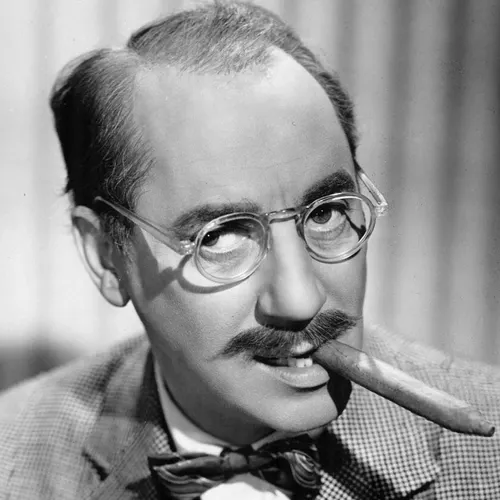
Groucho Marx
Groucho Marx was far more than just a comedian - he was a cultural icon who revolutionized entertainment across multiple mediums, with radio playing a pivotal role in his legendary career. Known for his quick wit, distinctive appearance, and razor-sharp improvisational skills, Marx transformed radio from a mere broadcast medium into a platform for comedic genius.
The Making of a Comedy Legend
Julius Henry "Groucho" Marx was born on October 2, 1890, in New York City, the third of five brothers who would become the legendary Marx Brothers. Growing up in a bustling immigrant neighborhood in Manhattan, young Julius was surrounded by creativity and humor. The family lived at 179 East 93rd Street, a building that would become a crucial backdrop to their early years. Marx's entry into entertainment began in vaudeville, where he developed his iconic look - the greasepaint mustache and eyebrows. Interestingly, this trademark appearance was born out of a spontaneous moment before a performance when he didn't have time to apply his usual pasted-on mustache. This improvisation would become a defining characteristic of his comedic persona.
Radio: The Medium That Amplified Marx's Genius
Radio became a critical platform for Marx, allowing his improvisational talents to truly shine. His radio career, while not always smooth, featured several notable programs. In 1932, he launched a short-lived series co-starring his brother Chico, which was thought lost but partially recovered in 1988. However, his most significant radio achievement was You Bet Your Life, which debuted in 1947. The show was a massive hit, transitioning from radio to television and becoming one of the most popular programs of its time. Featuring Marx's trademark wit and improvisation, the show was so unpredictable that it was pre-recorded to allow editing of potentially risqué content.
Beyond the Microphone: A Multifaceted Entertainer
While radio was important, Marx was a true multimedia star. He had already achieved fame with the Marx Brothers in film, appearing in 26 movies and developing a routine as a wisecracking hustler who delighted in insulting stuffy characters. His film career included classics like A Night at the Opera, where his quick wit was legendary. Marx's television career continued to flourish with shows like Tell It to Groucho in 1962 and a British TV show simply titled Groucho in 1965, though the latter was short-lived. His versatility as an entertainer was remarkable, spanning comedy, game shows, and even occasional dramatic roles.
The Personal Side of a Comedy Icon
Beyond his professional achievements, Marx was a complex personal figure. He was married three times, with significant age differences between himself and his wives. His political views were consistently liberal, and he proudly identified as a Democrat. In his later years, Marx continued to be celebrated. In 1974, he received an honorary Academy Award recognizing the Marx Brothers' contributions to motion picture comedy. Despite declining health, he remained a beloved public figure until his death on August 19, 1977, at the age of 86.
Legacy and Lasting Impact
Groucho Marx's influence on comedy cannot be overstated. He pioneered a style of humor that was simultaneously intellectual and absurd, breaking traditional comedic boundaries. His rapid-fire wit, memorable one-liners, and willingness to challenge social conventions made him a true revolutionary in entertainment.
Works and Appearances
Radio
- Groucho and Chico (1932)
- You Bet Your Life (1947-1961)
Television
- You Bet Your Life (1950-1961)
- Tell It to Groucho (1962)
- Groucho (British TV, 1965)
Film
- Duck Soup (1933)
- A Night at the Opera (1935)
- A Day at the Races (1937)
- Go West (1940)
Books
- Groucho and Me
- Memoirs of a Mangy Lover
Groucho Marx wasn't just a comedian - he was a cultural phenomenon who redefined humor for generations to come.
Heard in