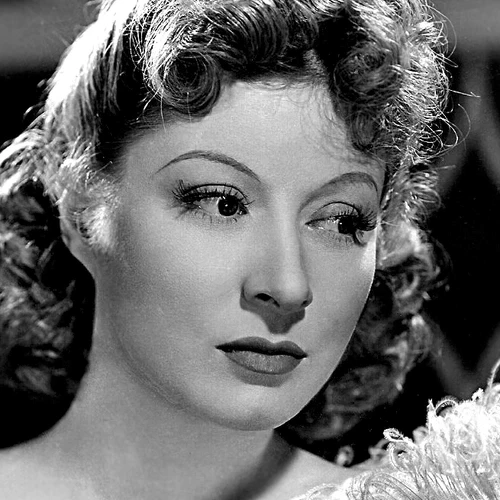
Greer Garson
Greer Garson was a luminous star who transcended the boundaries of stage, radio, and screen, becoming one of the most celebrated actresses of the mid-20th century. Her distinctive voice and commanding presence made her a beloved figure in entertainment, with a remarkable career that spanned multiple media platforms.
Early Life and Theatrical Beginnings
Born Eileen Evelyn Greer Garson on September 29, 1904, in Manor Park, East Ham, Essex, England, she came from a modest background. Her early life was marked by academic pursuits and a passion for literature. Garson studied French and 18th-century literature at King's College London and completed postgraduate studies at the University of Grenoble. Before her acting career took flight, she worked as the head of the research library at LINTAS, where a colleague would later note her influence in encouraging artistic pursuits. Her professional performance journey began on stage in January 1932 when she was 27 years old. Garson quickly established herself in theatrical circles, appearing in various stage productions and early television broadcasts. Her talent caught the eye of Louis B. Mayer, who discovered her while searching for new talent in London, ultimately signing her to Metro-Goldwyn-Mayer (MGM) in late 1937.
Radio Appearances and Performance Style
Greer Garson's radio career was an integral part of her broader entertainment portfolio. She made several notable radio appearances that showcased her versatility and dramatic range. Her radio work included performances on prestigious programs such as:
- The Screen Guild Theater (1942) - Performing in The Philadelphia Story
- My Favorite Wife (1945)
- Academy Award program - Performing in Brief Encounter (1946)
- Lux Radio Theatre - Appearing in Mrs. Parkington (1946) and The African Queen (1952)
- Suspense - Performing in 'Twas the Night Before Christmas (1953)
Her radio performances demonstrated the same nuanced acting that made her a Hollywood star, bringing dramatic narratives to life through her expressive voice and emotional depth.
Hollywood Success and Radio Crossover
While primarily known for her film career, Garson's radio work complemented her screen performances. She was one of the most celebrated actresses of her era, receiving an unprecedented seven Academy Award nominations. Her radio appearances often coincided with or promoted her film roles, creating a synergistic relationship between different media platforms. Garson frequently appeared on radio shows that celebrated cinema, using these platforms to connect with audiences and promote her latest projects. Her ability to transition seamlessly between film, stage, and radio made her a true multimedia star of the golden age of entertainment.
Legacy in Broadcasting and Entertainment
Greer Garson's contributions to radio and entertainment were significant. She was not just an actress but a cultural icon who represented the sophistication and grace of mid-20th century Hollywood. Her radio performances, though less documented than her film work, were an important part of her artistic repertoire. Beyond her radio and film career, Garson was recognized with numerous honors, including a star on the Hollywood Walk of Fame in 1960 and being made a Commander of the Order of the British Empire (CBE) in 1993. She received an honorary Doctor of Arts degree from Southern Methodist University in 1991, further cementing her cultural significance .
Works and Appearances
Radio Appearances
- The Screen Guild Theater (1942)
- My Favorite Wife (1945)
- Academy Award (1946)
- Lux Radio Theatre (1946, 1952)
- Suspense (1953)
Television Appearances
- What's My Line (1953-1958)
- Producers' Showcase (1955)
- General Electric Theater (1956-1960)
- Rowan & Martin's Laugh-In (1968-1970)
- The Love Boat (1982)
Film Appearances
- Goodbye, Mr. Chips (1939)
- Pride and Prejudice (1940)
- Mrs. Miniver (1942)
- Random Harvest (1942)
- Mrs. Parkington (1944)
Greer Garson passed away on April 6, 1996, in Dallas, Texas, leaving behind a remarkable legacy that spanned stage, radio, and screen. Her contributions to entertainment continue to be remembered and celebrated by film historians and fans alike.
Heard in