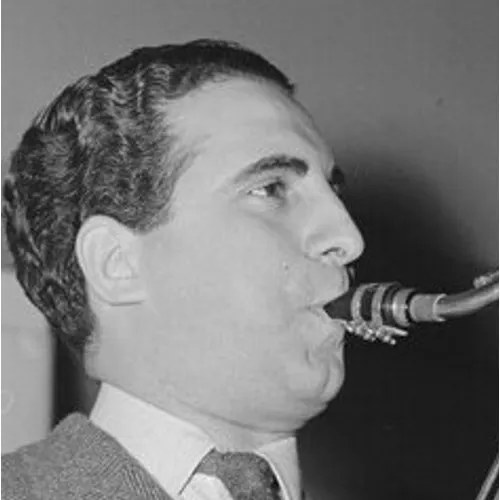
Dick Stabile
An American jazz saxophonist and bandleader. Dick Stabile got his start playing in theater ensembles on Broadway in the 1950s. He joined Ben Bernie's orchestra in 1928, where he remained for several years. In 1935 he started his own ensemble, recording with vocalists such as Bunny Berigan, Paula Kelly, Burt Shaw, and Gracie Barrie, the last of which he would go on to marry.
In the vibrant landscape of mid-20th century American jazz and big band music, Dick Stabile emerged as a multifaceted musician whose career spanned several decades of musical innovation. A saxophonist, clarinetist, and bandleader, Stabile navigated the dynamic world of swing music with remarkable skill and adaptability, leaving an indelible mark on the entertainment industry.
Early Life and Musical Roots
Born Richard Dominic Stabile on May 29, 1909, in Newark, New Jersey, he was destined for a musical career from the start. The son of a band leader and violinist, Stabile was immersed in music from a young age, initially learning piano and violin. His musical trajectory took a pivotal turn when his father was hired by a band leader on the condition of learning saxophone. Inspired by his father's example, Stabile began playing the saxophone and quickly demonstrated exceptional talent. His professional journey began early when he was hired by Jules Ansel at the Brunswick Hotel in Newark. This initial opportunity led to a significant breakthrough when he joined band leader Bernie's ensemble, where he served as lead alto saxophonist and soloist from 1928 to 1936. These formative years were crucial in developing his musical style and establishing his reputation in the jazz scene.
The All-America "Swing" Band and Professional Peak
In 1936, Stabile took a bold step by forming his own ensemble, the All-America "Swing" Band. This group was a powerhouse of talent, featuring notable musicians and attracting prominent vocalists. He recorded with artists like Berigan, Burt Shaw, and Gracie Barrie, whom he would later marry. During this period, Stabile recorded for multiple labels including Decca, Bluebird, and Vocalion, solidifying his presence in the recording industry. His band became a fixture in New York City's hotel music scene, and they achieved the prestigious honor of being chosen to play at a significant venue in 1959-60. Stabile's musical versatility was further demonstrated by his ability to design his own line of saxophones and clarinets, which carried his name.
War Years and Post-War Transition
During World War II, Stabile continued his musical career while serving in the military. In his absence, his wife Gracie Barrie led his ensemble, ensuring the band's continuity. After the war, he made a strategic move to Los Angeles, where he became a music director for notable entertainment figures. He even secured a small acting role as 'Private Pokey' in a film, showcasing his multifaceted talents.
Later Career and Legacy
The latter part of Stabile's career was marked by continued musical engagement. Throughout the 1960s, he led dance bands in Los Angeles ballrooms. In the mid-1970s, he took a position at the Hotel Roosevelt in New Orleans, where he continued performing until his death from a heart attack on September 18, 1980. Stabile's musical legacy extends beyond his performances. He worked with notable vocalists like Evelyn Oaks and Paula Kelly, and was part of the vibrant swing era that defined mid-20th century American music. As the cousin of singer Theresa Stabile, music truly ran in his family.
Works and Appearances
Radio
- Lead alto saxophonist on Bernie's weekly radio show (1928-1936)
Recordings as Leader
- Dick Stabile Plays for You (1957)
- At the Statler (1957)
- Dancing on the Sunset Strip (1959)
- This Cat Really Blows! (1960)
Performance Venues
- Brunswick Hotel, Newark
- Various New York City hotels
- Hotel Roosevelt, New Orleans
Instruments
- Saxophone (primary)
- Clarinet
- Designed personal line of saxophones and clarinets
Dick Stabile represents a quintessential musician of the swing era - adaptable, talented, and continuously evolving. His journey from a young saxophonist to a respected bandleader illustrates the dynamic musical landscape of mid-20th century America.