Dennis Morgan
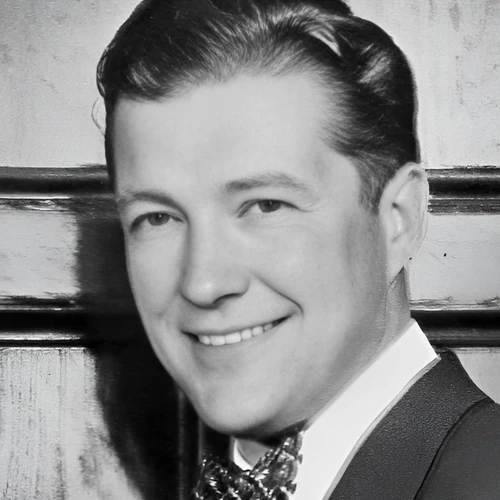
An American actor-singer. Born as Earl Stanley Morner, he used the acting pseudonym Richard Stanley before adopting the name he is famous under.
Dennis Morgan was a multifaceted entertainer whose career spanned radio, film, and stage, embodying the quintessential charm of mid-20th century American entertainment. Born Earl Stanley Morner in the small village of Prentice, Wisconsin, he would become a beloved radio personality and Hollywood star, known for his pleasant tenor voice and engaging screen presence.
Early Life and Musical Beginnings
Growing up in Wisconsin, Morgan's journey into entertainment began with music and performance. Of Swedish descent, he graduated from Marshfield Senior High and enrolled at Carroll College in Waukesha. His early professional experiences included performing with a theater troupe at the State Lake Theatre in Chicago, where he toured in productions like Faust . Morgan's musical talents quickly became apparent. He worked as a featured singer in the Empire Room of a famous Chicago hotel and even broadcast Green Bay Packers football games as a radio announcer. These early experiences would prove instrumental in shaping his future entertainment career .
Radio and Hollywood Breakthrough
Morgan's transition into professional entertainment was marked by his versatility. He began appearing in films in 1936, initially signed with MGM under the name "Stanley Morner". His breakthrough came when he was cast in musical numbers, most notably in The Great Ziegfeld, where he appeared as a singing bridegroom . His radio career ran parallel to his film work, with appearances on prestigious programs like Lux Radio Theatre and Cavalcade of America. Between 1941 and 1953, Morgan was a frequent radio performer, participating in shows that dramatized various stories and performances .
Peak of Popularity and Collaborative Work
Warner Bros. became Morgan's primary studio, where he was billed as "Dennis Morgan" and became a popular leading man. He was often paired with comedian Jack Carson, creating a successful on-screen duo reminiscent of other comedy teams of the era. Their collaborative films were characterized by Morgan playing the "easy-going singer who always got the girl" while Carson played the comedic sidekick . In 1947, Morgan was voted Singer of the Year, highlighting his musical prowess. His popularity was such that exhibitors voted him the 21st most popular star in the United States in 1948 .
Later Career and Legacy
As television began to dominate entertainment, Morgan made strategic transitions. He appeared in sporadic television guest roles and continued to perform, including with the Milwaukee Symphony and on summer stage circuits. In 1983, he was inducted into the Wisconsin Performing Artists Hall of Fame, cementing his legacy . Beyond entertainment, Morgan was known for his charitable work, notably dedicating Two Strike Park in 1959, demonstrating his commitment to providing recreational spaces for children .
Works and Appearances
Radio
- Lux Radio Theatre: Multiple episodes (1941-1953)
- Cavalcade of America: Multiple episodes (1942-1943)
- Screen Guild Theater: Multiple episodes (1943-1949)
- Family Theater: Multiple episodes (1947-1953)
Film
- The Great Ziegfeld (1936)
- Captains of the Clouds (1942)
- Thank Your Lucky Stars (1943)
- Two Guys from Milwaukee (1946)
- The Hard Way (1943)
Television
- The Jack Carson Show (1946)
- Schlitz Playhouse of Stars (1955)
- State Trooper (1958-1959)
Dennis Morgan passed away on September 7, 1994, in Fresno, California, leaving behind a rich legacy in American entertainment that bridged radio, film, and television.