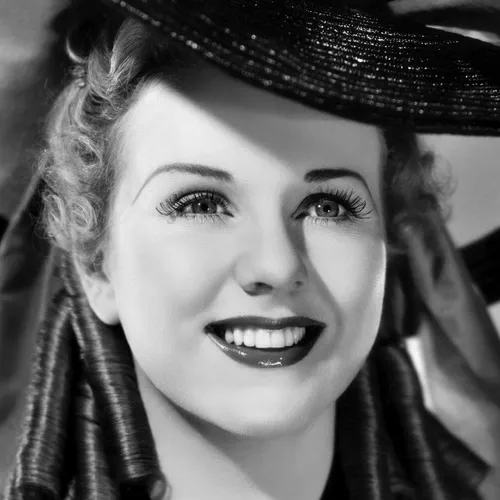
Deanna Durbin
A Canadian singer and actress, who appeared in a number of musical films in the 1930s and 1940s, her singing voice being variously described as being light but full, sweet and unaffected. With the technical skill and vocal range of a legitimate lyric soprano, she performed everything from popular standards to operatic arias.
Deanna Durbin was a remarkable performer whose extraordinary vocal talents and screen presence captivated audiences during the golden age of Hollywood and radio. Born Edna Mae Durbin on December 4, 1921, in Winnipeg, Canada, she would become one of the most celebrated singers and actresses of the 1930s and 1940s, bridging the worlds of classical music and popular entertainment.
Early Life and Musical Beginnings
Durbin's musical journey began early in her life. The younger child of James Allen Durbin and Ada Tomlinson Read, she moved with her family to Los Angeles during her infancy. By the age of 10, her sister recognized her exceptional musical talent and enrolled her in voice lessons at the Ralph Thomas Academy. Durbin quickly became Thomas's prize pupil, showcasing her abilities at local clubs and churches. Her vocal prowess was so remarkable that she caught the attention of professional musicians. In 1936, she auditioned for the vocal role of Snow White in Disney's animated film, but was rejected for being "too old" at 15. However, her vocal coach, De Segurola, a former Metropolitan Opera singer, believed she had the potential to become an opera star and was even commissioned to advise the Metropolitan Opera on her progress.
Rise to Stardom in Radio and Film
Durbin's breakthrough came in 1936 when she began a radio collaboration that lasted until 1938. Her remarkable voice and charismatic performances quickly made her a radio sensation. Simultaneously, she began her film career, signing with Universal Studios and becoming a pivotal figure in saving the studio from bankruptcy. Her early films, such as Three Smart Girls (1936) and subsequent musical comedies, established her as the ideal teenage performer. In 1938, she received a special Academy Juvenile Award, solidifying her status as a Hollywood darling. Producer Joe Pasternak was particularly effusive about her talents, recognizing her unique appeal.
Artistic Ambitions and Professional Challenges
As Durbin matured, she grew increasingly dissatisfied with her girl-next-door roles. She attempted to transition into more sophisticated, non-musical roles with films like Can't Help Singing (1944) and Christmas Holiday (1945). Despite her efforts, these films were not as successful as her earlier musical performances. Durbin was known for her strong will and influence within Universal Studios. She was one of the company's major stockholders and was not afraid to assert her artistic preferences. Columnist Jack Lait noted her determination, reporting that she would only proceed with projects on her own terms.
Retirement and Later Life
By 1949, Durbin had become disillusioned with Hollywood. She famously told her producer, Joe Pasternak, "I can't run around being a Little Miss Fix-It who bursts into song—the highest-paid star with the poorest material." She chose to retire, moving to Paris with her third husband, Charles Henri David. In a rare 1983 interview, Durbin acknowledged her dislike of the Hollywood studio system and emphasized that she never identified with the public image created around her. She continued to use her given name, Edna, in private life and steadfastly maintained her right to privacy.
Legacy and Impact
Deanna Durbin's influence extended far beyond her relatively short career. She was a global icon, with fans ranging from Mstislav Rostropovich, who cited her as a crucial musical influence, to Satyajit Ray, who mentioned her in his Oscar acceptance speech. Her star on the Hollywood Walk of Fame and her status as "Winnipeg's Golden Girl" are testaments to her enduring legacy.
Works and Appearances
Radio
- Various radio collaborations (1936-1938)
Film
- Three Smart Girls (1936)
- First Love (1939)
- Can't Help Singing (1944)
- Christmas Holiday (1945)
- Final four films: (1947-1948)
Concerts
- Classical concerts
- Semi-classical and popular music performances
- Performances for World War II troops
Deanna Durbin passed away on April 17, 2013, in Paris, leaving behind a remarkable legacy as a singer, actress, and cultural icon who helped define an era of entertainment.