Walter Abel
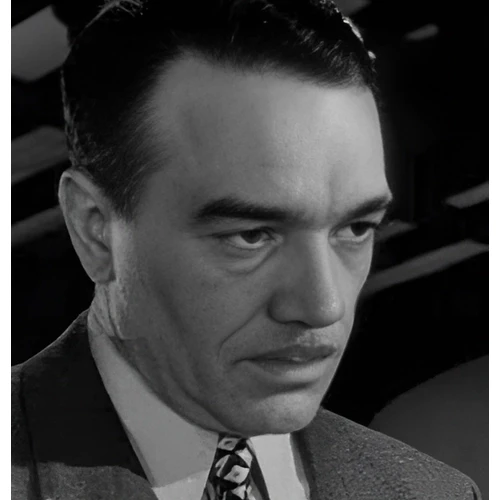
Walter Abel stands as one of the most accomplished and prolific performers of the twentieth century, a man whose remarkable career encompassed nearly seven decades across stage, film, radio, and television. Born in St. Paul, Minnesota, on June 6, 1898, Abel emerged from humble beginnings to become a consummate professional whose work spanned from the silent film era through the early years of television. His journey through entertainment demonstrates the evolution of American performance media itself, as he seamlessly transitioned between different mediums during an era when such versatility was increasingly rare. Despite the passage of time, Abel's contributions to radio, theater, and cinema remain a testament to a performer's dedication to his craft and his willingness to explore new creative frontiers.
The Foundation: Early Life and Training
Abel's path to stardom began in the American heartland, where he was born to Christine (née Becker) and Richard Michael Abel. His childhood in St. Paul was marked by both promise and tragedy. His brother Alfred died in 1922 from tuberculosis contracted while serving overseas during World War I, an event that shaped the Abel family profoundly. Rather than allowing personal loss to derail his ambitions, young Walter pursued formal training in dramatic arts with singular determination. In 1917, Abel enrolled at the prestigious American Academy of Dramatic Arts in New York, one of the nation's most respected institutions for theatrical training. Upon graduation, he immediately joined a touring company, beginning what would become an uninterrupted professional career spanning nearly seven decades. This early commitment to both formal training and practical experience established the work ethic that would define his entire career. Abel understood that excellence in performance required not just talent but disciplined preparation and continuous engagement with the craft.
The Broadway Years and Early Film Ventures
Abel's theatrical credentials were firmly established long before he became a household radio name. His Broadway debut came in 1919 with the production Forbidden, marking the beginning of what would become an impressive roster of stage appearances. Throughout the 1920s and early 1930s, he earned respect among theatrical circles for his range and professionalism. In 1923, he appeared in As You Like It, followed by William Congreve's Love for Love in 1925. His ability to handle both classic and contemporary material became evident when he appeared simultaneously in two Eugene O'Neill plays in 1924: Bound East for Cardiff at the Provincetown Playhouse and Desire Under the Elms at the Greenwich Village Theater. His theatrical resume grew increasingly distinguished as the decade progressed. Abel performed in Anton Chekhov's The Seagull (1929–1930), the ambitious Mourning Becomes Electra (1929), Kaufman and Hart's Merrily We Roll Along (1934), and Trelawny of the 'Wells'. In 1926, he appeared in Channing Pollock's The Enemy alongside Fay Bainter, an experience that proved doubly significant when the play was adapted into a film the following year. He also made his London stage debut in 1929 in Coquette, establishing an international reputation for excellence. Abel's film career began modestly in 1918 with a small part in Out of a Clear Sky, but remained relatively quiet for a decade as he focused on his theatrical work. The year before this debut, he had "just dabbled in the relatively new film industry" before returning to serious stage work for ten years. His first major film role arrived in 1935 when RKO Pictures cast him as D'Artagnan in the first sound version of Alexander Dumas' The Three Musketeers. This significant role demonstrated that Hollywood had taken notice of his stage success and recognized his potential for leading roles in prestigious productions. The part of the "enthusiastic but novice D'Artagnan really called for a younger actor reflecting those traits," yet RKO chose Abel for his talent and professionalism. He performed alongside a "strong supporting cast" including Paul Lukas, Moroni Olsen, and Onslow Stevens, with rousing music composed by Max Steiner and costumes rendered by Walter Plunkett.
Radio, Film Maturity, and Industry Standing
By the early 1940s, Abel had become an established presence across multiple entertainment mediums, and radio represented a natural extension of his already considerable reputation. Throughout the 1940s and early 1950s, Abel became "a frequent contributor to anthology series," with regular appearances on Lux Radio Theatre. His radio work demonstrated his versatility in dramatic performance. Notable radio appearances included Suspense, where he performed in Quiet Desperation on August 7, 1947, and Hollywood's Open House, appearing in The Artist on June 24, 1948. He also appeared on programs such as the Rudy Vallee Royal Gelatin Hour, where he performed in Invitation to a Murder with Humphrey Bogart and Gale Sondergaard. Meanwhile, Abel's film career flourished during the 1940s and beyond. In 1942, he played the hyperactive agent Danny Reed in the musical comedy Holiday Inn, performing alongside Hollywood giants Bing Crosby and Fred Astaire. His film work expanded dramatically throughout this period. In 1941, he appeared as Inspector Hammock in Hold Back the Dawn, and in 1944, he played George Trellis in Mr. Skeffington. In 1947, he took the role of Charles Gibson in 13 Rue Madeleine. He also made soundtrack contributions, performing "If You Knew Susie" (uncredited) in The Affairs of Susan (1945) and appearing in other musical recordings. Abel's contributions to American culture extended significantly. The NYPL Archives document his work with the Philadelphia Orchestra, particularly his concert narrations. His professional correspondence remained extensive, consisting of "letters concerning productions; agents; arrangements for speaking engagements and concert narrations, particularly with the Philadelphia Orchestra." Beyond entertainment, Abel devoted considerable energy to theatrical education and advocacy. His archived speeches at colleges throughout the 1960s demonstrate his "tireless work promoting the theater to college students and others," with most lectures focusing on Shakespeare, theater history, and the psychology of acting.
Legacy and Final Years
The latter portion of Abel's career saw him embrace the emerging medium of television with characteristic professionalism. By 1949, he had quickly embraced early television playhouse productions, appearing in approximately thirty roles by 1960. Throughout the 1960s and into the early 1970s, he remained active as a familiar face on episodic television, continuing to secure roles despite the changing landscape of the entertainment industry. He appeared in television programs including The Defenders (1963), where he played Ben Burke; The Farmer's Daughter (1963), as General Todd; East Side/West Side (1964), playing Brewer Bradford; and Bob Hope Presents the Chrysler Theatre (1966), as Reynard Pitney. His later film and television work continued through the early 1980s, including a role in Grace Quigley (1984), where he played Homer Morrison. Walter Abel passed away on March 26, 1987, at a nursing home in Essex, Connecticut, succumbing to a myocardial infarction. He was 88 years old. His final Broadway appearance had occurred in 1975, nearly a decade before his death, demonstrating his commitment to performance throughout his life. Following his wishes, he was cremated, and his ashes were combined with those of his wife—concert harpist Marietta Bitter—and scattered in Long Island Sound. A memorial service was held at the Little Church Around the Corner in Manhattan, honoring a man whose career had touched multiple generations of American audiences. The Walter Abel Papers, now archived at the New York Public Library, preserve the legacy of an actor whose sixty-year career spanned multiple entertainment mediums and influenced theatrical training and promotion. Abel's seven-decade career remains a model of professional consistency, artistic integrity, and creative adaptability in an entertainment industry undergoing profound transformation.
Works and Appearances
Radio
- Rudy Vallee Royal Gelatin Hour
- Suspense – Quiet Desperation (1947)
- Hollywood's Open House – The Artist (1948)
- Lux Radio Theatre
Theater
- Forbidden (1919)
- As You Like It (1923)
- Love for Love (1925)
- Bound East for Cardiff (1924)
- Desire Under the Elms (1924)
Cinema
- Out of a Clear Sky (1918)
- Liliom (1930)
- The Three Musketeers (1935)
- Fury (1936)
Television
- Play of the Week (1960)
- The Defenders (1963)
- The Farmer's Daughter (1963)
- East Side/West Side (1964)
- Seaway (1966) –
- Bob Hope Presents the Chrysler Theatre (1966)
- Early television playhouse productions (1949–1960)
Concert and Narration
- Lincoln Portrait by Aaron Copland (1951)
- Dylan Thomas's Under Milk Wood (1953)
- Israel: The Story of the Jewish People (1965, 1979)
Heard in