Susan Hayward
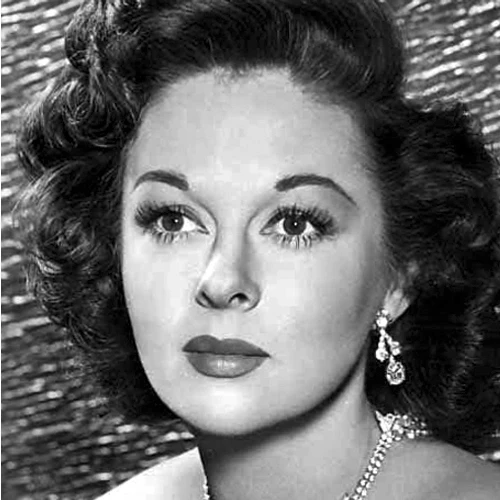
Susan Hayward (June 30, 1917 – March 14, 1975) was an American actress. After working as a fashion model in New York, Hayward traveled to Hollywood in 1937 when open auditions were held for the leading role in Gone with the Wind (1939). Although she was not selected, she secured a film contract, and played several small supporting roles over the next few years. By the late 1940s, the quality of her film roles had improved, and she achieved recognition for her dramatic abilities with the first of five Academy Award nominations for Best Actress for her performance as an alcoholic in Smash-Up, the Story of a Woman (1947). Her career continued successfully through the 1950s and she won the Academy Award for Best Actress for her portrayal of death row inmate Barbara Graham in I Want to Live! (1958). Hayward married and lived in Georgia and following her Oscar-winning performance, her film appearances became infrequent, although she continued acting in film and television until 1972. She died in 1975 of brain cancer.
Early life Hayward was born Edythe Marrenner in Brooklyn, New York, the youngest of three children born to Ellen (née Pearson) and Walter Marrenner. Her paternal grandmother was an actress, Kate Harrigan, from County Cork, Ireland. Her mother was of Swedish descent. She had an older sister Florence (born May 1910) and an older brother Walter, Jr. (born December 1911). Hayward was educated at Public School 181, and later attended The Girls' Commercial High School (later renamed Prospect Heights High School). During her high school years, she acted in various school plays and was named "Most Dramatic" by her class. She graduated in June 1935. Career Hayward began her career as a photographer's model, going to Hollywood in 1937, aiming to secure the role of Scarlett O'Hara in Gone with the Wind. Although she did not win the role, Hayward found employment playing bit parts until she was cast in Beau Geste (1939) opposite Gary Cooper. During the war years, she acted with John Wayne twice, as a second lead in Reap the Wild Wind (1942) and as his leading lady in The Fighting Seabees(1944). She also starred in the film version of The Hairy Ape (1944). Later, in 1955, she was cast by Howard Hughes to play Bortai in the historical epic The Conqueror, again opposite John Wayne.
in The Snows of Kilimanjaro (1952)
After the war, she established herself as one of Hollywood's most popular leading ladies in films such as Tap Roots (1948), My Foolish Heart (1949), David and Bathsheba (1951), and With a Song in My Heart (1952). In 1947, she received the first of five Academy Award nominations for her role as an alcoholic nightclub singer in Smash-Up, the Story of a Woman. During the 1950s she won acclaim for her dramatic performances as President Andrew Jackson's melancholic wife in The President's Lady (1953); the alcoholic actress Lillian Roth in I'll Cry Tomorrow (1955), based on Roth's best-selling autobiography of the same name, for which she received a Cannesaward; and the real-life California murderer Barbara Graham in I Want to Live! (1958). Hayward's portrayal of Graham won her the Academy Award for Best Actress. In 1959, she played the lead, Mary Sharron, in Woman Obsessed. In 1961, Hayward starred as a working girl who becomes the wife of the state's next governor (Dean Martin) and ultimately takes over that office herself inAda. The same year, she played Rae Smith in Ross Hunter's lavish remake of Back Street, which also starred John Gavin and Vera Miles. In 1967, Hayward replaced Judy Garland as Helen Lawson in the film adaptation of Jacqueline Susann's<span clas
Heard in