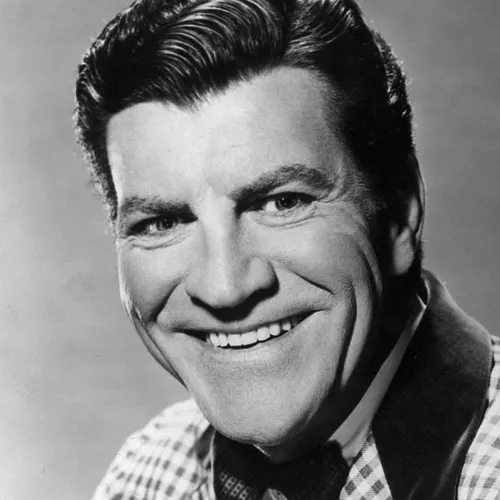
Robert Preston
In the colorful tapestry of 20th-century American entertainment, Robert Preston emerged as a dynamic performer whose commanding presence and versatile talent carried him from early Hollywood roles to Broadway triumphs. While best known for his stage and film work, his career offers a revealing look at how actors of his era navigated multiple performance mediums, including radio.
Early Life and Stage Foundations
Born Robert Preston Meservey on June 8, 1918 in Massachusetts, he later moved with his family to California, where he attended Pasadena Junior College before discovering his love for acting. His earliest performance training came through the Pasadena Community Playhouse, a respected proving ground for many actors of the period. The Playhouse honed his instincts for timing, voice control, and emotional expression—techniques that would later define his professional identity. His stage work quickly revealed a natural ease in front of an audience. Before long, Paramount Pictures took notice and offered him a contract, marking his transition from stage to screen. This shift established the foundation for a lifelong career that would balance planned performance with spontaneous charisma, especially evident in the musical roles he would later dominate.
Entry into Hollywood and Wartime Service
Preston entered Hollywood during the late 1930s, often cast in smaller roles or supporting parts that highlighted his youthful energy and strong presence. Throughout the late 1930s and early 1940s, he appeared in a string of films—many of them action pictures or dramas—gaining steady recognition without yet becoming a household name. His ascent paused during World War II, when he enlisted in the United States Army Air Forces and served as an intelligence officer. The discipline and resilience he developed during his service would carry over into his postwar career. When he returned to acting, he brought with him a deeper sense of confidence and maturity that enriched his performances on both stage and screen.
Broadway Breakthrough and Signature Roles
Although Preston enjoyed film success, his defining artistic moment came with Broadway. In 1957, he originated the unforgettable role of Professor Harold Hill in the musical The Music Man, a performance that propelled him into theatrical legend. The role demanded charm, bravado, musicality, and rhythmic precision—qualities Preston delivered with effortless flair. His portrayal earned him the Tony Award for Best Actor in a Musical, solidifying his status as one of Broadway’s most commanding leading men. Preston later reprised the role in the 1962 film adaptation, once again electrifying audiences with his signature rapid-fire patter and showman’s swagger. Though he often spoke about being typecast after such an iconic performance, he continued to pursue roles that showcased his dramatic range, proving he was far more than a single-character phenomenon. In the decades that followed, Preston appeared in additional stage productions that highlighted his depth as a performer, including I Do! I Do! alongside Mary Martin, which earned him another Tony nomination. His vocal expressiveness—honed in both theater and earlier radio work—remained one of his greatest artistic tools.
Film Career, Late Success, and Personal Style
Beyond his early Hollywood years, Preston maintained a strong presence in cinema. He acted in films across multiple genres, from wartime dramas to Westerns, drawing on his ability to blend seriousness with wry humor. But the 1980s brought a remarkable resurgence. His performance as Carroll “Toddy” Todd in Victor/Victoria (1982) earned him an Academy Award nomination for Best Supporting Actor, reminding audiences of his unmistakable charm and impeccable timing. Preston’s on-screen style balanced vigor with warmth. His voice—distinct, resonant, and rhythmically precise—became one of his trademarks, a trait that served him well not only in musicals but in dramatic roles requiring emotional nuance. Despite his visibility, Preston maintained a deliberately private personal life. He married actress Catherine Craig in 1940, and the two remained together until his death in 1987. Offstage, he preferred quiet domesticity over publicity, choosing to let his work speak for itself.
Legacy and Final Years
Robert Preston continued acting into the 1980s, appearing in television movies and feature films that benefited from his seasoned experience. He died on March 21, 1987 from lung cancer, leaving behind a legacy that continues to resonate strongly in American performing arts. His impact on musical theater is enduring: The Music Man remains inseparable from his performance, and subsequent generations of actors continue to measure themselves against the standard he set. His versatility across film, stage, radio, and television demonstrates the adaptability required of mid-century performers navigating rapidly evolving entertainment media. To this day, Preston’s blend of confidence, humor, and musical command keeps his work fresh and influential.
Works and Appearances
Radio
- Occasional radio appearances during the mid-20th century, including guest roles and promotional performances.
Theater
- The Music Man (1957)
- I Do! I Do! (1966) n
Film
- King of Alcatraz (1938)
- Beau Geste (1939)
- The Music Man (1962)
- Victor/Victoria (1982)
- The Last Starfighter (1984)
- Outrage! (1986)
Television
- Appeared in several television films during the 1980s, including crime dramas and character-driven stories
- Maintained steady presence in made-for-TV productions late in his career