Leith Stevens
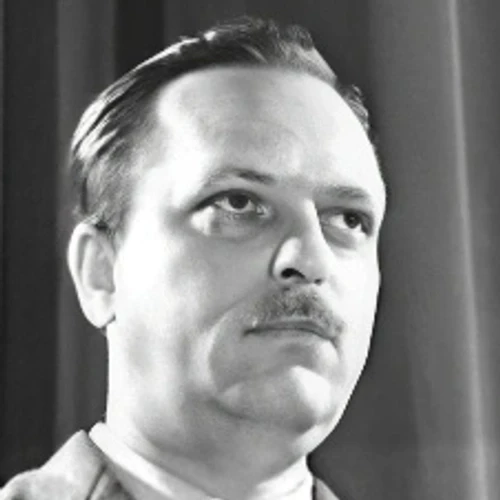
In the golden age of radio and early Hollywood, few composers bridged the worlds of broadcasting and cinema as seamlessly as Leith Stevens. A versatile musician whose career spanned multiple decades, Stevens emerged as a significant creative force in mid-20th century American entertainment, leaving an indelible mark on radio, television, and film music.
Early Life and Musical Beginnings
Born on September 13, 1909, Leith Stevens showed early promise as a pianist with a remarkable talent for musical interpretation. His initial forays into the entertainment world began in the early 1930s, when radio was rapidly becoming the dominant form of mass media. As a young musician, Stevens quickly distinguished himself not just as a performer, but as an innovative composer and conductor. By 1934, Stevens was already making waves in radio broadcasting. A newspaper from April 28 of that year highlighted his orchestra accompanying tenor Charles Carlile, signaling the beginning of a prolific career in musical performance and composition. His early work demonstrated a keen understanding of musical dynamics and audience engagement, traits that would define his entire professional trajectory.
Radio: The Crucible of His Creative Genius
Stevens' radio career was extraordinarily extensive, with credits spanning numerous programs across multiple genres. His work as a musical director and composer encompassed an impressive array of radio shows, including The Free Company, Rogue's Gallery, The Judge, and Men Against Death. These programs represented the diverse landscape of radio entertainment, from dramatic anthologies to crime melodramas. During World War II, Stevens took on significant responsibilities, serving as a radio director for the Southwest Pacific Area. This period not only expanded his professional repertoire but also allowed him to contribute to wartime communication and morale. His musical versatility and ability to adapt to different narrative contexts made him a sought-after talent in the radio industry.
Transition to Film and Cinematic Achievements
Stevens' musical talents were not confined to radio. He made significant contributions to cinema, composing film scores that captured the emotional complexity of their narratives. His piano concerto in C minor, first used in a 1947 Hollywood film, demonstrated his sophisticated compositional approach, blending influences from Delius, Rachmaninov, and Gershwin. His filmography is impressively extensive, including scores for numerous movies throughout the 1940s and 1950s. Notably, he co-wrote the Oscar-nominated title song for a 1956 movie and provided music for dozens of films, ranging from dramas to westerns. One of his most memorable works was the soundtrack for The James Dean Story, where he used unconventional instruments like recorders, harmonicas, and bongo drums to capture the essence of youth's uncertainty and rebellion.
Legacy and Final Years
Stevens' career continued to evolve, extending into television where he composed and conducted music for 36 different shows. He created haunting theme songs and scored episodes for popular series, further cementing his reputation as a versatile musical storyteller. Tragically, Stevens' life was marked by personal loss. He passed away at 60 years old, shortly after learning of his wife's fatal car accident. Despite this heartbreaking end, his musical legacy endures as a testament to his extraordinary talent and contribution to American entertainment.
Works and Appearances
Radio
- Musical director for numerous shows including Rogue's Gallery, The Judge, Men Against Death
- Radio director for Southwest Pacific Area during World War II
Film Scores (Selected)
- Destination Moon (1950)
- The James Dean Story (1957)
- The Wild Bunch (1969)
- Uncredited contribution to Frank Capra's classic film
Television
- Musical composer/conductor for 36 television shows
- Theme song composer for multiple series
- Musical director for shows like Rawhide
Leith Stevens represented the quintessential mid-20th century American musician - adaptable, innovative, and profoundly influential across multiple media platforms.
Heard in