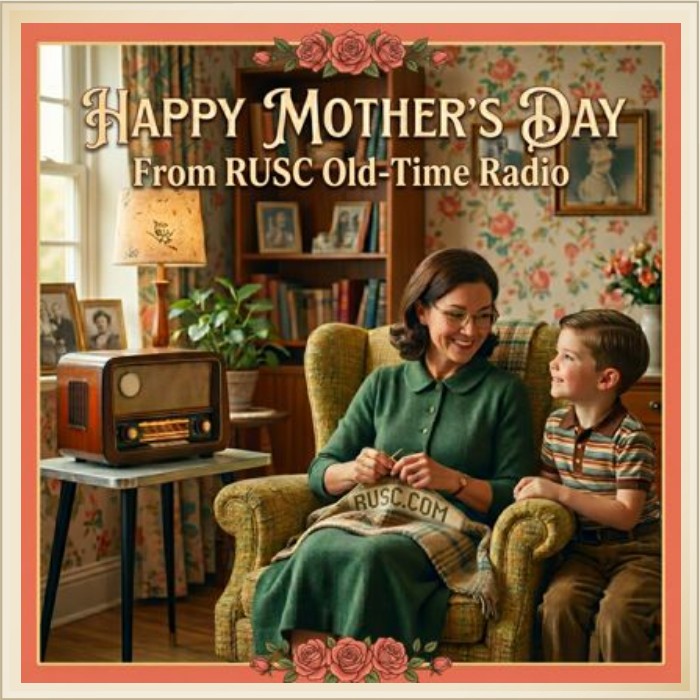
On RUSC this Mother's Day, I’ve paired two contrasting listens that capture how the medium embraced motherhood: a solemn appeal from the pulpit microphone, and a warm wink from America’s favorite comedian.
First, a selection that reflects the sober mood of the late 1930s. On May 14, 1939—Mother’s Day that year—Father Charles Coughlin delivered an address entitled The Mother’s Challenge to Warmongers. As the world edged closer to war, Coughlin chose to frame his remarks around the figure who personified nurture and sacrifice in so many American homes. As the program’s summary puts it:
“On this Mother’s Day broadcast, Father Coughlin delivers a powerful and heartfelt address, The Mother’s Challenge to Warmongers’s He eloquently contrasts the life-affirming spirit of motherhood with the devastating consequences of war. The message is built around some quite startling and little-known historical accounts from the Great War, which are used to illustrate the profound human cost of conflict in a way that is both moving and thought-provoking. Delivered with his characteristic conviction, the address serves as a poignant appeal for peace and a tribute to mothers everywhere. It is a compelling listen that encourages reflection on the sacrifices made far from the battlefield and the true meaning of patriotism.”
It’s important to place this in context. By 1939, Coughlin was one of radio’s most prominent and polarizing voices. Earlier in the decade he had built a mass audience through social commentary and populist rhetoric; as the years progressed, his broadcasts grew increasingly "controversial" in the eyes of some. The Mother’s Day address reveals how broadcasters used the airwaves to speak directly to family anxieties: mothers with sons of draft age, parents who still carried the memory of the Great War, and households searching the Sunday dial for clarity and comfort. You can hear in the cadence and construction the classic hallmarks of the period’s radio oratory—steady pacing, formal phrasing, and carefully selected anecdotes chosen to land with listeners seated around the set. It’s a piece that captures how radio could at once reflect and shape the national mood.
Of course, Mother’s Day on the air wasn’t only sermons and solemn reflections. It was also an opportunity for variety shows to mix sentiment with smiles—and nobody did that better than Jack Benny. I’ve added The Jack Benny Program’s 1937 - Mother’s Day broadcast to the lineup as a lighter companion piece. This is Benny in his Jell-O years, with Don Wilson at the microphone for sponsor tags, Mary Livingstone needling Jack with deft one-liners, Phil Harris tossing off that jaunty bandleader swagger, and young tenor Kenny Baker lending a silky number mid-show. Mother’s Day gave the Benny writers a perfect frame for their brand of affectionate mischief: Jack fussing over the “right” present, some farcical errand-gone-wrong, and the inevitable burst of comic vanity punctured by Mary’s asides. There’s warmth under the wit, which is why these episodes still play so well today. They mirror the small rituals listeners recognized in their own homes—phone calls to mothers back in hometowns like Jack’s Waukegan, a card read aloud, a bouquet arriving a day late—and they make gentle sport of them without losing the tenderness at the core.
Taken together, these two programs showcase radio’s remarkable range in the 1930s: from pulpit to punchline, a single medium could address the same holiday through entirely different lenses—and reach the same living rooms. They also remind us how central mothers were to the language of broadcasting in those decades. Advertisers built entire campaigns around “the homemaker.” Dramas leaned on the figure of the steadfast mother to summon instant empathy. Comedians aimed jokes at the foibles of filial devotion, while inevitably tipping their hat to maternal patience. And on the editorial side, as with Coughlin’s speech, appeals to motherhood were used to frame arguments about duty, sacrifice, and national purpose.
If you’re in the mood to explore further, I’ve gathered a link to many more Mother’s Day shows across genres—comedies that give you that cozy Sunday feeling, heartfelt family dramas and anthology pieces that honor the day in their own way, and a few musical hours that set the mood beautifully. It’s a lovely playlist for a quiet afternoon.
However you listen, I hope these selections add a touch of reflection and a few welcome laughs to your Mother’s Day. Old-time radio is at its best when it brings us together—voices from the past reminding us what we still hold dear today. Enjoy the shows, and do share your favorites with the RUSC community.