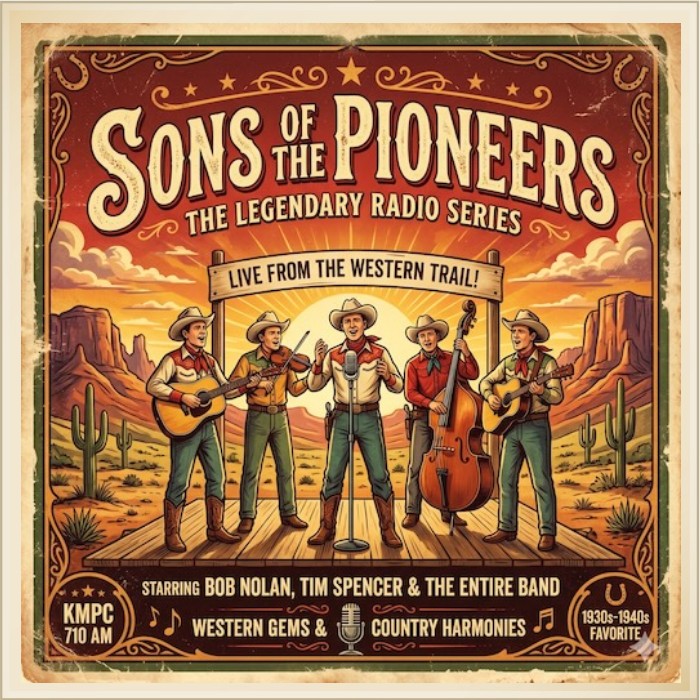
Their journey on the air runs in two strong strands: an earlier, compact run of 15‑minute transcriptions of which, 13‑episode are known to be extant, and a later, more expansive half‑hour series known as Lucky U Ranch from 1951–1952. It’s the latter that many collectors prize most—both for its breadth and for the superb sound quality preserved on Armed Forces Radio Service discs.
Lucky U Ranch arrived on radio in the early 1950s as a syndicated, 30‑minute showcase built squarely around the Pioneers’ blend of tight vocals and top‑flight Western instrumentation. The series was also distributed to service members through the facilities of the Armed Forces Radio Service, and a great many of the circulating copies today come from AFRS pressings. That’s one reason the audio is so clean; AFRS dubbing chains and storage often gave us remarkably faithful transfers.
What you’ll hear in Lucky U Ranch:
- Format: A relaxed “visit to the ranch” feel—three to five feature numbers per show, brief patter and introductions, and one or two instrumental spotlights that let the fiddles and guitars sparkle. - Repertoire: Cornerstones like Tumbling Tumbleweeds, Cool Water, Timber Trail, and Blue Prairie, alongside mid‑century favorites such as (Ghost) Riders in the Sky, Blue Shadows on the Trail, and period cowboy standards. - Lineup and sound: By 1951–52 the group’s core sound typically centered on Lloyd Perryman and Tommy Doss, often with Ken Curtis in the mix, and the Farr brothers adding that elegant twin engine—Hugh’s fiddle filigree and Karl’s nimble guitar. Bob Nolan had stepped back from full‑time performing by this point, but his songs remained the emotional foundation. - Quality and survival: More than 60 Lucky U Ranch programs in circulation, with excellent fidelity on AFRS-sourced discs. Expect occasional variations in opens/closes (AFRS versions drop commercials and use generic tags), but the musical content is prime Pioneers.
The earlier self‑titled transcriptions
Before Lucky U Ranch, the Sons of the Pioneers cut a compact series of 15‑minute transcriptions—straight music with light links—that many catalogs now list in a block of roughly 13 surviving episodes. These earlier shows are a wonderful snapshot of the group’s late‑1940s radio polish: brisk pacing, airtight harmonies, and repertoire that reads like a notebook of Western standards-in-the-making. For new listeners, they’re a quick, highly satisfying introduction; for longtime fans, they offer a close-up of the group fine‑tuning arrangements they would carry into the 1950s.
Other radio homes the Sons of the Pioneers graced
The Pioneers were indefatigable radio workers, and Lucky U Ranch was only one chapter. You’ll encounter them in: - The Roy Rogers Show: As Roy’s stardom soared, the Pioneers became natural regulars and featured guests on his radio adventures and variety episodes through the 1940s. Their harmonies served as both scene‑setters and emotional punctuation. - Armed Forces Radio Service favorites: Command Performance, Mail Call, and other AFRS morale programs brought the Pioneers to GIs around the world—often with the same crisp arrangements you hear on Lucky U Ranch, tailored to a homesick audience - 10-2-4 Ranch: A regional old-time radio variety/music program produced in Texas in the 1940s–early 1950s, sponsored by Dr Pepper (the title comes from the brand’s “10, 2, and 4 o’clock” slogan). It featured Western and country music with light sketches and commercials, aired over the Texas Quality Network and other Southwestern stations; a few transcription episodes still circulate among collectors.
Why this era still sings
Radio loved the Sons of the Pioneers because the microphone loved their discipline. Bob Nolan’s songwriting painted the open range with a poet’s ear; the vocal charts were as exacting as a top vocal group’s, yet never stiff; and the Farr brothers’ musicianship gave the sound its gleam. Lucky U Ranch, with its generous half‑hour canvas and AFRS‑grade sound, lets you hear all of that at full scale—unhurried, beautifully balanced, and ready for a living room or a distant outpost.
From the 1930s through the 1950s, radio was the Pioneers’ best ally. It took their “cowboy classical” sound out of the desert and into millions of homes, supported their film careers, and helped seed songs like Tumbling Tumbleweeds and Cool Water into the American standard book. Today, the Lucky U Ranch programs—many of them preserved via AFRS—stand as some of the finest‑sounding documents of that legacy.
Happy Listening,