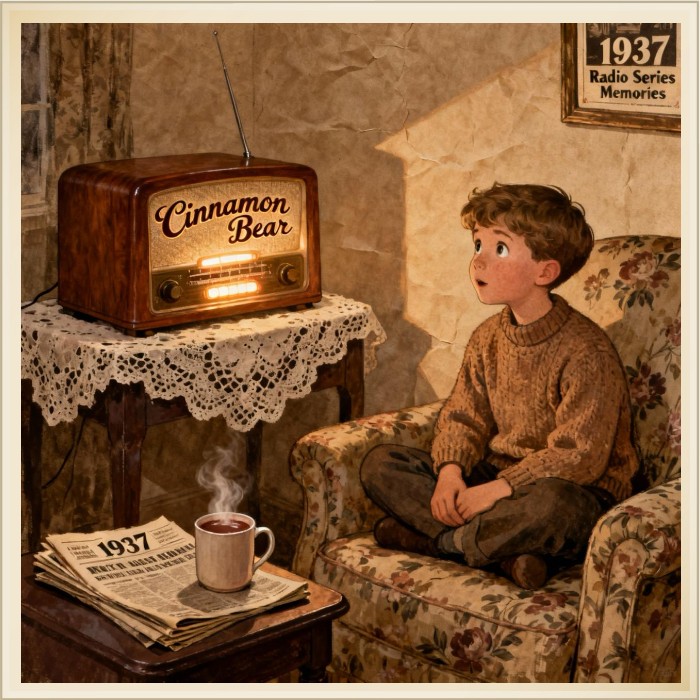
Debuting in 1937 as a children’s Christmas serial, it was designed to be heard in short daily installments between Thanksgiving and Christmas, creating a shared seasonal ritual for families gathered around the radio. Its blend of whimsy, cliffhanger adventure, and gentle humor helped it become a perennial favorite—and for many listeners, a treasured part of the holidays.
At its heart, The Cinnamon Bear is a quest story. Siblings Judy and Jimmy Barton are preparing for Christmas when they discover that the Silver Star meant for the top of their tree has gone missing. While searching through a trunk, they meet the dashing Paddy O’Cinnamon—the Cinnamon Bear with the shoe-button eyes—who whisks them into the miniature, fantastical world of Maybe Land. There, they set off to recover the star, encountering a parade of colorful characters and imaginative locales along the way.
The show’s format was part of its appeal: 26 episodes, each around 12 to 15 minutes long, perfectly timed for a daily countdown to Christmas. Produced in Los Angeles for syndication, it featured a stable of seasoned radio actors who were equally adept at character voices and warm narration. The performances are vivid without being overwrought, and the sound design—quirky effects, sprightly cues, and occasional songs—helps the world feel tactile and mischievous. Bud Duncan voiced the titular bear with a friendly Irish lilt, while other familiar radio stalwarts filled out the cast, giving the series a professional polish that set it apart from many children’s shows of the era.
What keeps The Cinnamon Bear memorable is its imagination. Judy and Jimmy’s journey takes them past the Root Beer Ocean, through the land of the Inkaboos, into the clutches of the Wintergreen Witch, and alongside allies and adversaries like the Roly-Poly Policeman, Captain Tintop, and the Crazy Quilt Dragon. The stakes are never too scary, but the cliffhangers are clever enough to keep listeners eager for the next chapter. Each episode wraps in a way that makes “tune in tomorrow” feel irresistible, and yet the overall tone remains cozy and reassuring—the perfect winter-evening listen for families.
The series also stands as a snapshot of how radio once shaped seasonal culture. Department stores and local sponsors often tied promotions to The Cinnamon Bear, and in some cities it became a genuine community tradition. In Portland, Oregon, for instance, the Cinnamon Bear has long enjoyed a special, ongoing legacy with live appearances and family events inspired by the original radio tale. More broadly, the show’s structure—an advent-like progression of episodes—helped families create a shared rhythm to the holiday weeks, building anticipation toward Christmas Eve.
For newcomers, a delightful way to experience it is the way it was intended: one episode a day starting right after Thanksgiving. The short runtime fits easily into family routines, and the cumulative effect—journeying with Judy, Jimmy, and Paddy O’Cinnamon across Maybe Land as the holiday approaches—still feels special.
Listening now, you’ll notice how well the show balances playful wordplay with a gentle moral center. The heroes succeed as much through kindness, teamwork, and persistence as through luck or magic. Paddy’s catchphrase and the recurring musical bits are catchy without being cloying, and the storytelling trusts the listener’s imagination—something that gives the series its lasting power. If modern holiday entertainment sometimes feels loud or hurried, The Cinnamon Bear invites you to slow down and savor a different pace.
For longtime fans, the series is a bridge to cherished memories. For new listeners, it’s a window into a golden age of radio that remains accessible and fun. Either way, its formula still works: a captivating quest, a festive countdown, and a world where even a missing tree-topper can launch an adventure. More than 80 years on, The Cinnamon Bear continues to twinkle—much like that Silver Star—at the top of many families’ holiday traditions.