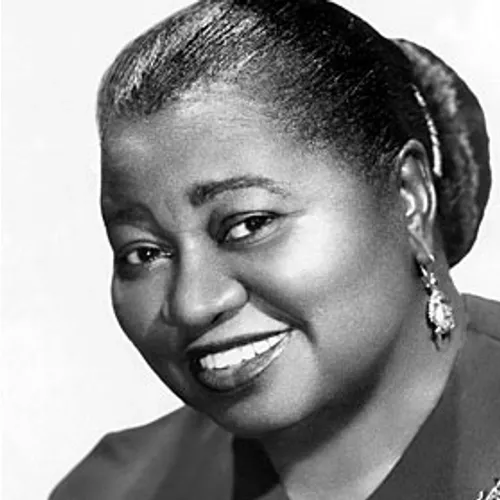
Hattie McDaniel
An American actress who was the first African American to win an Academy Award. She won the award for Best Supporting Actress for her role of Mammy in Gone with the Wind (1939). In addition to acting in many films, McDaniel was a professional singer-songwriter, comedian, stage actress, radio performer, and television star; she was the first black woman to sing on the radio in America.
Hattie McDaniel was a trailblazing African American entertainer who broke significant barriers in radio, film, and television during the early to mid-20th century. Her remarkable journey from a talented performer to the first Black Oscar winner is a testament to her extraordinary resilience, skill, and determination in the face of pervasive racial discrimination.
Early Life and Musical Beginnings
Born on June 10, 1893, in Wichita, Kansas, Hattie McDaniel was the youngest of 13 children in a family with a rich musical heritage. Her mother, Susan Holbert, was a singer, and her father, Henry McDaniel, was a Civil War veteran who preached and sang at church. From an early age, McDaniel showed a remarkable talent for performance, winning a gold medal in 1910 for reciting a poem at a local contest. McDaniel's musical career began to take shape when she and her sister Etta launched the McDaniel Sisters Company, an all-female minstrel show in 1914. She honed her skills working with her brother Otis McDaniel's carnival company, developing her songwriting and performance abilities. From 1920 to 1925, she toured with Professor George Morrison's Melody Hounds, a Black musical ensemble.
Breaking Ground in Radio
The mid-1920s marked a pivotal moment in McDaniel's career when she embarked on a radio career. She began singing with the Melody Hounds on radio stations and recorded numerous songs between 1926 and 1929. Her breakthrough came in 1931 when she moved to Los Angeles and joined her brother Sam's radio program, The Optimistic Do-Nut Hour. On this show, McDaniel performed as "Hi-Hat Hattie", a bossy maid character that quickly became popular. Despite the show's success, her salary remained so low that she continued working additional jobs. Her radio performances were characterized by her dynamic personality and comedic timing, which would become hallmarks of her entertainment career.
Hollywood and Groundbreaking Achievements
McDaniel's transition to film began in 1932, with her first appearance in The Golden West. She quickly gained recognition for her performances, landing more significant roles and eventually attracting Hollywood's attention. Her most historic moment came in 1940 when she won the Academy Award for Best Supporting Actress for her role in Gone with the Wind, becoming the first Black person to win an Oscar. Throughout her career, McDaniel appeared in over 300 films, though she received on-screen credits for only 83. She became a friend to many Hollywood stars and continued to perform in notable films like Show Boat, Saratoga, and In This Our Life.
Navigating Racial Barriers
Despite her success, McDaniel faced significant racial discrimination. She was unable to attend the Gone with the Wind premiere due to segregation, and at the Oscar ceremony, she was seated at a segregated table. She was often criticized by civil rights groups for perpetuating racial stereotypes in her roles, a challenge she met with pragmatism, famously saying, "Why should I complain about making $700 a week playing a maid?" In her later years, McDaniel became a pioneering television performer, starring in Beulah, the first radio and television show to feature a Black actor in a leading role. Though the show was controversial for its stereotypical portrayal, it was a significant milestone in entertainment history.
Legacy and Impact
Hattie McDaniel's legacy extends far beyond her performances. She was an active supporter of the war effort during World War II, serving as chairman of the Negro Division of the Hollywood Victory Committee. She also fought against racial housing discrimination in her Los Angeles neighborhood. Her groundbreaking achievements paved the way for future generations of Black performers. In 2006, she was honored with a commemorative stamp, and her influence continues to be celebrated in various media and artistic tributes.
Works and Appearances
Radio
- The Optimistic Do-Nut Hour (1931)
- Beulah (1947-1952)
- Various radio programs including Amos 'n' Andy
Film
- Gone with the Wind (1939)
- Show Boat (1936)
- Saratoga (1937)
- In This Our Life (1942)
Television
- Beulah (1950-1952)
Awards
- Academy Award for Best Supporting Actress (1940)
- Two stars on the Hollywood Walk of Fame
- Inducted into the Black Filmmakers Hall of Fame (1975)
Hattie McDaniel passed away on October 26, 1952, leaving an indelible mark on American entertainment history.