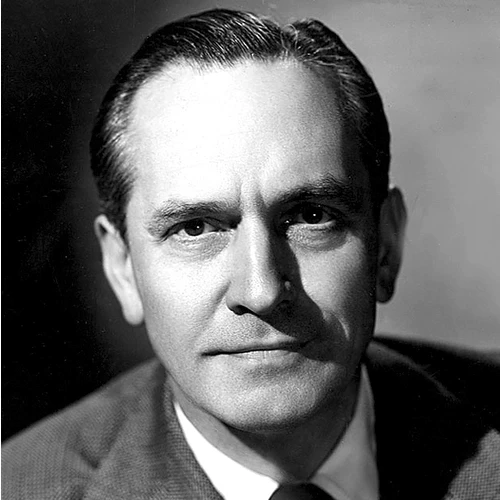
Frederic March
An American stage and film actor.He won the Academy Award for Best Actor in 1932 for Dr. Jekyll and Mr. Hyde and in 1947 for The Best Years of Our Lives. March is the only actor to win both the Academy Award and the Tony Award twice.
Fredric March was a versatile performer whose talents transcended the boundaries of film, stage, and radio, making him one of the most celebrated actors of the mid-20th century. His remarkable ability to inhabit diverse characters with extraordinary depth and nuance set him apart in an era of Hollywood legends.
Early Life and Theatrical Roots
Born Ernest Frederick McIntyre Bickel on August 31, 1897, in Racine, Wisconsin, March came from a middle-class background. His father, John F. Bickel, was a hardware business professional, and his mother, Cora Brown Marcher, was a schoolteacher from England. Initially pursuing a career in banking, an unexpected emergency prompted March to re-evaluate his life trajectory, leading him to explore acting in 1920. March's early career was marked by a rapid transition from banking to performance. He began working as an extra in New York City movies and made his stage debut in 1926. His versatility quickly became apparent, and he signed a film contract by the end of the decade, making seven pictures in 1929.
Radio and Performance Diversity
March's radio career was an integral part of his multifaceted performance portfolio. Between 1942 and 1953, he made several notable radio appearances, demonstrating his adaptability across media platforms. His radio work included performances on prestigious programs such as Lux Radio Theatre, Academy Award, MGM Theater of the Air, and Theatre Guild on the Air. Notably, March wasn't just a passive participant in radio but an active, engaging performer. He made spoken word recordings, including a remarkable narration of Walt Whitman's work in 1945 and contributed to a twelve-volume LP set accompanying The Pageant History of the United States.
Stage and Screen Achievements
March's theatrical prowess was extraordinary. He won two Tony Awards - in 1947 for Years Ago and in 1957 for his performance in Eugene O'Neill's play. His film career was equally distinguished, with two Academy Awards and multiple nominations. He was renowned for his ability to convincingly portray complex characters, from Dr. Jekyll and Mr. Hyde to presidential roles. His collaboration with his wife, Florence Eldridge, was particularly noteworthy. They appeared in seven films together, including the landmark Inherit the Wind, and remained married until his death in 1975.
Social Activism and Later Career
Beyond performance, March was socially engaged. In 1936, he co-founded the Screen Actors Guild, demonstrating his commitment to actors' rights. He was also investigated by the House Un-American Activities Committee in 1938 and 1940, reflecting the complex political landscape of mid-century Hollywood. In his later years, March continued to deliver powerful performances. Despite undergoing surgery for cancer in 1970, he managed one final performance in The Iceman Cometh in 1973.
Legacy and Impact
March is remembered as a consummate actor who rejected the traditional Hollywood studio system. Critics like Robert Osborne considered him one of the two greatest actors of Hollywood's golden age, alongside Spencer Tracy. His ability to suggest genuine emotional depth and transform completely into his characters set him apart from his contemporaries.
Works and Appearances
Radio
- Lux Radio Theatre (1942)
- Academy Award program (1946)
- MGM Theater of the Air (1949)
- Theatre Guild on the Air (1953)
Film Highlights
- Dr. Jekyll and Mr. Hyde (1931)
- A Star is Born (1937)
- Inherit the Wind (1960)
- Seven Days in May (1964)
Stage
- Years Ago (1947 Tony Award)
- Long Day's Journey into Night (1956 Tony Award)
Fredric March passed away on April 14, 1975, in Los Angeles, leaving behind a legacy of extraordinary performances that continue to inspire actors and audiences alike.