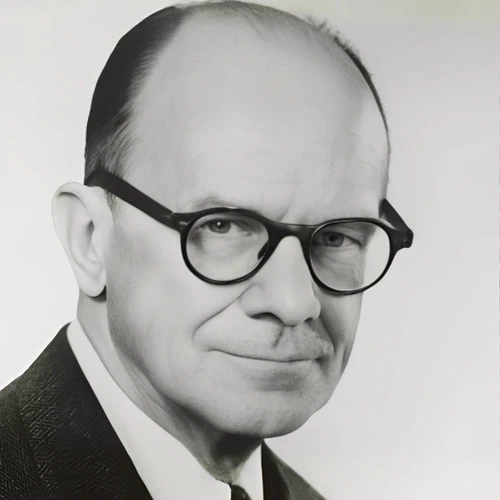
Deems Taylor
An American composer, music critic, and promoter of classical music. Nat Benchley, author of The Lost Algonquin Roundtable, referred to him as "the dean of American music."
In the vibrant landscape of early 20th-century broadcasting, few personalities were as influential and multifaceted as Deems Taylor. A composer, music critic, radio commentator, and pivotal figure in American cultural life, Taylor bridged the worlds of classical music and popular media with remarkable skill and charisma.
The Making of a Musical Polymath
Born Joseph Deems Taylor on December 22, 1885, in New York City, he emerged from a cultural milieu that would shape his diverse career. Initially planning to become an architect, Taylor quickly discovered his true calling in music composition. Despite minimal formal musical training, he began creating orchestral works that quickly garnered public recognition. His early compositions, such as The Chambered Nautilus in 1916 and Through the Looking-Glass in 1918, established him as a promising American composer. Taylor's musical style was distinctly post-Romantic, characterized by wit, precise formation, and entertaining qualities. While his works were initially met with great enthusiasm, they would later fade from prominence, a testament to the changing musical landscape of the 20th century.
Radio's Musical Maestro
Taylor's transition into broadcasting was seamless and transformative. Beginning as a music critic for the New York World in 1921, he soon became a prominent voice in musical commentary. His radio career flourished, with his program Deems Taylor Concerts reaching over 100 radio stations by 1949. His most iconic broadcasting moment came through Walt Disney'sFantasia, where he served as both on-screen narrator and musical guide. Taylor was instrumental in selecting the film's musical pieces and provided comprehensive commentary that helped audiences understand and appreciate classical music. His ability to make complex musical concepts accessible to mainstream audiences was unparalleled.
Beyond the Microphone: A Renaissance Man
Taylor's talents extended far beyond music and radio. He was a respected author, writing for prestigious publications like Vanity Fair and The New Yorker. In 1943, he published A Pictorial History of the Movies, which was among the earliest comprehensive books on cinema history. A member of the legendary Algonquin Round Table, Taylor moved in elite intellectual circles, counting composers and novelists among his close friends. His social connections and wit made him not just a commentator, but a cultural icon of his era.
Legacy and Lasting Impact
The breadth of Taylor's contributions was recognized by his peers. He served as the third president of the American Society of Composers, Authors and Publishers (ASCAP) and was instrumental in establishing the ASCAP Deems Taylor Awards in 1967, which continue to honor excellence in music writing. Though his musical compositions have largely faded from performance repertoires, his role in popularizing classical music during radio's golden age remains significant. Taylor demystified complex musical concepts, making them accessible to millions of Americans.
Conclusion
Deems Taylor represented a unique intersection of artistic creativity and public communication. His legacy is not just in the notes he composed or the words he wrote, but in his ability to make music a shared, understood experience for generations of Americans.
Works and Appearances
Radio
- Deems Taylor Concerts (1940s)
- Intermission commentator for various classical music broadcasts
- Frequent panelist on radio quiz programs
Television
- Host of multiple music series and documentaries
- Panelist on various quiz shows in the early 1950s
Cinema
- Narrator in Fantasia (1940)
- On-screen appearance and musical commentary
Compositions
- Operas: The King's Henchman, Peter Ibbetson, Ramuntcho
- Orchestral works: Through the Looking-Glass, Three Century Suite
- Numerous vocal and chamber music compositions
Publications
- A Pictorial History of the Movies (1943)
- Writings in Vanity Fair, The New Yorker
- Deems Taylor: Selected Writings (posthumous compilation, 2007)