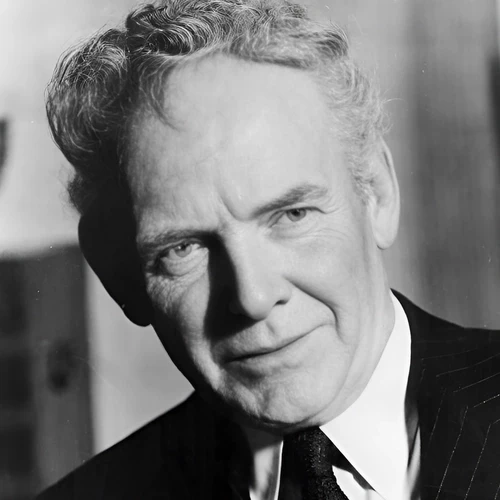
Charles Bickford
An American actor best known for his strong supporting roles. He was nominated three times for the Academy Award for Best Supporting Actor, for The Song of Bernadette (1943), The Farmer's Daughter (1947), and Johnny Belinda (1948).
Charles Bickford was far more than just an actor - he was a dynamic performer who bridged the worlds of stage, radio, film, and television during Hollywood's golden era. With his distinctive gravelly voice and imposing physical presence, Bickford carved out a remarkable career that spanned multiple decades and media platforms.
Early Life and Unconventional Beginnings
Born on January 1, 1891, in Cambridge, Massachusetts, Charles Ambrose Bickford was anything but a typical aspiring performer. As the fifth of seven children, he was known for his independent and unruly nature from an early age. His childhood was marked by a strong relationship with his maternal grandfather, a sea captain who significantly influenced his formative years. Bickford's early life was filled with unexpected adventures. At just nine years old, he was tried and acquitted of attempting to murder a trolley motorman who had callously killed his beloved dog - an incident that hinted at his fierce and passionate personality. Always more interested in experiencing life than reading about it, he was considered the "wild rogue" of his family. Before entering entertainment, Bickford worked a variety of jobs that demonstrated his restless spirit. He was a lumberjack, an investment promoter, and even ran a brief pest-extermination business. He served as a stoker and fireman in the United States Navy and later as an engineer lieutenant in the Army during World War I.
The Path to Performance
Bickford's entry into performance was as unconventional as his earlier life. Initially planning to attend MIT for an engineering degree, he was convinced by a burlesque show manager to take a role in the production. He made his debut in Oakland, California in 1911, enjoying the experience so much that he abandoned his engineering aspirations. His legitimate stage debut came with the John Craig Stock Company in Boston in 1912. For over a decade, he traveled throughout the United States with various road companies, appearing in numerous productions. His breakthrough came in 1925 while performing in the Broadway play Outside Looking In, where he received rave reviews.
Hollywood and Character Acting
Bickford's transition to film was marked by his independent and sometimes confrontational nature. After becoming a star by playing a lover in a 1930 film, he never fully developed as a leading man. His strong-willed personality often led to conflicts, including famously punching out a director during the production of Dynamite. A dramatic turning point in his career occurred in 1935 when he was mauled by a lion while filming East of Java, resulting in significant neck scarring. This incident effectively ended his leading man status but opened doors to character roles, which he ultimately preferred. He found great success playing a wide range of characters - from lovable father figures to stern businessmen and authority figures.
Legacy and Later Career
During the 1940s, Bickford reached the pinnacle of his recognition, being nominated three times for the Academy Award for Best Supporting Actor. He seamlessly transitioned into television, hosting The Man Behind the Badge and later playing rancher John Grainger on The Virginian, a role that was praised for restoring the show's quality. Bickford continued acting until his death, appearing in various television shows and films. His final years were marked by continued professional success and respect from his peers. He passed away in Los Angeles on November 9, 1967, leaving behind a rich legacy in American entertainment.
Works and Appearances
Radio
- The Man Behind the Badge (Host, 1950s)
Television
- The Virginian (John Grainger, 1966-1967)
- Guest appearances on various series throughout the 1950s and 1960s
Film
- Numerous supporting roles from 1929-1962, including:
- Johnny Belinda (1948)
- A Star Is Born (1954)
- The Big Country (1958)
Theater
- Broadway productions, including Outside Looking In (1925)
Charles Bickford's career exemplified the versatility and resilience of mid-century performers, successfully navigating multiple entertainment mediums with his distinctive talent and indomitable spirit.