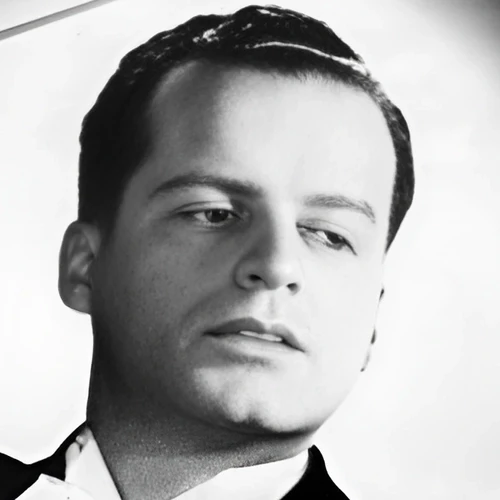
Carmen Dragon
An American conductor, composer, and arranger who in addition to live performances and recording, worked in radio, film, and television.
In the vibrant landscape of mid-20th century American entertainment, Carmen Dragon emerged as a multifaceted conductor, composer, and radio personality who transcended traditional artistic boundaries. His remarkable career spanned radio, film, television, and live performance, making him a quintessential figure in the cultural renaissance of the 1940s and 1950s.
Early Life and Musical Beginnings
Born on July 28, 1914, in Antioch, California, Carmen Dragon was the son of Italian immigrants Rose and Frank Dragon. Even in his early years, music coursed through his veins. While a student, he demonstrated remarkable musical talent by composing Forward, Antioch!, a song performed between acts of a school play on February 28, 1930. Amusingly, a local newspaper erroneously identified the young composer as "a high school girl" named Carmen Dragon. By May 1935, Dragon had established his own orchestra, quickly gaining recognition across California. Newspapers of the time praised his musical prowess, with one describing him as "The Sensation of the Coast" and highlighting his ability to musically transport dancers "over the world" through his orchestral performances.
Radio: A Platform for Musical Education
Dragon's most significant contribution to broadcasting came through his work with the NBC radio network. He conducted the Capitol Symphony Orchestra on Music Hall, a groundbreaking program broadcast to elementary schools across the western United States from 1928 through the 1970s. This show was revolutionary, providing high-quality classical music education to young listeners during the 1940s and early 1950s. His radio career was diverse and dynamic. In the summer of 1947, he collaborated with singer Bob Langford, hosting a program where Langford performed accompanied by Dragon's 25-piece orchestra. Dragon also maintained a regular classical music radio show well into the 1980s, demonstrating his enduring commitment to musical broadcasting.
Versatility Across Media
Beyond radio, Carmen Dragon was a prolific composer and conductor in multiple entertainment domains. He composed film scores for movies like At Gunpoint (1955) and collaborated with Morris Stoloff to win the 1944 Academy Award for a popular musical score. His orchestral arrangement of America the Beautiful became widely performed by bands nationwide, symbolizing his patriotic musical contributions. Interestingly, Dragon even appeared as himself in the 1979 film, portraying the conductor of the fictional Paramus Philharmonic Orchestra, further blurring the lines between his professional and performative personas.
Personal Life and Legacy
Carmen Dragon's musical legacy extended through his family. His children included Daryl Dragon (of the Captain & Tennille duo), Dennis Dragon (a drummer), and Carmen E. Dragon (a classical harpist). His wife, Eloise Rawitzer, was also a singer who performed on his radio series. Recognized for his contributions, Dragon received a star in the Radio section of the Hollywood Walk of Fame in 1989, and an elementary school in his hometown of Antioch, California, was named in his honor. He passed away on March 28, 1984, leaving behind a rich musical legacy.
Works and Appearances
Radio
- Music Hall (NBC) - Conductor, Capitol Symphony Orchestra (1928-1970s)
- Unnamed Classical Music Radio Show (1980s)
- Summer Program with Bob Langford (1947)
Film Scores
- At Gunpoint (1955)
- Unnamed films from 1950, 1951, 1956
- Academy Award-winning musical score (1944)
Television
- Glendale Symphony Orchestra Christmas Special (NBC, 1964)
- Appeared as himself in a 1979 film
Recordings
- Series of light classical albums with Capitol Symphony Orchestra (1950s)
Carmen Dragon's multifaceted career exemplifies the rich, interconnected world of mid-century American entertainment, where musicians seamlessly traversed radio, film, and live performance.