Walter Pidgeon
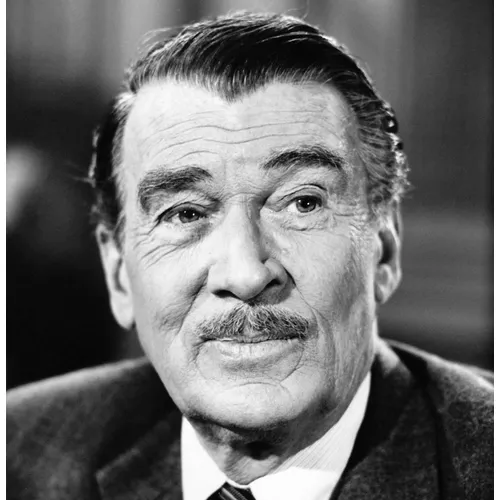
Walter Davis Pidgeon stands as one of Hollywood's most distinguished leading men, yet his career trajectory reveals a fascinating connection to broadcasting that deserves recognition. Born on September 23, 1897, in Saint John, New Brunswick, Canada, Pidgeon's journey from military service to international stardom encompasses radio performances that bridged his theatrical roots and cinematic success. His deep, resonant baritone voice—the product of formal training and natural talent—made him equally compelling whether performing before live audiences, speaking into a microphone in a radio studio, or commanding the silver screen. While best remembered for his Academy Award-nominated roles in Mrs. Miniver (1942) and Madame Curie (1943), Pidgeon's involvement in old-time radio demonstrates the interconnected nature of entertainment media during the Golden Age of Hollywood.
From Soldier to Performer: The Road to Radio
Pidgeon's path to entertainment was anything but direct. Following World War I service in the Canadian Expeditionary Force, where he suffered a severe injury that left him crushed between two gun carriages and hospitalized for 17 months, Pidgeon emerged from the conflict determined to pursue a new direction. Rather than return to conventional work, he relocated to Boston, Massachusetts, where he took employment as a bank runner while simultaneously studying voice at the New England Conservatory of Music, developing himself as a classically trained baritone. Discontented with banking's constraints, Pidgeon made a decisive career move in 1923 when he relocated to New York City. The story of his entry into theatrical life carries the flavor of old Hollywood determination: he walked directly into the office of E.E. Clive, a British Broadway producer, announced his dual capabilities as both actor and singer, and declared his readiness to prove his worth. Clive responded by casting Pidgeon in a supporting role in You Never Can Tell, despite Pidgeon's acknowledged lack of theatrical experience at the time. Pidgeon's Broadway debut arrived in 1925 in the revue Puzzles of 1925, produced by Elsie Janis, a multifaceted entertainer who recognized Pidgeon's potential as a male vocalist for her production. These early theatrical experiences cultivated the performance skills and vocal command that would later serve him exceptionally well in radio work, where an actor's voice carried the entire dramatic weight of entertainment.
Silent Films and the Talkies Revolution
Pidgeon's transition to cinema began during the silent film era of the 1920s, where he appeared in Mannequin (1926) and The Girl from Rio (1927). However, the advent of sound technology fundamentally transformed his career trajectory. Where silent films had relegated him to secondary status, the arrival of talking pictures unleashed his full potential. His trained baritone voice became his greatest professional asset, catapulting him to stardom in the extravagant early Technicolor musicals that defined early sound cinema. During this golden period of movie musicals, Pidgeon secured starring roles in lavish productions including The Bride of the Regiment, Sweet Kitty Bellairs, Viennese Nights, and Kiss Me Again. These early sound films showcased his vocal abilities and established him as a leading man capable of carrying major productions. Yet like many performers of his era, Pidgeon remained flexible, adapting when public tastes shifted away from the musical genre. As audiences grew weary of musicals, Pidgeon navigated the career transition by accepting secondary roles in films such as Saratoga and The Girl of the Golden West, demonstrating the professional resilience that would characterize his entire career.
Radio Performances and Broadcast Work
Pidgeon's involvement in old-time radio represented an important complement to his film career, allowing him to reach audiences through the intimacy of broadcast entertainment. His radio appearances spanned multiple prestigious programs that dominated American broadcasting during the Golden Age. Between 1946 and 1953, Pidgeon participated in several Lux Radio Theatre broadcasts, including performances in Mrs. Parkington (1946), Together Again (1946), and The People Against O'Hara (1953). The Lux Radio Theatre, one of radio's most celebrated dramatic anthology series, regularly featured major Hollywood stars performing adaptations of famous films and theatrical productions, making Pidgeon's participation a marker of his continued prominence in entertainment. Beyond Lux Radio Theatre, Pidgeon also appeared on Screen Guild Theatre in 1952, where he performed "Heaven Can Wait," further demonstrating his sustained involvement in quality radio drama programming during the medium's twilight years. These radio appearances occurred during a particularly interesting period in Pidgeon's career—the early 1950s—when he was simultaneously maintaining a robust film schedule while selectively engaging with radio work. Such dual involvement reflected both the enduring prestige of radio performance and the way major Hollywood stars continued to view broadcasting as a valuable platform for their craft.
Later Career, Television, and Lasting Impact
By the mid-1950s, after a 20-year absence from Broadway, Pidgeon made a significant artistic return to the theatrical stage, appearing in Take Me Along alongside Jackie Gleason. This performance earned him a Tony Award nomination, adding theatrical recognition to his already impressive array of career achievements. Meanwhile, his film career continued with notable roles in science fiction, adventure, and political dramas. His portrayal of Admiral Harriman Nelson in Voyage to the Bottom of the Sea (1961), his role as James Haggin in Walt Disney's Big Red (1962), and his performance as a Senate Majority Leader in Otto Preminger's Advise & Consent demonstrated his versatility across diverse genres and dramatic registers. Pidgeon's final decades of active performance involved selective work across multiple mediums. Television became increasingly important to his schedule, with guest appearances on notable series including Dick Powell's Zane Grey Theatre, where he played Dave King, a prosperous rancher embroiled in financial disputes, Rawhide, Breaking Point, The F.B.I., Marcus Welby, M.D., and Gibbsville. In 1963, he guest-starred as corporate attorney Sherman Hatfield in a special Perry Mason episode during Raymond Burr's surgery recovery period. A particularly memorable television assignment came in 1965, when Pidgeon played the king in a CBS television production of Rodgers and Hammerstein's Cinderella, starring Lesley Ann Warren, bringing classical theatrical music to television audiences. Pidgeon's final film appearance came in Sextette (1978), where he played The Chairman, but his retirement from acting occurred in 1977. Over a career spanning more than five decades, Pidgeon accumulated two Academy Award nominations for Best Actor, multiple prestigious television appearances, theatrical performances of distinction, and a notable body of radio work. He passed away on September 25, 1984, just two days after his 87th birthday, leaving behind a legacy as one of Hollywood's most consistently employed and respected leading men—an actor whose golden baritone voice and distinguished screen presence defined multiple eras of American entertainment.
Works and Appearances
Radio
- Lux Radio Theatre – Mrs. Parkington (1946)
- Lux Radio Theatre – Together Again (1946)
- Screen Guild Theatre – "Heaven Can Wait" (1952)
- Lux Radio Theatre – The People Against O'Hara (1953)
Television
- Dick Powell's Zane Grey Theatre – "King of the Valley" (1959) – Dave King
- Rawhide – "The Reunion" (1962)
- Breaking Point
- Perry Mason (1963) – Sherman Hatfield
- The F.B.I.
- Cinderella (CBS production, 1965) – The King
- Voyage to the Bottom of the Sea (1961) – Admiral Harriman Nelson
- Marcus Welby, M.D.
- Gibbsville
Film
- Mannequin (1926)
- The Girl from Rio (1927)
- The Bride of the Regiment
- Sweet Kitty Bellairs
- Viennese Nights
- Kiss Me Again
- Saratoga
Theater
- Puzzles of 1925 (1925) – Broadway debut
- You Never Can Tell – Supporting role
- Take Me Along (mid-1950s) – Tony Award nomination
Heard in