Virginia Mayo
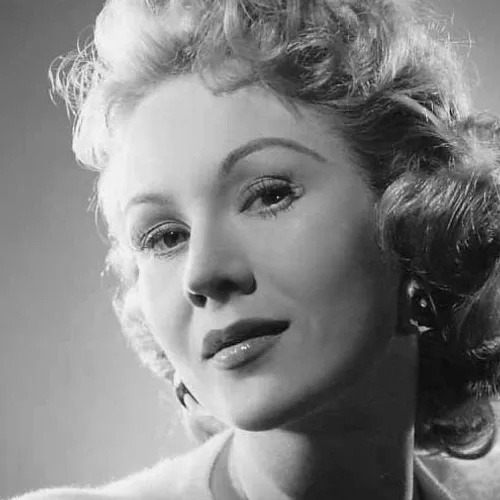
Virginia Mayo's journey from a St. Louis high school graduate to one of Hollywood's most recognizable leading ladies represents a remarkable arc of entertainment history. While her primary legacy rests in cinema and stage performance, her limited but notable radio appearances on Lux Radio Theatre showcase her versatility as a performer across multiple entertainment mediums during the golden age of broadcast media. Her career trajectory reveals the interconnected nature of 1940s and 1950s entertainment, where radio served as both a promotional platform for film stars and a venue for recreating cinematic triumphs in audio form.
Early Life and Entry Into Entertainment
Virginia Mayo graduated from Soldan High School in St. Louis at the remarkably young age of 16 in 1937, immediately launching into professional entertainment work. Her initial opportunities came through the St. Louis Municipal Opera Theatre, commonly known as "The Muny," where she performed as both an actress and dancer. However, her real break came when performer Andy Mayo, impressed by her talents, recruited her to become part of his vaudeville act "Morton and Mayo." For three years, Mayo toured the American vaudeville circuit, serving as ringmaster and comedic foil for an unusual and memorable act—she performed alongside "Pansy the Horse," a horse suit worn by Andy Mayo and his partner Nonnie Morton. The act proved spectacularly popular, particularly during an engagement at Billy Rose's Diamond Horseshoe nightclub in New York's Broadway theater district. This high-profile New York appearance would prove pivotal; she was spotted by Samuel Goldwyn, the legendary film producer who would become instrumental in launching her motion picture career.
Rise to Stardom in Hollywood
Mayo's transition to film began modestly when Goldwyn placed her in the chorus of Up in Arms, ostensibly to allow her to learn the craft, though she was never officially designated as one of the Goldwyn Girls. RKO borrowed her for a support role in the musical Seven Days Ashore (1944), but her true breakthrough arrived in 1944 when she earned her first starring role opposite Bob Hope in The Princess and the Pirate, a pirate movie spoof produced by Goldwyn that earned over $3 million at the box office. Goldwyn then made her the leading lady opposite Danny Kaye in two successful musicals: Wonder Man (1945) and The Kid from Brooklyn (1946). Throughout the late 1940s and early 1950s, Mayo became one of Hollywood's most reliable and popular leading ladies, appearing alongside cinema's biggest stars. Roy Del Ruth borrowed her to play opposite George Raft in the noir film Red Light (1949), while she became Milton Berle's leading lady in Always Leave Them Laughing (1949). She starred as the title role in the film noir Backfire (1950) and achieved significant success as Burt Lancaster's love interest in The Flame and the Arrow (1950). Her versatility extended to musicals, where she was paired with Dennis Morgan in David Butler's Technicolor production Painting the Clouds with Sunshine (1951), and she appeared in the all-star cast of Starlift (1951). Though Mayo appeared in several musicals and utilized her extensive dance training, her singing voice was consistently dubbed by other performers, a common practice for the era.
Radio Appearances and Broadcast Legacy
Mayo's radio career, while limited in scope, reflected the standard practice of Hollywood stars promoting their films through broadcast appearances on Lux Radio Theatre, the prestigious anthology series that adapted popular films and plays for radio audiences. Her six radio appearances spanned from 1946 to 1954, each serving to reach radio listeners with dramatic recreations of her most notable film work. Her first radio appearance came in 1946 when she starred in an adaptation of Wonder Man on Lux Radio Theatre, the same film that had catapulted her to stardom alongside Danny Kaye. Five years later, in 1951, she returned to the program to perform in an adaptation of Bright Leaf. The following year, 1952, saw her appearing in a Lux Radio Theatre broadcast of Captain Horatio Hornblower. Her radio work continued in 1953 with two appearances: one in This Woman Is Dangerous on Lux Radio Theatre and another in China Run on Lux Summer Theatre. Her final radio broadcast came in 1954 when she performed in Lux Radio Theatre's adaptation of The Iron Mistresses, the popular biopic of Jim Bowie for which she had served as Alan Ladd's leading lady in the original film.
Continued Film Work and Later Career
Mayo's film career remained remarkably active throughout the 1950s, even as television began fragmenting the audience. Benedict Bogeaus gave her the lead in Pearl of the South Pacific (1955), followed by Edmund Grainger'sGreat Day in the Morning (1956) alongside Robert Stack. She transitioned to 20th Century Fox to play Robert Ryan's leading lady in The Proud Ones (1956), then appeared in Congo Crossing (1956) at Universal. During the late 1950s, she appeared in a succession of Westerns: The Tall Stranger (1957) with McCrea for Allied Artists, Fort Dobbs (1958) with Clint Walker and Westbound (1959) with Randolph Scott, both produced by Warner Bros. Her final film of the 1950s was Jet Over the Atlantic (1959). As her film career tapered considerably during the 1960s, Mayo adapted to changing entertainment landscapes. She guest-starred on television shows including Wagon Train, The Loretta Young Show, Lux Playhouse, Burke's Law, and Daktari. She made occasional film appearances, including Young Fury (1965) with Rory Calhoun, Castle of Evil (1966), and Fort Utah (1967) with John Ireland, while also maintaining an active stage presence in productions such as That Certain Girl (1967) and Barefoot in the Park (1968) with Lyle Talbot.
Legacy and Enduring Impact
Virginia Mayo's career encapsulates a golden era of American entertainment when performers seamlessly transitioned between vaudeville, stage, radio, film, and television. While radio represented only a small chapter in her extensive professional life, her appearances on Lux Radio Theatre demonstrated her ability to recreate her film performances for audio audiences during a period when radio remained a vital entertainment medium competing with the rise of television. Her legacy rests primarily in her contributions to 1940s and 1950s cinema, where she established herself as one of Hollywood's most dependable and charismatic leading ladies, appearing alongside the era's greatest male stars and earning significant box office success.
Works and Appearances
Radio
- Lux Radio Theatre – Wonder Man (1946)
- Lux Radio Theatre – Bright Leaf (1951)
- Lux Radio Theatre – Captain Horatio Hornblower (1952)
- Lux Radio Theatre – This Woman Is Dangerous (1953)
- Lux Summer Theatre – China Run (1953)
- Lux Radio Theatre – The Iron Mistresses (1954)
Television
- Wagon Train (guest appearance)
- The Loretta Young Show (guest appearance)
- Lux Playhouse (guest appearance)
- Burke's Law (guest appearance)
- Daktari (guest appearance)
Cinema
- Up in Arms (uncredited chorus role, early 1940s)
- Seven Days Ashore (1944, support role)
- The Princess and the Pirate (1944, starring role opposite Bob Hope)
- Wonder Man (1945, opposite Danny Kaye)
- The Kid from Brooklyn (1946, opposite Danny Kaye)
- Red Light (1949, opposite George Raft)
Theater
- Banjo Eyes (1941, Broadway, opposite Eddie Cantor)
- That Certain Girl (1967)
- Barefoot in the Park (1968, opposite Lyle Talbot)
Vaudeville
- "Morton and Mayo" act (approximately 1937-1940, three-year vaudeville circuit tour)
- Billy Rose's Diamond Horseshoe nightclub, New York (1940, Broadway theater district engagement)
- Hotel Jefferson act (early career, six-girl ensemble)
- St. Louis Municipal Opera Theatre "The Muny" (early career performances)