Virginia Bruce
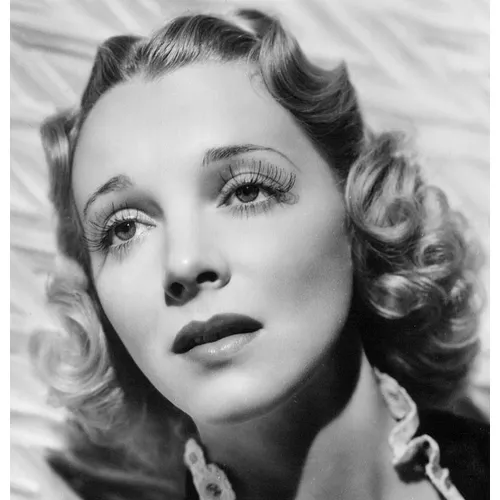
Virginia Bruce embodied the glamour and versatility of 1930s entertainment. Born Helen Virginia Briggs on September 29, 1910, in Minneapolis, Minnesota, she would eventually become one of the era's most recognizable leading ladies, gracing film, stage, radio, and television with her distinctive soprano voice and captivating screen presence. Her journey from a small North Dakota town to the heights of Hollywood success represents a quintessential American entertainment story, marked by professional triumphs, personal heartaches, and an enduring legacy in the annals of old-time radio and classic cinema.
From Fargo to the Footlights
Bruce's path to entertainment began not through ambition but through circumstance. As an infant, she relocated with her parents, Earl and Margaret Briggs, to Fargo, North Dakota, where the family settled at 421 14th Street South. She remained in Fargo through her childhood and teenage years, graduating from Fargo Central High School in 1928. Her parents' financial struggles would prove instrumental in shaping her career, as they encouraged her to pursue film work rather than her genuine passion for music at UCLA. After graduation, Bruce moved with her family to Los Angeles with the intention of enrolling at the University of California, but a friendly wager redirected her toward the film industry instead. Bruce's entry into entertainment proved serendipitous. While touring the Paramount movie studio, she caught the attention of Harry Wurtzel, publicist for director William Beaudine, who offered her a personal contract at $25 per week. It was during this period that she adopted the stage name "Bruce," transforming from Helen Virginia Briggs into the persona that would define her career. Over the following year, she appeared in small roles across 19 films, gradually building experience and visibility in the studio system.
Breaking Through on Stage and Screen
Bruce's first documented screen appearance came in 1929 as an extra in the Paramount film Why Bring That Up? Her theatrical ambitions blossomed when she secured a role in the Broadway musical Smiles at the Ziegfeld Theatre in 1930, working alongside theatrical luminaries. The following year, she appeared in another Broadway production, America's Sweetheart, gaining valuable stage experience that would enhance her vocal abilities and stage presence. Her transition to substantial film roles accelerated dramatically in 1932. In early August, she began work at Metro-Goldwyn-Mayer on the film Kongo, starring Walter Huston. That same month, on August 10, 1932, Bruce married John Gilbert, her costar from their recent film Downstairs. The wedding, held in Gilbert's dressing room on the studio lot, drew an impressive guest list including Irving Thalberg, head of MGM production and Gilbert's best man; screenwriter Donald Ogden Stewart; and Cedric Gibbons, MGM's renowned art director, accompanied by his wife, actress Dolores del Río. The marriage, however, would prove tumultuous due to Gilbert's alcoholism—a lingering consequence of his failed transition from silent films to talkies. Bruce gave birth to their daughter Susan Ann in 1933 but divorced Gilbert in May 1934. Tragedy struck when Gilbert died of a heart attack in 1936.
Vocal Artistry and Radio Success
Bruce's most significant contribution to entertainment history came through her voice and her association with one of the 20th century's greatest songwriting teams. She is credited with introducing Cole Porter's standard "I've Got You Under My Skin" in the 1936 filmBorn to Dance, where she performed the iconic number opposite James Stewart. That same landmark year, she costarred in the lavish MGM musical The Great Ziegfeld, further cementing her status as a major star capable of carrying substantial musical productions. Beyond the silver screen, Bruce leveraged her vocal talents in radio, demonstrating the medium's appeal to established film personalities seeking additional exposure and income. In 1949, she starred as both host and lead in Make Believe Town, a 30-minute afternoon drama broadcast daily on CBS Radio. This program represented a significant venture into the radio medium for Bruce, showcasing her ability to command a series in the dramatic genre rather than purely musical productions. Her radio work during this period reflected the era's trend of major film stars maintaining active presences across multiple entertainment media.
Later Years and Enduring Legacy
Bruce married director and producer J. Walter Ruben in 1937 after they collaborated on The Bad Man of Brimstone, in which she played the lead role. The marriage lasted until his death from heart disease less than five years later. She had two children during her lifetime and maintained her professional commitments throughout various personal challenges. In the early 1960s, Bruce gradually withdrew from film appearances, having accumulated over 70 screen credits during her career spanning more than four decades. Beyond her entertainment career, Bruce was a politically engaged citizen. She was a Democrat who supported Adlai Stevenson's presidential campaign in 1952, reflecting the era's Hollywood activism. Bruce spent her final decades in Los Angeles, living at the Motion Picture & Television Country House and Hospital in Woodland Hills, where she passed away from cancer on February 24, 1982, at age 71. Her ashes were scattered by family and close friends, concluding a remarkable life spent in the entertainment industry. Virginia Bruce's legacy encompasses more than her substantial filmography. She represented a particular moment in entertainment history when versatile performers could successfully navigate Broadway, Hollywood, and radio simultaneously. Her introduction of "I've Got You Under My Skin," her starring roles opposite major leading men, and her willingness to explore new media like radio demonstrated the adaptability required of successful entertainers in the 20th century. Though her star eventually faded as Hollywood tastes changed, Bruce's work remains a testament to the golden age of entertainment when film, stage, and radio created an integrated ecosystem for artistic expression.
Works and Appearances
Radio
- Make Believe Town (1949)
Film
- Why Bring Tthat Up? (1929)
- Fugitives (1929)
- Blue Skies (1929)
- River of Romance (1929)
- Fashions in Love (1929)
- Hard to Get (1929)
- Illusion (1929)
- Whoopee (1930)
Television
- The Ford Television Theatre (1952–1957)
- General Electric Theater (1953)
- The Bigelow Theatre
Theater
- Smiles (1930)
- America's Sweetheart (1931)
Heard in