Victor Jory
Victor Jory emerged as one of old-time radio's most distinctive personalities, lending his commanding presence and sinister voice to some of the medium's most memorable moments. Though his career ultimately spanned stage, film, and television with remarkable breadth, his contributions to radio broadcasting revealed a performer who understood the unique power of voice to create character and atmosphere. From adventure serials to children's programming, Jory demonstrated versatility that belied his typecasting as Hollywood's quintessential villain. His journey through radio illuminates an important chapter in broadcasting history when actors moved fluidly between different entertainment mediums, each feeding their creative hunger.
The Making of a Menacing Presence
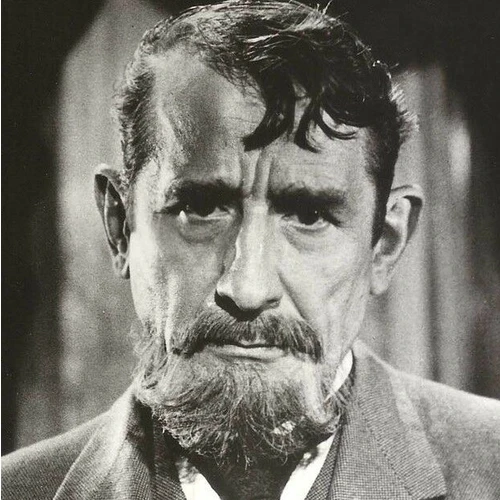
Victor Jory was born on November 23, 1902, in Dawson City, Yukon, Canada, into a world far removed from the glittering stages and studios that would later define his career. His early years shaped the physical and vocal qualities that would become his trademark. During his military service in the United States Coast Guard, Jory's burly physique earned him recognition as both a wrestling and boxing champion. This athletic background contributed to the imposing presence that cameras and microphones would later capture so effectively. After establishing himself through appearances on Broadway, Jory transitioned to Hollywood in 1930, marking the beginning of a professional journey that would span exactly fifty years. His initial roles capitalized on his romantic leading-man potential, but something in his distinctive features—most notably his seemingly coal-black eyes—suggested menace and complexity that studios recognized as more valuable than conventional handsomeness. His appearance possessed an inherent quality of threat, and Hollywood's casting directors proved eager to exploit this natural asset. This realization would prove pivotal, redirecting his career toward the villainous and sinister roles that became his calling card.
The Voice of Adventure and Drama
Jory's entrance into radio stardom came with significant fanfare in the mid-1940s when he became the lead star of Dangerously Yours, a weekly adventure and romance series that premiered on the Columbia Network in 1944. The program, which ran for a single season through April 1945, featured Jory in a series of dramatic retellings of famous literary works. This format perfectly suited his talents—each episode required him to inhabit different characters while maintaining the atmospheric tension that his voice naturally conveyed. The inaugural episode, broadcast on July 2, 1944, titled "The Highwayman," adapted the celebrated Alfred Noyes poem into dramatic form, immediately establishing the show's commitment to adapting literary classics for radio audiences. The series underwent a title change in October 1944 to Matinee Theater, reflecting either programming shifts or network decisions, but Jory remained the consistent anchor holding these disparate stories together. His performance across the program's various episodes demonstrated his ability to anchor intimate dramas while commanding the listener's attention through voice alone. Unlike his film roles, where his physical appearance contributed substantially to his menacing presence, radio required Jory to create characters entirely through vocal modulation, timing, and interpretation. This challenge clearly suited him, as his work in the medium revealed depths that sometimes remained unexplored in his more visually-driven cinematic performances.
The Narrator's Gift: Children's Programming and Beyond
While Jory's dramatic work showcased his range, his voice also found remarkable success in children's programming, revealing yet another facet of his versatility. In 1946, he narrated "Tubby the Tuba" for children, a recording that transcended its original purpose to become a cultural artifact of enduring significance. The story, which tells of a tuba who struggles to fit in with its orchestral peers, resonated with audiences far beyond the intended younger demographic. The recording achieved remarkable commercial success, selling over one million copies, and its cultural impact proved so substantial that it was later inducted into the National Recording Registry in 2005. Beyond its commercial achievement, "Tubby the Tuba" introduced countless young listeners to orchestral instruments and musical concepts, demonstrating that Jory's voice possessed warmth and accessibility alongside its more famous menacing qualities. Following this success, Jory continued his work in children's media by narrating "Bumpo the Ballerina," another production aimed at introducing young listeners to artistic concepts through storytelling. These recordings revealed a performer capable of shifting emotional registers entirely, moving from the heavy drama of Dangerously Yours to the whimsical, accessible tone required for children's entertainment. This range underscored that Jory's reputation as a villain, while commercially successful and professionally defining, represented only one dimension of a genuinely talented and adaptable performer.
From Radio to Recognition and Legacy
Though Jory's radio career remained relatively concentrated in the mid-1940s compared to his extensive work in film and television, his contributions to the medium left an indelible mark. His distinctive appearance and sinister vocal qualities made him radio gold—audiences who heard his voice in dramatic roles or as a narrator immediately recognized him through sheer force of personality and performance. The Hollywood Walk of Fame acknowledged his broader contributions to entertainment in 1960, honoring his work across all mediums with a star located at 6605 Hollywood Blvd. Beyond entertainment, Jory's later life revealed a commitment to education and civic engagement. He served on the faculty of the University of Utah, teaching acting in the Department of Theater, and endowed the Victor Jory Scholarship, which continues supporting junior and senior theater students to the present day. This legacy demonstrates that his influence extended beyond performance into the cultivation of future generations of artists. Victor Jory passed away on February 12, 1982, at age 79, from a heart attack in Santa Monica, California, concluding a career that had remarkably traversed five decades of American entertainment. His work in radio, though perhaps overshadowed by his cinematic achievements, remains a testament to the power of voice as a dramatic instrument. From the weekly adventures of Dangerously Yours to the warmth of "Tubby the Tuba," Jory proved that radio's greatest asset—the human voice—could convey infinite possibility when wielded by an artist of genuine skill and commitment.
Works and Appearances
Radio
- Dangerously Yours (1944-1945)
- "The Highwayman" (July 2, 1944)
- "Tubby the Tuba" (1946
- "Bumpo the Ballerina"
- Grand Central Station (1953)
- Suspense (1959) episode "Death Notice"
Television
- Crossroads (1957)
- Manhunt (1959-1961)
- The High Chaparral (1968) "The Peacemaker"
- The Rockford Files (1978) "The Attractive Nuisance"
Cinema
- The Devil's in Love (1933)
- Rangle River (1936)
- A Midsummer Night's Dream (1935)
- Escape from Devil's Island (1935)
- The Adventures of Tom Sawyer (1938)
- Gone with the Wind (1939) — Jonas Wilkerson, overseer of slaves at Tara
Theater
- The Two Mrs. Carrolls (1943-1945)
- King Henry VIII (1946-1947)
- John Gabriel Borman (1946-1947)
- Yellow Jack (revival, 1947) — Sidney Howard production
- Androcles and the Lion (1947) — Shaw play
- The Devil's Disciple (1950) — Shaw play