Victor Borge
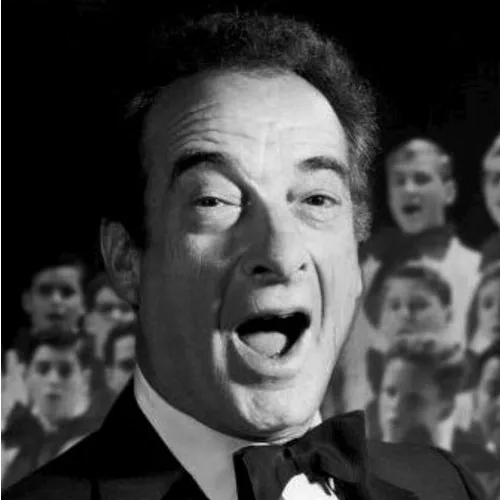
When Børge Rosenbaum arrived in America in 1940 speaking not a word of English, few could have predicted that this Danish concert pianist would revolutionize entertainment by fusing highbrow classical music with lowbrow comedy. Yet within a single year, Victor Borge would debut on American radio and begin a journey that would span over seventy years, fundamentally reshaping how audiences experienced both comedy and classical performance. His unique ability to blend virtuosic piano playing with irreverent humor created a new genre of entertainment—one that proved audiences would enthusiastically embrace the unexpected marriage of Beethoven and belly laughs.
Early Life as a Classical Musician
Born on January 3, 1909, Borge showed early promise as a musician in Denmark. His first major concert performance came in 1926 at the Odd Fellows Mansion concert hall, establishing him as a serious classical pianist with a promising future in European concert halls. For several years, he pursued this conventional path, performing the standard classical repertoire that concert pianoners were expected to master. However, the young musician possessed an irrepressible comedic sensibility that refused to remain confined within the rigid traditions of classical performance. In 1933, Borge married American Elsie Chilton, the same year he debuted with his revue acts, signaling a dramatic shift in his artistic direction. Rather than continuing exclusively as a concert pianist, he began developing the now-famous stand-up act that would become his signature—a distinctive blend of piano music and jokes that confounded classical purists but delighted general audiences. His comedic instincts led him to begin performing extensively throughout Europe, where he discovered that humor could transcend national boundaries. During these European tours, he began perfecting material that would define his career, including anti-Nazi jokes that demonstrated his willingness to use comedy as a vehicle for political commentary during troubled times.
Breaking Through in American Radio
The transition to America marked the true beginning of Borge's meteoric rise. Arriving in the United States in 1940 without speaking English, many might have dismissed him as an unlikely candidate for radio stardom. Instead, Borge demonstrated remarkable resourcefulness by learning the language through the unlikely method of watching movies, absorbing not just vocabulary but timing, cadence, and American humor sensibilities. He methodically adapted his European material for American audiences, modifying jokes and cultural references while maintaining the core of his entertainment philosophy. In 1941, Borge made his American radio debut on Rudy Vallee's show, quickly followed by an appearance on Bing Crosby's Kraft Music Hall. The radio establishment took notice immediately. His rapid ascent culminated in 1942 when he won the prestigious award for Best New Radio Performer of the Year, a remarkable achievement for someone who had been in the country barely two years and speaking English for barely longer. By 1945, the Danish-American entertainer had earned his own radio show on NBC, which featured the Benny Goodman Orchestra, giving him a platform to develop and refine the comedic techniques that would define his legacy.
The Art of Musical Comedy
While hosting The Victor Borge Show on NBC beginning in 1946, Borge developed many of the trademarks that would make him instantly recognizable to audiences throughout his career. His comedy operated on several levels, combining physical humor, wordplay, and genuine musical knowledge in ways that allowed both sophisticated musicians and casual listeners to find entertainment value. One of his most celebrated routines involved repeatedly announcing his intention to play a classical piece, only to become "distracted" by something in the audience or a tangential thought, derailing his musical performance with comedic interjections. Borge's most ingenious innovation was his "phonetic punctuation" routine, in which he would read a story aloud but substitute distinctive vocal sounds for each punctuation mark—a technique that somehow managed to be simultaneously absurd and genuinely clever. Another trademark bit involved "inflated language," where he transformed numbers and homophones into higher numerical values, turning a word like "wonderful" into "twoderful." Perhaps most delightfully, he would initiate performances with genuinely masterful renderings of well-known classical pieces like Beethoven's "Moonlight Sonata," only to suddenly veer into popular standards such as Cole Porter's "Night and Day" or the children's favorite "Happy Birthday to You." These transitions showcased both his technical facility and his conviction that entertainment should never take itself too seriously.
Broadway Triumph and Later Achievements
The pinnacle of Borge's career arrived on October 2, 1953, when he opened his one-man show Comedy in Music at the John Golden Theatre in New York City. This production became a phenomenon, running for an extraordinary 849 performances until January 21, 1956, setting a Guinness Book of World Records record as the longest-running one-person show in theater history at that time. The show's success demonstrated that Borge's unique brand of entertainment possessed genuine staying power—audiences did not tire of his routines but instead returned repeatedly to experience the perfect synthesis of musicianship and mirth. Yet Borge refused to be confined to comedy. He maintained serious credentials as a musician throughout his career, performing with and conducting major orchestras including the Chicago Symphony Orchestra, the New York Philharmonic, and the London Philharmonic. In 1979, he appeared with the Cleveland Opera Company in Mozart's The Magic Flute, and in 1986, he performed at London's Royal Opera House Covent Garden in Bizet's Carmen. His 1992 invitation to conduct the Royal Danish Orchestra at the Royal Danish Theatre in Copenhagen particularly honored him, representing a triumphant return to his native country as an internationally celebrated artist. He also appeared on numerous television programs, including The Electric Company, Sesame Street, and The Muppet Show, extending his reach to younger audiences and demonstrating the universal appeal of his particular brand of entertainment.
A Life in Performance
Borge became a naturalized citizen of the United States in 1948, formalizing his commitment to his adopted country. Yet he maintained his Danish identity and his sense of gratitude toward those who had aided Jewish refugees during World War II. In 1963, he helped establish the Thanks to Scandinavia Foundation, which funded scholarships for Scandinavian students as a gesture of appreciation for the humanitarian assistance many Scandinavians provided during the Holocaust. He also authored or co-authored several works, including My Favorite Intermissions (1971), written with Robert Sherman, and Victor Borge's My Favorite Comedies in Music (1980). Borge continued performing with astonishing vigor throughout his entire life, maintaining a schedule of up to 60 shows per year even at the age of 90. This extraordinary longevity and work ethic spoke to his genuine passion for entertaining audiences and his conviction that performance was not merely a profession but a calling. He received numerous honors throughout his career, including a Kennedy Center Honor in 1999, one year before his death. Victor Borge passed away on December 23, 2000, leaving behind a legacy that fundamentally altered how the world viewed the relationship between classical music and comedy.
Works and Appearances
Radio
- Rudy Vallee's Show (1941)
- Bing Crosby's Kraft Music Hall (1941)
- Radio shows of Bing Crosby and Rudy Vallee
- The Victor Borge Show, NBC (1945–1946)
- The Victor Borge Show, NBC (1946 onwards)
Television
- Toast of the Town (1948)
- The Victor Borge Show, NBC (1951)
- The Electric Company – Performed "Phonetic Punctuation" routine in filmed sketches
- Sesame Street
- The Muppet Show
Theater
- Comedy in Music, John Golden Theatre, New York
- Cleveland Opera Company – The Magic Flute by Mozart (1979)
- Royal Opera House Covent Garden, London – Carmen by Bizet (1986)
Concert and Orchestral Performances
- Odd Fellows Mansion concert hall (1926)
- Chicago Symphony Orchestra
- New York Philharmonic
- London Philharmonic
- Royal Danish Orchestran (1992)
Film
- Higher and Higher
Books and Publications
- My Favorite Intermissions (1971)
- Victor Borge's My Favorite Comedies in Music (1980)
Other Media
- ASCAP – Composer; joined in 1961; composed "Blue Serenade"
- Comedy and classical music albums