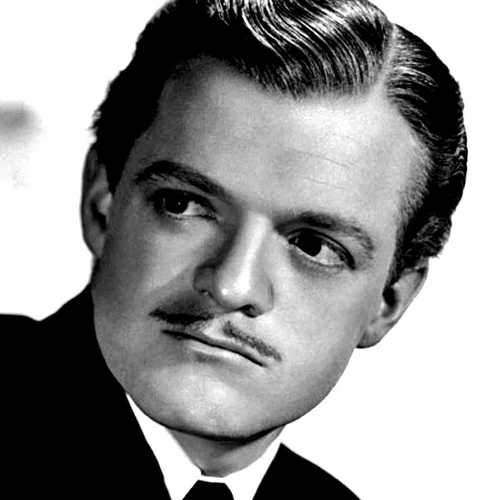
Van Heflin
Emmett Evan "Van" Heflin Jr. carved out a distinctive career spanning Broadway, radio, and Hollywood, becoming one of the entertainment industry's most dependable and versatile character actors. Born on December 13, 1908, Heflin's journey through the entertainment world reflected both his ambition and his willingness to move between different mediums at a time when many performers specialized in just one arena. His craggy features and serious demeanor made him ideal for the roles he inhabited—men of substance and complexity who grounded the stories around them. While Hollywood never quite catapulted him to leading man status despite his talent, Heflin's work across all media earned him respect, awards, and a devoted following among those who appreciated skilled character acting.
Early Years and Theatrical Foundation
Before Van Heflin became a familiar voice on radio waves or a face on cinema screens, he established himself as a capable stage actor with serious theatrical credentials. His acting career commenced on Broadway in the late 1920s, beginning with Mr. Moneypenny in 1928. These early theatrical years provided Heflin with fundamental training in his craft, though his path proved anything but straightforward. He appeared in several Broadway productions throughout the early 1930s, including The Bride of Torozko and The Night Remembers, both mounted in 1934. Interestingly, before fully committing to acting, Heflin was an accomplished seaman, and he temporarily left the entertainment industry to pursue this maritime passion. This unconventional detour demonstrated his independent spirit and willingness to seek experiences beyond the theatrical bubble. When he returned to acting in the mid-1930s, he brought a grounded authenticity to his performances that would become his trademark. His Broadway résumé grew to include Mid-West and End of Summer in 1936, establishing him as a performer of note in theatrical circles. The pivotal moment in Heflin's early career came through his association with Katharine Hepburn, who recognized his talent and helped him secure a film contract with RKO Radio Pictures. After a screen test in New York, Heflin made his film debut in A Woman Rebels opposite Hepburn, but rather than immediately pursuing Hollywood opportunities, he returned to Broadway. His decision to remain committed to theatrical work paid dividends when he was cast opposite Hepburn once again in the prestigious The Philadelphia Story, which ran for 417 performances from 1939 to 1940.In this production, Heflin played Macaulay Connor alongside Joseph Cotten and Shirley Booth, earning recognition that would fuel his rise in Hollywood and radio.
Radio Career and Notable Performances
Van Heflin's radio work represented a significant portion of his professional output during the late 1940s and early 1950s. His most prominent radio assignment came as the lead in The Adventures of Philip Marlowe, a detective drama that aired on NBC from June 17, 1947, through September 15, 1951. Heflin's tenure as the hardboiled investigator lasted from June 12, 1947, through September 9, 1947, during the program's initial run. The role suited Heflin's gravelly voice and no-nonsense persona, bringing Raymond Chandler's iconic character to life for audiences across the nation. Beyond his work as Philip Marlowe, Heflin's radio resume reflected the breadth of programming available during the medium's golden age. He appeared on the prestigious Lux Radio Theatre, lending his talents to adaptations of major motion pictures. He also worked on Suspense, the anthology series known for psychological thrillers and horror elements that required actors capable of conveying menace and tension without visual aids. Additionally, Heflin performed on Cavalcade of America and "many more radio programs," demonstrating his status as a go-to performer for quality productions requiring seasoned actors. His radio work coincided with his emerging film career, allowing him to maintain visibility across multiple entertainment platforms simultaneously. Unlike many performers who treated radio as a stepping stone to be abandoned once film success arrived, Heflin seemed to value the medium for its unique challenges and immediate audience connection. The live nature of radio broadcasting demanded precision, reliability, and the ability to deliver compelling performances without the safety net of retakes or editing—qualities that Heflin possessed in abundance.
Hollywood's Leading Character Actor
While Heflin never quite achieved the status of a major Hollywood star, his film career from the 1940s through the 1970s demonstrated his considerable value to studios. His breakthrough film role came in Johnny Eager (1942), where he portrayed a heavy-drinking, Shakespeare-quoting mobster with a conscience. His performance earned him the Academy Award for Best Supporting Actor in 1942, a recognition that validated his skills and opened doors to more substantial roles. This achievement early in his film career established him as an actor worth investing in, and major studios took notice of his potential. MGM signed Heflin to a long-term contract, keeping him on their roster for eight years from 1941 to 1949.During this period, the studio cast him in a variety of roles, both leading and supporting, in prestige pictures and lesser productions. He portrayed President Andrew Johnson in Tennessee Johnson (1942), opposite Lionel Barrymore, in a film that attempted serious historical drama despite being a commercial disappointment. He co-starred with Lana Turner in Green Dolphin Street (1947), a big prestige film that became MGM's biggest hit of 1947. These assignments demonstrated that studios trusted Heflin with complex, demanding roles requiring dramatic gravitas. His post-MGM career saw him move between various studios on a contract-by-contract basis, working for Universal from 1951-54, 20th Century Fox in 1954, Columbia from 1957-59, and Paramount from 1959-60. This arrangement reflected his status as a dependable character actor studios could call upon for specific projects. Some of his most memorable film work came in this period, particularly in westerns where his authoritative presence and weathered features proved ideal. He appeared as the honest farmer in Shane (1953), working alongside Alan Ladd, in what became one of cinema's most celebrated westerns. He reunited with Glenn Ford for 3:10 to Yuma (1957), demonstrating his versatility within the genre. He later appeared in Gunman's Walk (1958) with Tab Hunter, a reunion with an actor from his earlier film Battle Cry.
World War II Service and Personal Commitment
An often-overlooked aspect of Van Heflin's life involved his wartime service, which interrupted his MGM contract during the height of his studio years. During World War II, Heflin served as a combat photographer with the U.S. 9th Air Force, First Motion Picture Unit, which produced training and morale-boosting short films. This assignment lasted approximately two years and demonstrated his commitment to his country during the global conflict. Rather than seeking cushy entertainment assignments to boost morale or remaining safely in Hollywood, Heflin volunteered for combat duty, a choice that revealed his character and values beyond his professional persona. His military service interrupted what might have been an even more prolific period in his film career during the 1940s, yet Heflin never seemed to publicly resent this sacrifice. Upon his return to civilian life and his career, he resumed his work with the same professionalism and dedication he had demonstrated before enlisting. This commitment to service beyond the entertainment industry contributed to his reputation as a serious, principled performer rather than someone obsessed with personal celebrity.
Later Career and Lasting Legacy
As Heflin entered his later years, he continued working in film and occasionally returned to Broadway. Unlike many of his peers, Heflin shunned the limelight and was never part of the Hollywood glamour set, preferring to let his work speak for itself rather than cultivating a public persona. He was described as "a well-liked, introspective and talented performer," qualities that endeared him to colleagues and audiences alike. One of his final film performances came in Airport (1970), where he portrayed a mentally disturbed airline passenger—a role that showcased his ability to convey psychological complexity even in his sixties. On Broadway, his final theatrical appearance came in A Case of Libel (1963-64), where he played Robert Sloane, demonstrating his continued connection to the stage that had launched his career. Van Heflin died of a heart attack in July 1971, aged 62, leaving behind a substantial body of work across multiple entertainment mediums. His death marked the end of an era for a performer who represented a particular type of actor—reliable, skilled, unpretentious, and committed to the craft itself rather than to stardom.
Works and Appearances
Radio
- The Adventures of Philip Marlowe (1947–1951)
- The New Adventures of Philip Marlowe (1947) – "Red Wind" episode, NBC
- Lux Radio Theatre (1949) – "Green Dolphin Street" episode
- Suspense (1953) – "The Case of the Marie Celeste" episode
- Suspense (1953) – "The Shot" episode
- Theater of Stars (1953) – "The Apple Tree" episode
- Cavalcade of America
Theater
- Mr. Moneypenny (1928)
- The Bride of Torozko (1934)
- The Night Remembers (1934)
- Mid-West (1936)
- End of Summer (1936)
- Western Waters (1937–1938)
Cinema
- A Woman Rebels (1936)
- The Outcasts of Poker Flat (1937)
- Saturday's Heroes (1937)
- Annapolis Salute (1937)
- Back Door to Heaven (1939)
Heard in