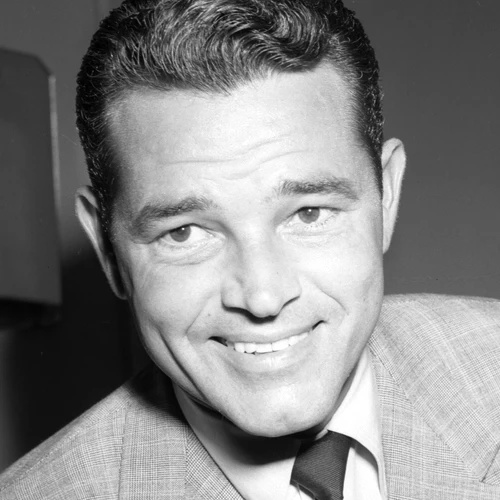
Tom Neal
Thomas Carroll Neal Jr. remains one of old-time radio's most intriguing figures—a man whose career trajectory defied the typical Hollywood narrative. Born on January 28, 1914, Neal possessed the versatility to move seamlessly between stage, screen, and the microphone, yet his life would ultimately be defined by personal tragedy and legal turmoil as much as by his professional accomplishments. His journey through entertainment reflects both the opportunities and perils of mid-twentieth century show business, offering a complex portrait of an actor navigating the precarious balance between ambition and circumstance.
The Amateur Boxer Turned Actor
Before Neal became a recognizable face on screen or a voice on radio, he pursued athletic ambitions that would shape his physique and, arguably, his temperament. Between 1932 and 1934, he worked as an amateur boxer, competing in numerous fights and gaining experience in the ring. This background as an athlete would follow him throughout his career, informing the physical presence he brought to dramatic roles and occasionally surfacing in violent personal incidents that would later define his legacy. Neal's entertainment career began in earnest after he abandoned his initial college ambitions. He dropped out of Northwestern after just one year and made his way to Chicago, where he immersed himself in various stage productions in summer stock. This theatrical apprenticeship proved essential to his development as a performer, providing the foundational training that would enable his later success in multiple media. The experience gained through live performance would translate into the technical skills necessary for radio work, where actors relied entirely on vocal delivery and timing rather than physical presence. His Broadway debut came in 1935, marking his entry into New York's theatrical establishment. This milestone demonstrated that Neal had moved beyond regional theater into the major leagues of American entertainment. Yet Broadway would serve primarily as a launching pad; it was the emerging media of radio and film that would capture his primary attention and define his professional identity throughout the 1930s and 1940s.
Radio Work and Dramatic Series
Neal's radio career placed him squarely within the Golden Age tradition, where versatile actors moved fluidly between dramatic anthology programs. His documented radio appearances showcase his work on Suspense, one of the era's most acclaimed dramatic series. In 1942, he appeared in the episode titled "The Singing Walls" as the character Tom Cochrane, with the episode airing on September 2, 1943. The following year, he returned to the program to play Walter Bates in "Life Ends at Midnight," which aired on February 17, 1944. These appearances on Suspense placed Neal alongside the program's regular cast and guest stars, positioning him within radio's dramatic hierarchy. The series itself represented the pinnacle of radio drama, featuring suspenseful narratives that demanded skilled vocal acting and the ability to convey tension and character nuance through voice alone. Neal's casting in these episodes suggests he had earned credibility within radio's casting circles, though his radio work remained somewhat sporadic compared to his concurrent film career.
Motion Picture Career and Recognition
Neal's first film appearance occurred in 1938 when he appeared in Out West with the Hardys, part of the Mickey Rooney "Hardy family" movie series. This entry point into Hollywood placed him in an established, family-friendly franchise, though his role remained relatively minor in the larger scheme of the production. However, this initial screen appearance opened doors that would lead to more substantial opportunities throughout the 1940s and early 1950s. His breakthrough came with the critically acclaimed film Detour (released in 1948), in which he starred in the leading role. This film noir masterpiece became Neal's most enduring legacy in cinema, showcasing his ability to carry a feature film and deliver the morally complex performance the genre demanded. Detour established him as a legitimate leading man capable of navigating sophisticated dramatic material, yet paradoxically, this success did not translate into sustained stardom or a steady stream of major roles. The film's cult status grew over decades, but contemporary box office success eluded him. Throughout the 1940s and early 1950s, Neal appeared in various other productions, building a respectable filmography despite never achieving the A-list status that his talent seemed to warrant. His screen presence combined physicality inherited from his boxing background with a brooding intensity that suited noir and dramatic material. Yet the film industry's mercurial nature meant that a single acclaimed performance did not guarantee continued prominence or choice of roles.
Personal Life and Legal Tragedy
Neal's personal life would ultimately overshadow his professional achievements, transforming him from a promising actor into a cautionary tale of Hollywood excess and violence. His relationship with actress Barbara Payton became one of the entertainment industry's most infamous scandals, marked by public affairs, violent confrontations, and tabloid sensationalism. In a particularly brutal incident, Neal beat actor Tone severely in a fight over Payton, with Tone suffering severe injuries, including a smashed cheekbone, a broken nose, and a brain concussion, requiring hospitalization. The dramatic arc of Neal's romantic entanglements with Payton spanned years of turbulent engagement and separation. Tone and Payton married on September 28, 1951, but Payton left after just 53 days and returned to Neal. Tone filed for divorce in March 1952, citing Payton for adultery. Neal and Payton announced their engagement in May 1953, but the relationship ultimately fractured later that year. In June 1953, the former lovers accepted an offer to star in the touring production of The Postman Always Rings Twice, but their performances were largely panned and the tour ended in September 1953. Neal and Payton broke up for the final time in November 1953, effectively ending a chapter of his life defined by public scandal and personal turmoil. The consequences of these public scandals proved devastating to Neal's career momentum. By the mid-1950s, his professional opportunities had contracted significantly, and he found himself unable to recapture the promise of his earlier years. His final film, The Last Hurrah, saw him playing a character named Tom and came in 1958. Television work during the 1950s provided some income, but the consistent roles and starring opportunities that had seemed within reach had evaporated. The true tragedy of Neal's life crystallized on April 1, 1965, when his wife was found shot dead. The circumstances surrounding her death became the subject of a dramatic trial that captivated public attention. Neal admitted that he and Bennett were separated at the time of her death but claimed the shooting was accidental. He testified that he had returned from Chicago to their Palm Springs home to attempt reconciliation, and the two began fighting after he accused her of infidelity. According to his account, Bennett pulled out a gun and held it to his head, and the two began to struggle. During the ensuing struggle, Neal said that the gun accidentally discharged, killing her. Despite prosecutors seeking the death penalty, a jury convicted Neal of involuntary manslaughter on November 18, 1965. On December 10, he was sentenced to one-to-fifteen years in prison, of which he served six years. On December 6, 1971, he was released on parole. After his release from prison, Neal withdrew from the entertainment industry entirely, returning to work as a landscaper and gardener—a profound fall from the heights of theatrical ambition that had once defined his life.
Legacy and Final Years
Tom Neal died on August 7, 1972, just months after his parole, of heart failure. His death marked the end of a life that had encompassed tremendous promise, genuine artistic achievement, and profound personal failure. The trajectory of his career—from Broadway success to film leading man to radio dramatic performer to prison inmate—provides a sobering meditation on the volatility of show business and the consequences of personal choices. Neal's legacy in entertainment remains complicated and incomplete. He demonstrated genuine talent across multiple performance media, yet never achieved the sustained stardom that his abilities warranted. His work in Detour endures as a testament to his capabilities as a dramatic actor, while his radio appearances document his participation in the era's premier dramatic programming. Yet these professional accomplishments exist alongside the personal tragedies and legal consequences that defined the latter portion of his life. For media historians, Neal represents both a skilled performer of the Golden Age and a cautionary figure whose life demonstrates the industry's capacity to elevate and destroy with equal ferocity.
Works and Appearances
Radio
- Suspense (1942)
- Suspense (1943)
Television
- Various television programs during the 1950s
Cinema
- Out West with the Hardys (1938)
- Detour (1948)
- The Last Hurrah (1958)
Theater
- Broadway debut (1935)
- Various summer stock productions in Chicago and regional theater
- The Postman Always Rings Twice