Ray Eberle
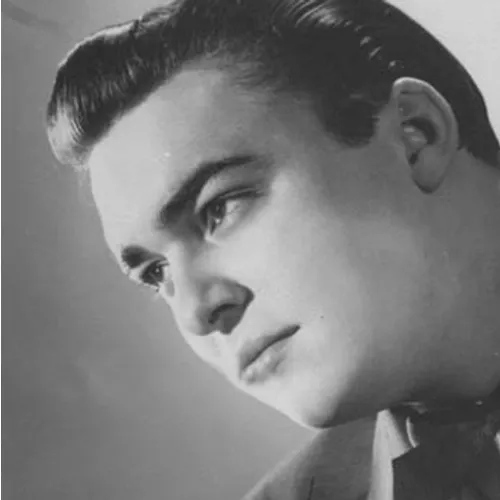
In the golden age of radio and swing music, few vocalists captured the hearts of listeners quite like Ray Eberle. A pivotal figure in the Glenn Miller Orchestra, Eberle's smooth baritone became synonymous with the romantic ballads that defined an entire musical generation.
Early Life and Musical Beginnings
Born Raymond Eberle on January 19, 1919, in Mechanicville, New York, he emerged from a family with musical inclinations. His father, John A. Eberle, worked as a local policeman, sign-painter, and tavern-keeper, while his elder brother Bob Eberly was already establishing himself as a notable singer. Ray's entry into music was somewhat serendipitous, as he had no formal vocal training when he began his career. In 1938, a pivotal moment occurred that would shape his entire musical trajectory. Glenn Miller, searching for a male vocalist for his big band, approached Bob Eberly about potential singers. When Bob mentioned he had a brother who could sing, Ray was immediately invited to audition. Despite initial skepticism from music critics and Miller's own musicians about Eberle's vocal style, Miller saw potential and hired him on the spot.
Rise with the Glenn Miller Orchestra
Eberle quickly became a signature voice of the Glenn Miller Orchestra, performing on numerous radio shows and recordings. His vocal performances were particularly notable on songs like "Moonlight Cocktail" and "Elmer's Tune". Music critics, including George Simon, noted that while Miller often pitched songs in keys that strained Eberle's voice, his performances were most compelling when singing in lower registers. The young vocalist appeared in significant musical films of the era, including "Sun Valley Serenade" (1941) and "Orchestra Wives" (1942), further cementing his popularity. From 1940 to 1943, he consistently ranked high in Billboard's "College Poll" for male vocalists, a testament to his widespread appeal.
Professional Challenges and Transitions
Despite his success, Eberle's relationship with Glenn Miller was not without tension. Miller was known for his strict management style, and in a defining moment, he fired Eberle in June 1942 for being late to a rehearsal. This abrupt departure led Eberle to briefly join Tex Beneke's band before launching a solo career. Throughout the 1950s and 1960s, Eberle maintained his musical presence, appearing on numerous television variety shows and leading his own orchestras. He formed the Ray Eberle Orchestra and the Serenade in Blue Orchestra, demonstrating his continued commitment to the big band and swing music traditions.
Later Life and Legacy
In the later stages of his career, Eberle continued performing and touring. In 1970, he rejoined former Miller bandmate Tex Beneke for a national tour, showcasing the enduring appeal of his musical style. Throughout his career, he remained dedicated to the romantic ballads and swing music that had defined his early success. Ray Eberle passed away on August 25, 1979, in Douglasville, Georgia, leaving behind a rich musical legacy. He was not just a vocalist but a crucial interpreter of the big band sound that defined an era of American popular music.
Works and Appearances
Radio
- Glenn Miller's Music (1938-1942)
- Chesterfield Show (1939-1942)
- Various Glenn Miller radio broadcasts
Films
- Sun Valley Serenade (1941)
- Orchestra Wives (1942)
Orchestras
- Glenn Miller Orchestra (1938-1942)
- Ray Eberle Orchestra (1943-1979)
- Serenade in Blue Orchestra (1943-1979)
- Tex Beneke Orchestra (Brief period post-Miller)
Television
- Various variety shows (1950s-1960s)