Lee Marvin
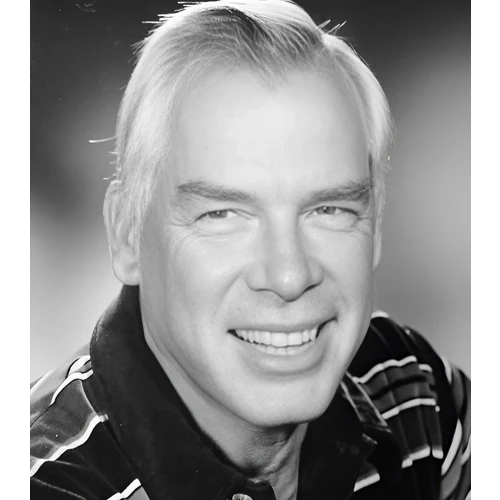
Lee Marvin (February 19, 1924 – August 29, 1987) was an American film actor. Known for his gravelly voice, white hair and 6 ft 2 in (1.88 m)stature, Marvin at first did supporting roles, mostly villains, soldiers and other hardboiled characters, but after winning an Academy Award for Best Actor for his dual roles in Cat Ballou (1965), he landed more heroic and sympathetic leading roles. He was perhaps best known for his starring role as Detective Lieutenant Frank Ballinger in the 1957-1960 NBC hit crime series, M Squad. Early life Marvin was born in New York City. He was the son of Lamont Waltman Marvin, an advertising executive and the head of the New York and New England Apple Institute, and his wife Courtenay Washington (née Davidge), a fashion writer and beauty consultant. As with his older brother, Robert, he was named in honor of Confederate General Robert E. Lee, who was his first cousin, four times removed. His father was a direct descendant of Matthew Marvin, Sr., who emigrated from Great Bentley, Essex, England in 1635 and helped found Hartford, Connecticut. Marvin studied violin when he was young. As a teenager, Marvin "spent weekends and spare time hunting deer, puma, wild turkey, and bobwhite in the wilds of the then-uncharted Everglades." He attended St. Leo College Preparatory School in St. Leo, Florida after being expelled from several other schools for bad behavior. Military Service Marvin left school to enlist in the United States Marine Corps in August 1942, serving in the 4th Marine Division. He was wounded in action during the WWII Battle of Saipan, in the assault on Mount Tapochau, during which most of his company ("I" Company, 24th Marines, 4th Marine Division) were killed. Marvin's wound (in the buttocks) was from machine gun fire, which severed his sciatic nerve. He was awarded the Purple Heart and was given a medical discharge with the rank of Private First Class in 1945 at Philadelphia. Contrary to rumors, Marvin did not serve with producer and actor Bob Keeshan during World War II. Career After the war, while working as a plumber's assistant at a local community theatre in Upstate New York, Marvin was asked to replace an actor who had fallen ill during rehearsals. He then began an amateur Off-Broadway acting career in New York City and served as an understudy in Broadwayproductions. In 1950, Marvin moved to Hollywood. He found work in supporting roles, and from the beginning was cast in various war films. As a decorated combat veteran, Marvin was a natural in war dramas, where he frequently assisted the director and other actors in realistically portraying infantry movement, arranging costumes, and the use of firearms. His debut was in You're in the Navy Now (1951), and in 1952 he appeared in several films, including Don Siegel's Duel at Silver Creek, Hangman's Knot, and the war drama Eight Iron Men. He played Gloria Grahame's vicious boyfriend in Fritz Lang's The Big Heat (1953). Marvin had a small but memorable role in The Wild One (1953) opposite Marlon Brando (Marvin's gang in the film was called "The Beetles"), followed by Seminole (1953) and Gun Fury (1953). He also had a notable small role as smart-aleck sailor Meatball in The Caine Mutiny. He had a substantially more important part as Hector, the small town hood in Bad Day at Black Rock (1955) with Spencer Tracy. During the mid-1950s, Marvin gradually began playing more important roles. He starred in Attack, (1956) had a good supporting role in the WesternSeven Men from Now (1956) and starred in The Missouri Traveler (1958) but it took over one hundred episodes as Chicago cop Frank Ballinger in the successful 1957-1960 television series M Squad to actually give him name recognition. One critic described the show as "a hyped-up, violentDragnet... with a hard-as-nails Marvin" playing a tough police lieutenant. Marvin received the role after guest-starring in a memorable Dragnet episode as a serial killer. In the 1960s, Marvin was given prominent supporting roles in such films as The Comancheros (1961), John Ford's The Man Who Shot Liberty Valance (1962), andDonovan's Reef (1963), all starring John Wayne, with Marvin's roles getting larger with each film. As the vicious Liberty Valance, Marvin played his first title role and held his own with two of the screen's biggest stars (Wayne and James Stewart). For director Don Siegel, Marvin appeared in The Killers (1964) playing an efficient professional assassin alongside Clu Gulager. The Killers was also the first film in which Marvin received top billing. Marvin won the 1965 Academy Award for Best Actor for his comic role in the offbeat Western Cat Ballou starring Jane Fonda. He also won the Silver Bear for Best Actor at the 15th Berlin International Film Festival. Next Marvin performed in the hit Western The Professionals (1966), in which he played the leader of a small band of skilled mercenaries (Burt Lancaster, Robert Ryan, and Woody Strode) rescuing a kidnap victim (Claudia Cardinale) shortly after the Mexican Revolution. He followed that film with the hugely successful World War II epic The Dirty Dozen (1967) in which top-billed Marvin again portrayed an intrepid commander of a colorful group (future stars John Cassavetes, Charles Bronson, Telly Savalas, Jim Brown, and Donald Sutherland) performing an almost impossible mission. In the wake of these two films and after having received anOscar, Marvin was a huge star given enormous control over his next film. In Point Blank, an influential film for director John Boorman, he portrayed a hard-nosed criminal bent on revenge. Marvin, who had selected Boorman himself for the director's slot, had a central role in the film's development, plot line, and staging. In 1968, Marvin also appeared in another Boorman film, the critically acclaimed but commercially unsuccessful World War II character study Hell in the Pacific, also starring famed Japanese actor Toshiro Mifune. Marvin was originally cast as Pike Bishop (later played by William Holden) in The Wild Bunch (1969), but fell out with director Sam Peckinpah and pulled out in order to star in the Western musical Paint Your Wagon (1969), in which he was top-billed over a singing Clint Eastwood. Despite his limited singing ability, he had a hit song with "Wand'rin' Star". By this time he was getting paid a million dollars per film, $200,000 less than top starPaul Newman was making at the time; yet he was ambivalent about the film business, even with its financial rewards:
"You spend the first forty years of your life trying to get in this business, and the next forty years trying to get out. And then when you're making the bread, who needs it?"
Marvin had a much greater variety of roles in the 1970s and 1980s, with fewer 'bad-guy' roles than in earlier years. His 1970s films included Monte Walsh (1970) withJeanne Moreau, the violent Prime Cut (1972) with Gene Hackman, Pocket Money (1972) with