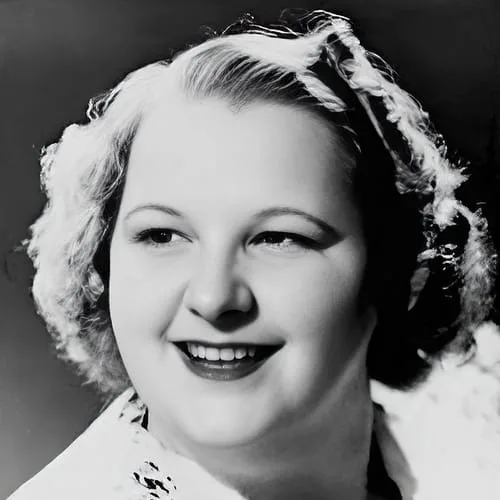
Kate Smith
In the golden age of radio, few personalities captured the heart of America quite like Kate Smith. Known as the "First Lady of Radio" and the "Songbird of the South," Smith was more than just a singer—she was a cultural icon who defined an era of American entertainment and patriotism.
Early Life and Musical Beginnings
Born Kathryn Elizabeth Smith on May 1, 1907, in Greenville, Virginia, her early life was marked by unique challenges and extraordinary potential. As a child, Smith was notably late to develop speech, not talking until she was four years old. However, by age five, she was already singing at church social events, hinting at the remarkable vocal talent that would define her career. Smith's musical influences came directly from her family. Her father sang in the Catholic church choir, while her mother played piano at the Presbyterian church. These early exposures to music would shape her future career. Despite never taking a formal singing lesson, Smith possessed an impressive vocal range of two and a half octaves. Her earliest performances were during amateur nights at local theaters in Washington, D.C., where her family had settled. Her father, concerned about her stage aspirations, even sent her to a convent school between 1924 and 1925, hoping to divert her from show business. Ironically, this only strengthened her resolve to pursue entertainment.
Breaking into Show Business
Smith's breakthrough came in 1926 when she secured a spot in a Boston performance, catching the attention of producer Ted Collins. She was soon part of the revue Honeymoon Lane, which opened on Broadway. Her debut was memorable, with The New York Times describing her as a "19-year-old girl, weighing in the immediate neighborhood of 200 pounds" who was a notable "discovery" in the music scene. Her early recordings began during Honeymoon Lane's run, first with Columbia Records and later with budget labels. She developed a versatile style, ranging from jazz to more traditional performances. By the late 1920s, she had earned the moniker "Songbird of the South," a title that would stick throughout her career.
Radio Stardom and Patriotic Impact
Smith's radio career was nothing short of phenomenal. She became a major radio star, hosting multiple shows across networks like NBC and CBS. Her flagship program, The Kate Smith Hour, was a leading variety show that ran for eight years from 1937 to 1945, featuring comedy, music, and drama. During World War II, Smith became a national treasure. She "stirred patriotic fervor" by helping sell over $600 million in war bonds—a staggering achievement that no other entertainment figure could match. In one remarkable 18-hour broadcast, she sold $107 million in war bonds alone. Her rendition of "God Bless America" became her signature song and a powerful symbol of national unity. President Ronald Reagan would later say that her performance of the song had "taken on added meaning for all of us" when he awarded her the Presidential Medal of Freedom in 1982.
Later Career and Legacy
Beyond radio, Smith appeared in films like This Is the Army (1943) and continued broadcasting until 1960. She was inducted into the Radio Hall of Fame in 1999 and received numerous honors, including a commemorative U.S. postal stamp in 2010. In her personal life, Smith converted to Roman Catholicism in 1965 and was known for her deep faith and community involvement. She passed away on June 17, 1986, leaving behind a legacy as one of America's most beloved entertainers.
Works and Appearances
Radio
- Kate Smith Sings (NBC, multiple years)
- Kate Smith and Her Swanee Music (CBS, 1931-1933)
- The Kate Smith Hour (1937-1945)
Films
- Honeymoon Lane (1926)
- This Is the Army (1943)
Notable Recordings
- "God Bless America"
- "Carolina Moon"
- "Bless You Sister"
Kate Smith was more than an entertainer; she was a national symbol of hope, patriotism, and resilience during some of America's most challenging times.