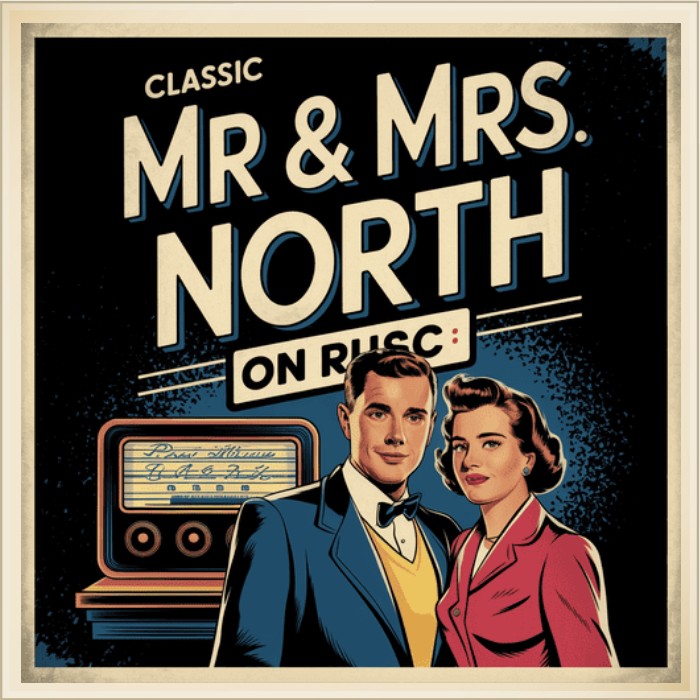
When Mr. and Mrs. North signed off the air on April 18, 1955, it marked the end of one of radio’s most endearing detective series—one that proved you didn’t need a license, a trench coat, or a tough-guy monologue to solve a good mystery. Pamela and Jerry North were not detectives at all, but an ordinary Manhattan couple with a gift for turning an evening out, a quiet weekend, or a simple errand into a brush with murder. That mix of amiable domesticity and clever crime-solving, delivered with warmth and wit, is exactly what made the show such an immediate—and lasting—hit.
Pam and Jerry began on the printed page, brought to life by the husband-and-wife writing team of Frances and Richard Lockridge. Their first full-length North mystery, The Norths Meet Murder (1940), set the tone: an accidental discovery, a witty and affectionate married couple caught up in a puzzle, and a police inspector who learns to take them seriously despite their knack for stumbling over trouble. The Lockridges’ charm lay in making the Norths recognizably “real”: urban, sociable, and curious, with the kind of easy banter that feels lived-in rather than scripted.
Radio seized on that appeal in the early 1940s and ran with it for more than a decade. On the air, Pamela and Jerry were most memorably portrayed by Alice Frost and Joseph Curtin, whose chemistry anchored the series. Frost’s Pam is sparkling, intuitive, and irrepressibly curious; Curtin’s Jerry is steady, good-humored, and just practical enough to keep them (mostly) out of harm’s way. Together, they offered a refreshing alternative to hardboiled gumshoes.
In the final years of the radio series from 1953 Mr. and Mrs. North were played by Richard Denning and Barbara Britton who also starred in the 1952 - 1954 Television series. The Norths weren’t chasing danger for a fee; danger simply had a way of finding them. And when it did, the couple’s quick minds and affectionate teamwork made listeners feel like they were right there at the kitchen table, puzzling it out over coffee.
Typical episodes unfolded with a light touch: a party guest who doesn’t make it home, an odd phone call, a missing manuscript (Jerry works in publishing, after all), or a misdelivered package that isn’t what it seems. The mood could turn serious when the stakes rose, but the show never lost its sense of humanity—or its gentle humor. The writing leaned into character and situation rather than sensationalism. Red herrings were fair, clues were planted honestly, and the denouement felt earned.
A key figure in the Norths’ world is their long-suffering friend in blue, Inspector Bill Weigand. Far from a stock obstructionist, Weigand functions as a genuine colleague who recognizes the value of Pam’s instincts and Jerry’s logic. That respectful triangle—amateurs and professional—kept the series grounded. It also gave the show an easy rhythm: the Norths observe, hypothesize, and blunder into the truth; Weigand tests, confirms, and collars the culprit.
What set Mr. and Mrs. North apart, especially to wartime and postwar audiences, was tone. In an era when radio was rich with grim murders and shadowy alleys, the Norths’ brand of comedy-mystery felt fresh and inviting. You can hear echoes of screwball comedy in their exchanges, but the series never descends into farce. Instead, it balances real jeopardy with warmth—a reminder that ordinary people, using ordinary sense, can rise to extraordinary moments.
By the time the series wrapped on April 18, 1955, the Golden Age of Radio was giving way to television. Many detective programs faded in that transition, but Mr. and Mrs. North left behind a distinctive legacy. They showed that mystery could be domestic without being dull, funny without being frivolous, and romantic without being coy. For longtime listeners, the finale felt like saying goodbye to friends. For newer fans discovering the shows today, the appeal is immediate: bright performances, nimble plotting, and the cozy thrill of sharing a whodunit with two people who genuinely like each other.
Mr. and Mrs. North didn’t reinvent the detective story so much as they invited it into the living room. In doing so, they helped define a radio subgenre—the warm-hearted, fair-play comedy mystery—that still charms. Their last bow in 1955 may have closed the curtain on new adventures, but the best of their cases feel as lively as ever. For anyone who loves a smart puzzle solved with affection and good sense, Pam and Jerry are evergreen company.