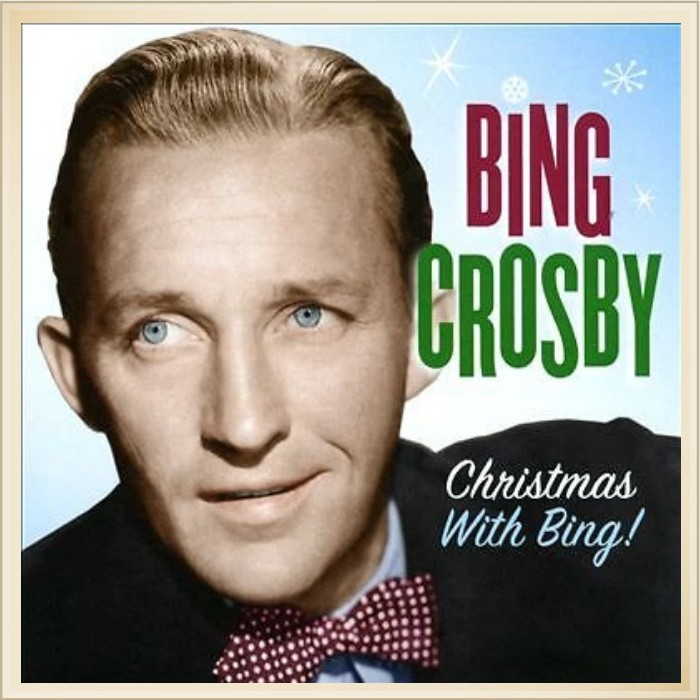
It was a living tradition that gathered families around the radio just as it had in the 1930s and 40s. The seventh annual show, sponsored by Insurance Company of North America (INA), Christmas Sing with Bing broadcast Christmas Eve 1961, is a warm, expertly paced hour that blends carols, pop standards, light comedy, and a touch of transatlantic pageantry—very much the Crosby way.
From the first notes of Joy to the World, Bing sets the tone: easy, inclusive, and communal. This was “gang singing,” as he liked to say—listeners at home were invited to sing along rather than simply listen in. Announcer Ken Carpenter, a longtime Crosby cohort from Kraft Music Hall days, frames the evening with genial polish and sponsor pride. Even as network radio music variety was fading, Bing’s Christmas Eve special still felt like a national hearth.
The guest list is quintessentially mid-century: Jo Stafford (Mrs. Paul Weston), in luminous voice on Winter Wonderland and a plush, hearth-warm rendition of The Christmas Song; Edgar Bergen with Charlie McCarthy, bringing their evergreen back-and-forth and a sly thread of sponsor-minded mischief; and Catherine (Kathryn) Crosby joining Bing for a cozy, nursery-set favorite, Rudolph the Red-Nosed Reindeer. Paul Weston conducts with unfussy finesse, and the Norman Luboff Choir supplies that clean, buoyant choral sheen that defined so many 1950s-60s holiday LPs.
One of the evening’s loveliest touches is a taped segment from London: the St. Michael’s Choir of St. Michael’s, Cornhill—squarely in the City’s old financial district—directed by Dr. Harold Darke, offering a jubilant Ding Dong Merrily on High. Bing and Carpenter adorn the handoff with a bit of atmospheric scene-setting (“Threadneedle Street and Cornhill”), the sort of evocative radio writing that harkens back to the era when sound alone could conjure place.
As ever, Crosby balances the carols with the “Hit Parade” side of Christmas. A breezy medley with Jo Stafford—Santa Claus Is Comin’ to Town, Silver Bells, and Here Comes Santa Claus—plays to his genial swing. And then comes the big one: White Christmas, delivered with the relaxed authority of the man who made it a cultural ritual. By 1961, the song was effectively a modern carol, and Bing treats it that way—no grandstanding, just warmth and memory.
The comedy is gentle and well-spaced. Bergen and Charlie spar cheerfully through the sponsor copy—Charlie angling for INA “package insurance” in his stocking—and there’s a delightful flashback to a 1955 Christmas Eve bit with Candice (“Candy”) Bergen and Charlie attempting (and creatively mangling) The Night Before Christmas before fessing up that they knew it all along. It’s pure mid-century radio family entertainment, and it lands.
Part of the pleasure of these INA years is how unabashedly sponsor-forward the patter can be while still feeling Christmassy. Carpenter compares INA agents to real-life Santas—no white beards required—on call when families need them most. It’s old-school sponsor integration done with a wink, grounded in the holiday’s themes of care and community.
Historically, this particular program also gives a snapshot of the Crosby household in transition. Bing had married Kathryn Grant in 1957; by this Christmas, Harry (“Tex”) and Mary Frances were toddlers, and baby Nathaniel had just arrived in October. There’s affectionate talk of bringing the little ones on next year’s show—a reminder that Crosby, America’s voice of Christmas since the Kraft Music Hall years, was still very much living the season as a young dad.
Musically, the closer is inevitable and perfect: Silent Night, with choir and orchestra supporting Bing’s plainspoken sincerity. And then, in a fitting sign-off for a program that celebrates belief, wonder, and family ritual, Bing quotes the London Daily Express: “There’s so little magic in the world, let us encourage it in our children just as long as we can.” That line captures why these broadcasts endure. Beyond the star power and the immaculate arrangements, they model a kind of shared holiday—neighbors singing together, miles apart, by way of radio.
For old-time radio devotees, the 1961 Christmas Sing with Bing is a late yet shining chapter in the medium’s holiday canon: professional but intimate, worldly yet homey, with enough sparkle to feel festive and enough heart to feel true. Whether you come for the carols, the Crosby croon, Stafford’s velvet warmth, Bergen and Charlie’s mischief, or the glow of that London choir, you’ll find the same thing families found in 1961: an hour that makes the room feel a little warmer...
P.S. How much do you know about the song, White Christmas? Why not take our quiz and find out! Once you've done it be sure to share it with your friends and see how well they do.