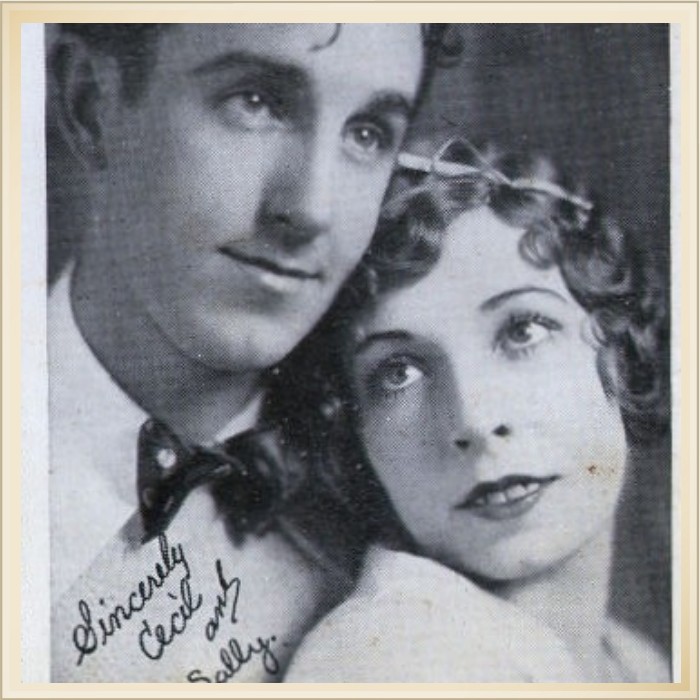
Sometimes billed as The Love Story of Cecil and Sally, it was one of the earliest continuing radio romances to be recorded on electrical transcription discs and syndicated to stations across the country. In other words, it showed American radio how a pre-recorded, cliffhanger serial could hook listeners day after day—years before the great network factories of the 1930s hit full stride.
Starring Johnny Patrick and Helen Troy, Cecil and Sally emerged in the late 1920s on the West Coast, right as electrical transcription technology was coming into its own. Most radio then was live; if you missed it, it was gone. Transcriptions changed that, giving independent stations a way to buy a ready-made program, schedule it at their convenience, and sell it to a local sponsor. Cecil and Sally made especially good use of that model. With short, intimate episodes—typically around 10 minutes—it could run five days a week and fit neatly around a station’s news breaks and musical programs.
As the title suggests, the series centered on the courtship and early married life of a young couple. The tone was light romantic melodrama rather than broad comedy or overwrought tragedy. Think sweet-natured entanglements, misunderstandings, and the everyday obstacles that face two people determined to make a life together. Each installment pushed the story one step forward and ended with just enough suspense to guarantee listeners would be back tomorrow. Organ bridges, minimal sound effects, and an intimate microphone style all kept the focus squarely on the characters’ emotions—exactly the ingredients that would soon define an entire genre.
Because it was recorded rather than networked live, Cecil and Sally found outlets on scores of small and mid-sized stations from coast to coast. Station announcers could wrap the show with their own local IDs and commercials, so the same episode might be “brought to you by” a bakery in Oregon one week and a furniture store in Ohio the next. That flexibility is a big reason the program turns up in trade press of the period as a model for independent stations looking to build loyal daytime audiences at modest cost.
In the broader story of radio history, Cecil and Sally matters for two reasons:
- It’s an early, clear example of daily serialized storytelling aimed at homemakers. Irna Phillips’s Painted Dreams began in 1922 on WGN in Chicago, and Clara, Lu ’n’ Em went national in 1930—but Cecil and Sally shows how that same kind of continuity drama was also taking root through transcription, outside the big network pipelines. Listeners were already demonstrating the habit of tuning in tomorrow.
- It helped prove the business case for transcribed serials. By the early 1930s, transcription companies were pressing hundreds of discs every week for music libraries, dramas, and features. Cecil and Sally’s success convinced station managers—and sponsors—that recorded continuity programming could be reliable audience bait without the expense of live casts and network lines.
For those fascinated by how radio learned to talk “one-to-one,” Cecil and Sally is a miniature textbook. Johnny Patrick, who wrote and starred in the series kept scenes tight and built rhythm with short exchanges, The plotting leans on relatable stakes—money, work, pride, and the pitfalls of young love—rather than sensational shocks. And the performers aim straight for the ear: warm, conversational, and close-miked, an intimacy that set radio apart from vaudeville and the stage.
By mid-decade, the program was overshadowed by the flood of nationally networked daytime serials—the Hummert factory shows, the Procter & Gamble titles, and the many medically and legally themed dramas that followed. But Cecil and Sally had already done its quiet work. It showed that listeners would invite a pre-recorded serial into their homes, keep up with a continuing story, and build that uniquely radio habit of daily companionship.
If you’ve never tried it, sample a handful of episodes in sequence rather than just one. Ten minutes at a time, you can feel how the arc builds—and why so many stations stuck with it. It’s a gentle, historically important stepping stone between the freewheeling 1920s and the golden age of serialized radio that followed. And for those of us who love hearing the medium find its voice, Cecil and Sally is a lovely place to listen in.