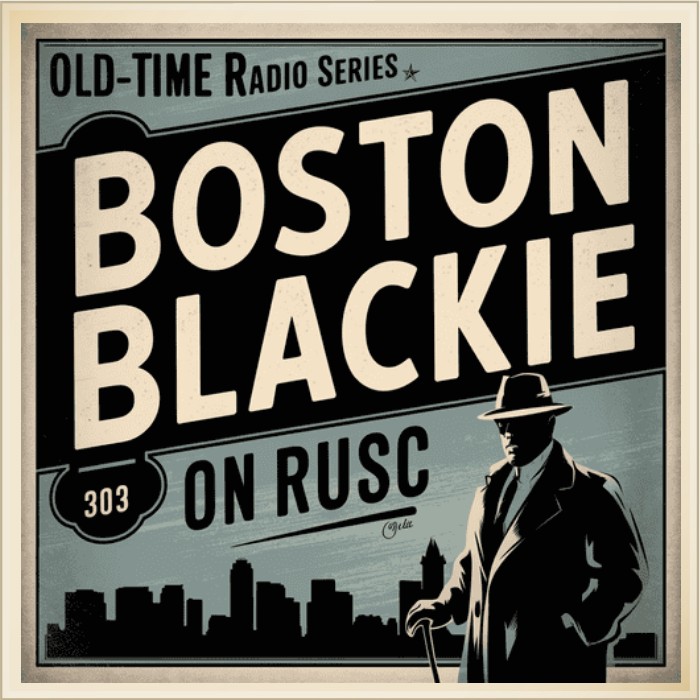
Boston Blackie began life on the page as the creation of Jack Boyle—an urbane ex-jewel thief who’d turned his skills toward solving crimes—and went on to stride across films, radio, and eventually television. But it’s the radio version that cemented Blackie as one of the era’s most beloved sleuths: quick with a quip, quicker with a clue, and always two steps ahead of both the crooks and the cops.
On radio, Blackie’s world took final shape in the mid-1940s, when Ziv transcriptions sent the series out to stations across the country. The syndicated model meant producers could deliver a consistent run of tightly written, half-hour mysteries that any station could schedule locally—one reason the program became so widespread and remains so well represented among surviving recordings. Richard Kollmar—New York broadcaster and later the “Dick” of Breakfast with Dorothy and Dick—starred as Blackie, giving the character a light, agile touch that balanced derring-do with just the right amount of insouciance. Across the desk, forever skeptical and perennially exasperated, was Inspector Farraday, played with gravelly gusto by Maurice Tarplin (also heard as the unforgettable narrator of The Mysterious Traveler). Mary Wesley, Blackie’s steady and sensible confidante, was portrayed at different times by fine radio actresses including Jan Miner, whom many later recognized as “Madge” in the long-running Palmolive commercials, and Lesley Woods.
Listeners of the time—and fans today—remember the series’ signature line:
“Enemy to those who make him an enemy… friend to those who have no friend.”
It’s more than a bit of flourish. That motto sums up the show’s attitude: Blackie is a gentleman rogue with a strong moral compass, always willing to help the helpless and always ready to needle poor Farraday, who rarely starts an episode without suspecting Blackie first. That good-natured tug-of-war gives the series much of its buoyant energy. Crimes tend to burst in with a sudden murder, jewel heist, or insurance swindle; suspects multiply; facts get slippery; and by the final act Blackie has untangled the knots, exposed the real culprit, and explained it all to a begrudging but grateful inspector.
Before this definitive syndicated run, Boston Blackie had a brief network stint in 1944 as a summer series, with film star Chester Morris stepping to the microphone after a successful line of B-mysteries at Columbia Pictures. Those movies—fourteen features between 1941 and 1949, with Morris as Blackie and Richard Lane as Farraday—did much to fix the character in the public imagination. The radio show borrowed the brisk pacing and playful rivalry and ran with them, week after week, building a world of nightclub owners, shady promoters, thieves with hearts of brass, and clever accomplices whose best-laid alibis never quite survive Blackie’s scrutiny.
Part of the radio series’ charm is the way it balances hardboiled atmosphere with light-footed fun. Sound effects paint a lively city—office doors, clacking typewriters, taxi horns, and the occasional scuffle—while dialogue leads the dance. Blackie’s explanations are crisp and logical, yet the scripts never forget the value of banter. The show also makes smart use of recurring types: phony psychics, double-crossing partners, insurance rackets, and elegant jewel jobs that hinge on timing and observation. For listeners who enjoy fair-play puzzles spiced with streetwise wit, Boston Blackie is a perfect fit.
For those curious about the wider legacy, Blackie even made the leap to television in the early 1950s, with Kent Taylor starring in a syndicated series. But it’s the radio incarnation—sleek, nimble, and endlessly replayable—that continues to win new admirers. The transcribed format preserved so many episodes in remarkably listenable form, which is why Boston Blackie remains a staple of OTR collections.
Here on RUSC, we’re especially proud of the breadth and quality of our Blackie holdings. There are currently 193 episodes live on RUSC, and we have 8 more to add to complete the collection. As with many syndicated shows of the period, you’ll find the occasional alternate title or duplicate take; we do our best to identify these variations and present the cleanest, most complete versions available. Episodes are designed to be enjoyed in any order, so you can jump in anywhere. If you’re new, pick a story with a classic setup—a jewel robbery, a frame-up, or a clever impersonation—and you’ll get the full measure of the show’s appeal in one sitting.
Why does Boston Blackie endure? In part because it delivers what radio does best: character and cleverness conjured by voice and imagination. Kollmar’s Blackie is the pal you trust in a tight spot; Tarplin’s Farraday is the foil who ensures the stakes stay sharp; and Mary Wesley brings heart and good sense to adventures that whisk you from penthouses to precincts. It’s polished, urbane crime drama that never talks down to the audience and never forgets to entertain.
Whether you’ve been listening for years or are meeting Blackie for the first time, you’re in for a treat. Dip into a few cases, let that famous motto set the stage, and enjoy the ride. And keep an eye on our updates—those last eight episodes are on the way, bringing our Boston Blackie collection to a satisfying finish here on RUSC.