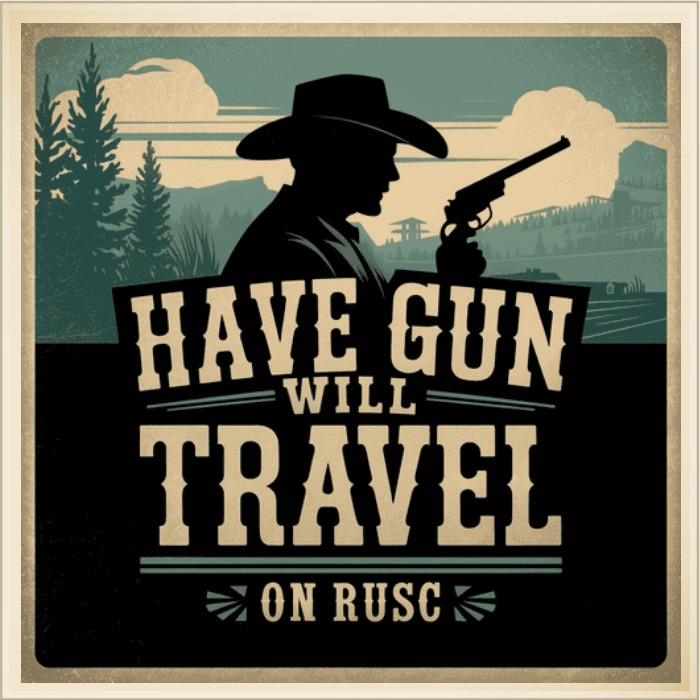
Unusual for radio series Have Gun Will Travel was adapted from the hit CBS television Western starring Richard Boone, the radio edition aired from 1958 to 1960 and delivered 106 episodes—remarkably, all of them survive today. That completeness, combined with superb performances and consistently smart storytelling, helps explain why new listeners keep falling for it. As one fan put it:
“I have just fallen in love with this show. The chemistry between voice actors is terrific. You don't need a TV.” - Zoe
At the center of the series is Paladin, a cultured gentleman who hires out his gun—but only on his terms. Based at San Francisco’s Hotel Carlton, he’s as comfortable quoting poetry as he is facing down a desperado. His iconic calling card—adorned with a chess knight and the words Have Gun—Will Travel—Wire Paladin, San Francisco—signals the show’s core idea: a strategist who prefers brains over bullets, but never shies from either.
On radio, Paladin is brought to life by John Dehner, one of the era’s finest dramatic voices. Dehner’s Paladin is wry, thoughtful, and quietly formidable, his baritone full of moral shading that suits the series’ more adult sensibilities. Many listeners come away as lifelong fans of the actor.
“This show made me into a John Dehner fan,” writes Steve M. “This really is great. Give it a try.”
While the television version is justly famous, the radio incarnation has its own, remarkably strong identity. Freed from the constraints of sets and locations, the writers and production team leaned into moody soundscapes, layered effects, and crisp dialogue. Gunfights crack like thunderclaps, trail rides rustle and creak, and hotel lobbies hum with life—all crafted to pull you into the moment without a single camera cut. Episodes typically run a tight 25 minutes, making each story a finely calibrated mix of setup, moral dilemma, and decisive resolution.
As JR notes, “Just finished the entire series and if you like westerns with a little bit of theatrics thrown in, you will enjoy this series.”
The supporting cast—drawn from CBS’s deep bench of radio talent—adds warmth and texture, and the chemistry is exactly the sort of intangible that keeps listeners coming back. Recurring characters and one-off guests alike feel lived-in, and the interplay with Paladin is alternately witty, tense, and humane. The result is a Western that rewards repeat listening. Randy sums up a common reaction:
“I never really liked Westerns, but I love this radio series. Liked it so much that I looked for and watched a few episodes of the TV series with Richard Boone. I was surprised that I liked the radio broadcasts much better! I listen to them repeatedly.”
Have Gun—Will Travel also occupies a distinctive corner of the Western landscape. Where Gunsmoke often explores the rough civic fabric of Dodge City, Paladin’s world is more itinerant and personal: each week, a new town, a new client, a new ethical knot to untangle. The tone may shift from brooding to ironic to romantic, but it’s always anchored by Paladin’s code. He’s a professional, yes, but he’s also a gentleman trying to nudge a chaotic frontier toward justice—without surrendering to cynicism. Small wonder that fans rank it with the very best.
Part of the show’s continuing appeal is accessibility. Because all 106 episodes are extant—a rare gift for collectors and newcomers alike—listeners can take in the complete arc of the series in excellent sound, appreciating how deftly it balances action with character and atmosphere.
If you’ve never tried it, start anywhere, there are many episodes with 5 star ratings. Have Gun Will Travel isn’t serialized, and the setup is instantly graspable. You’ll meet a Paladin who thinks before he draws, who weighs his fee against his conscience, and who brings a chess player’s foresight to the unpredictability of the West. Give a couple of episodes a spin and you may find yourself echoing Zoe, Randy, JR, and Steve M.—discovering not just a great Western, but one of radio drama’s most inviting and enduring companions.