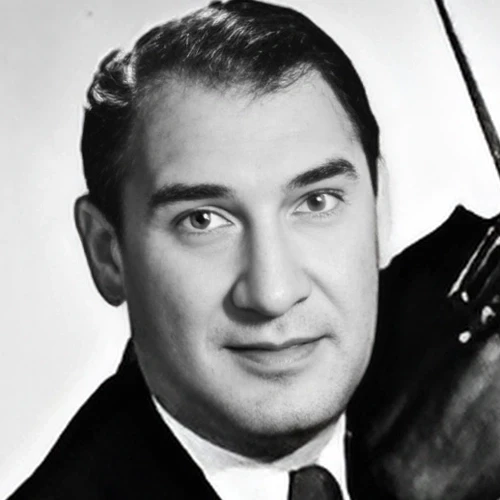
Henny Youngman
In the golden age of comedy and radio, few performers could match the rapid-fire wit and comedic precision of Henny Youngman. Known as the "King of the One-Liners," Youngman revolutionized comedy with his unique style of humor that would become legendary in American entertainment. His trademark violin, quick jokes, and unforgettable catchphrases made him a standout performer across multiple media platforms.
Early Life and Musical Beginnings
Henry "Henny" Youngman was born on March 16, 1906, in London, England, to parents Yonkel Yungman and Olga Chetkin. His family immigrated to New York City when he was a child, where young Henny began taking violin lessons and developing his musical skills. Before becoming a comedian, Youngman worked at a print shop, where he honed his comedic craft by writing "comedy cards" containing one-line gags. His early career was deeply influenced by music. Youngman led a small band called the Swanee Syncopators, where he would intersperse jokes between musical performances. His breakthrough came unexpectedly when a club's regular comedian failed to show up, and Youngman was asked to fill in. This serendipitous moment launched what would become a remarkable seven-decade career in comedy.
Radio and Performance Breakthrough
Youngman's big break in radio came in 1937 when he appeared on a popular radio show. His manager secured increasingly numerous appearances on highly rated network radio programs like "The Fleischmann's Yeast Hour". His comedy style was revolutionary - while many comedians of the era told elaborate anecdotes, Youngman specialized in rapid-fire, succinct one-liners that went straight to the punchline. His performances were remarkably concise, typically lasting only 15 to 20 minutes but packed with dozens of jokes. Holding his trademark violin and bow, he would occasionally play short interludes between jokes, adding to his unique comedic persona. His most famous line, "Take my wife... please," became an iconic piece of American comedy folklore.
Television and Broader Entertainment Career
Throughout his career, Youngman made numerous television appearances, including a long-running stint on an unnamed show. In 1955, he even hosted The Henny and Rocky Show with champion boxer Rocky Marciano. He appeared in several movies, including cameo roles that showcased his comedic timing. Youngman's approach to entertainment was decidedly pragmatic. He treated comedy as a working job, famously advising other entertainers to "nem di gelt" (Yiddish for "take the money"). His work ethic was legendary - he performed almost every day for over seventy years, with only brief breaks following his wife's death and during his final hospital stay.
Personal Life and Legacy
Despite the jokes at his wife Sadie's expense, the Youngmans shared a deeply loving relationship, remaining married for 59 years until her death in 1987. Henny was incredibly devoted, even building an ICU in their bedroom to care for Sadie during her prolonged illness. Youngman never truly retired, performing worldwide until his final days. When the New York Telephone Company started a comedy hotline in 1974, over three million people called to hear 30 seconds of his material - the most ever for a comedian. He passed away on February 24, 1998, at Mount Sinai Medical Center, leaving behind a comedy legacy that transformed stand-up humor.
Works and Appearances
Radio
- Various network radio shows (1937-1950s)
- The Fleischmann's Yeast Hour
Television
- The Henny and Rocky Show (1955)
- Multiple unnamed television appearances
Film
- College Confidential (1956)
- The Stoogemania (1986)
- The Last Laugh (1995) - Cameo as a mental patient
Albums
- The Primitive Sounds of Henny Youngman (1959)
Henny Youngman's career exemplified the quintessential American comedian - hardworking, witty, and always ready with a joke. His influence on comedy extends far beyond his own performances, inspiring generations of comedians who followed in his rapid-fire, one-liner tradition.