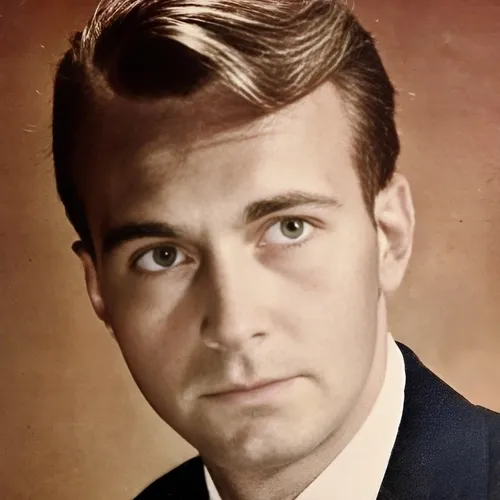
Helmut Dantine
A film actor remembered for playing many Nazis in thriller films of the 1940s. The Vienna-born actor appeared uncredited in Casablanca early in his career (he played the desperate newlywed gambling to obtain visa money).
In the tumultuous landscape of mid-20th century entertainment, Helmut Dantine emerged as a remarkable figure whose life story transcended the boundaries of acting, resistance, and artistic expression. A Vienna-born actor who transformed personal adversity into a compelling Hollywood career, Dantine became known for his nuanced portrayals of complex characters during World War II and beyond.
Early Life and Resistance
Born Helmut Guttmann on October 7, 1918, in Vienna, Austria, Dantine's early life was marked by political courage and personal risk. As a young man, he became deeply involved in the anti-Nazi youth movement, actively resisting the rising tide of fascism in his homeland. In 1938, at just 19 years old, his activism put him in direct conflict with the Nazi regime when they annexed Austria. Consequently, he was imprisoned in a concentration camp outside Vienna, a harrowing experience that would later inform his powerful screen performances.
Entry into Radio and Performance
Dantine's journey to performance began after his release and immigration to the United States. He enrolled at UCLA and became involved with the Pasadena Playhouse, where he honed his acting skills while simultaneously running two gas stations to support himself. It was during this period that he began exploring opportunities in radio and theater.
Radio Performances and Notable Appearances
While Dantine was primarily known for his film work, he did make notable radio appearances. His most significant radio performance was in the suspense-thriller series Suspense, specifically in the 1945 episode "The Taming of the Beast" broadcast on March 29. In this psychological drama, Dantine portrayed a patient of a psychiatrist, showcasing his ability to convey complex emotional landscapes Though detailed documentation of his complete radio repertoire is limited, Dantine likely appeared in other radio programs typical of Hollywood actors of his era, such as Lux Radio Theatre and The Screen Guild Players. These programs were common platforms for film actors to expand their performance range and reach broader audiences.
Transition to Film and Legacy
Dantine's radio work was a stepping stone to his more prominent film career. Spotted by a Warner Bros. talent scout, he began appearing in films, often playing Nazi characters - a ironic twist given his real-life anti-Nazi activism. His performances in films like Casablanca and Mrs. Miniver established him as a versatile actor capable of portraying both sympathetic refugees and antagonistic Nazi officers.
Works and Appearances
Radio
- Suspense: "The Taming of the Beast" (1945) - Patient
- Potential appearances on Lux Radio Theatre and The Screen Guild Players (unconfirmed)
Film (Selected)
- Casablanca (1942) - Jan Brandel
- Mrs. Miniver (1942) - German Pilot
- Northern Pursuit (1943) - Col. Hugo von Keller
- Passage to Marseille (1944)
Television
- Night Gallery (1971) - General von Grunn (1 episode)
- Run for Your Life (1967) - Erich Krieger (1 episode)
Stage
- The Parisienne (Broadway, 1950)
Helmut Dantine passed away on May 2, 1982, in Beverly Hills, leaving behind a complex legacy of artistic resilience and powerful storytelling that bridged the worlds of radio, film, and theater.
