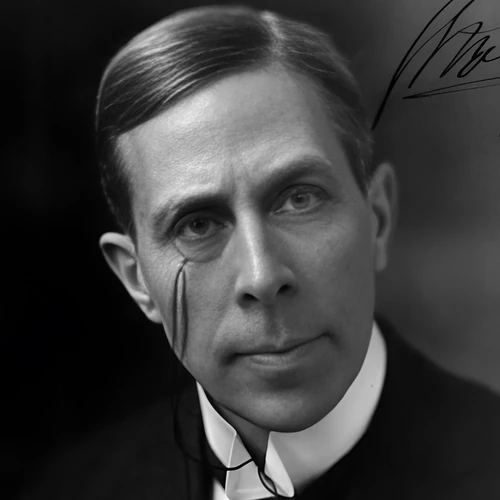
George Arliss
An English actor, author, playwright and film maker who found success in the United States. He was the first British actor to win an Academy Award.
George Arliss was a remarkable performer who bridged the worlds of theater, silent film, and early sound cinema, leaving an indelible mark on early 20th-century entertainment. Though primarily known as a stage and film actor, his versatility and artistic prowess made him a significant cultural figure of his era.
Early Life and Theatrical Beginnings
Born Augustus George Andrews on April 10, 1868, in London, George Arliss began his professional journey in an unexpected manner. Initially working in his father's publishing office, he made a bold decision at age 18 to pursue a career on the stage. His early theatrical career took root in the British provinces in 1887, and by 1900, he was performing supporting roles in London's prestigious West End. Arliss's breakthrough came when he embarked on a tour of America in 1901 with a theatrical troupe. What was intended to be a temporary tour transformed into a twenty-year residency in the United States. His Broadway debut in Magda in 1902 marked the beginning of a distinguished theatrical career. By 1908, he had become a star with his performance in The Devil.
Rise to Prominence in Film
Transitioning from stage to film, Arliss began his cinematic journey with The Devil in 1921. He successfully navigated the challenging shift from silent to sound films, remaking several of his earlier works in the new medium. His most notable achievement came in 1929 when he won the Academy Award for Best Actor for his portrayal of Benjamin Disraeli in the film of the same name. Arliss developed a unique position in Hollywood, working exclusively with Warner Bros. under a contract that granted him unprecedented creative control. He was known for his meticulous approach to filmmaking, often collaborating closely on script rewrites and actor selections. Notably, he played a crucial role in launching Bette Davis's career, insisting on her as a leading lady in several films.
Artistic Specialization and Critical Acclaim
Arliss became renowned for his historical biopics, portraying notable figures with remarkable depth and nuance. His filmography included memorable portrayals of Alexander Hamilton, Voltaire, Cardinal Richelieu, and Duke of Wellington. These performances were not just mere impersonations but complex character studies that brought historical figures to life. Beyond historical dramas, he also excelled in domestic comedies, demonstrating his remarkable range as an actor. His versatility was so appreciated that in 1934, British film audiences named him their favorite male star. This recognition underscored his international appeal and artistic excellence.
Personal Life and Legacy
A man of diverse interests, Arliss was more than just an actor. He was a prominent animal rights advocate, founding the National Anti-Vivisection Society of Chicago. He was also a strict vegetarian, famously stating, "I eat nothing I can pat." His commitment to health was evident in his daily four-mile walks and interest in aerobics. Arliss wrote an autobiography, Up the Years from Bloomsbury, in 1927, providing insights into his remarkable journey. He was also honored with a star on the Hollywood Walk of Fame, cementing his place in entertainment history. In his later years, Arliss returned to London, where he lived through World War II. He passed away on February 5, 1946, leaving behind a legacy of artistic excellence and versatility that influenced generations of performers.
Works and Appearances
Radio
- Disraeli (1938) - Radio adaptation on Cecil B. DeMille's show
- The Man Who Played God (March 1938)
- Unnamed production (January 1939)
Film
- The Devil (1921)
- Disraeli (1921, 1929)
- The Green Goddess (1923, 1930)
- Alexander Hamilton (1931)
- Voltaire (1933)
- The House of Rothschild (1934)
- Cardinal Richelieu (1935)
- Doctor Syn (1937)
Theater
- Magda (1902)
- The Devil (1908)
- Various stage productions (1887-1920s)
Books
- Up the Years from Bloomsbury (1927, autobiography)
- My Ten Years in the Studios (1940)
