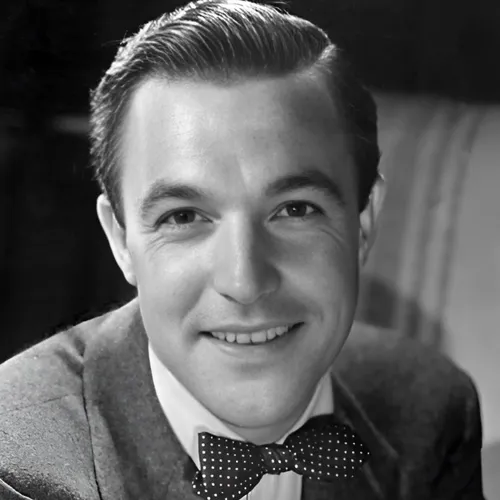
Gene Kelly, renowned for his revolutionary dance style and cinematic musicals, was also a versatile and compelling radio performer whose talents extended far beyond the silver screen. His radio work revealed a multifaceted artist capable of captivating audiences through sound alone.
Early Radio Performances and Breakthrough
Kelly's radio career began in the early 1940s, coinciding with his rising Hollywood stardom. His first notable radio appearance was on the Screen Guild Theatre in 1943, performing in the production of For Me and My Gal alongside Judy Garland . This performance showcased his ability to translate his dynamic stage presence into an audio medium. Throughout the 1940s, Kelly became a frequent and sought-after radio performer. He appeared on prestigious programs like the Kate Smith Hour in 1946 , demonstrating his versatility and growing popularity in entertainment circles. His radio work was not merely a side pursuit but an integral part of his expanding artistic repertoire.
Dramatic Turns in Radio Drama
Surprisingly, Kelly was not confined to musical performances in radio. He made significant appearances in dramatic radio shows, particularly the legendary Suspense mystery series. His performances in episodes like "Thieves Fall Out" (1943), "Death Went Along for the Ride" (1944), and "The Man Who Couldn't Lose" (1949) revealed a different side of his artistic range . These dramatic radio performances challenged the public's perception of Kelly as solely a musical performer. His ability to convey complex emotions and tension through voice alone demonstrated his profound acting skills beyond dance and choreography.
Collaborative Radio Appearances
Kelly's radio career was marked by remarkable collaborations. He appeared on shows like the Lux Radio Theatre, where he often reprised film roles or performed unique adaptations. A notable example was his appearance in the Anchors Aweigh radio adaptation, reuniting him with Frank Sinatra . He also participated in special radio events like the Victory Bond Show with Bing Crosby, using his platform to support wartime efforts and national morale . These appearances highlighted Kelly's commitment to using his celebrity status for broader social purposes.
Legacy of Radio Performance
While Kelly is primarily remembered for his groundbreaking film musicals, his radio work represents an often-overlooked aspect of his artistic journey. His radio performances demonstrated his adaptability, range, and ability to connect with audiences through multiple mediums. From musical variety shows to intense dramatic narratives, Gene Kelly's radio career was a testament to his multifaceted talent. He transformed radio from a mere entertainment medium into a platform for artistic expression, much like he revolutionized dance in cinema.
Works and Appearances
Radio Performances
- Suspense Mystery Radio Play: "Thieves Fall Out" (1943)
- Hollywood Players: "The Glass Key" (1946)
- Kate Smith Hour (1946)
- Lux Radio Theatre: Anchors Aweigh adaptation
- Suspense Mystery Radio Play: "Death Went Along for the Ride" (1944)
- Suspense Mystery Radio Play: "The Man Who Couldn't Lose" (1949)
- Suspense Mystery Radio Play: "To Find Help" (1949)
- Victory Bond Show with Bing Crosby (1945)
Other Radio Programs
- Kraft Music Hall
- Treasury Salute
- Theater Guild on the Air
- Sealtest Variety Theater
Film
- Cover Girl (1944)
- Anchors Aweigh (1945)
- The Pirate (1948)
- On the Town (1949)
- An American in Paris (1951)
- Singin' in the Rain (1952)
Television
- Dancing is a Man's Game (1958) - Documentary
- Various TV specials in 1960s and 1970s
Theater
- Pal Joey (Broadway, 1939)
- Hold Your Hats (Musical Revue, 1938)