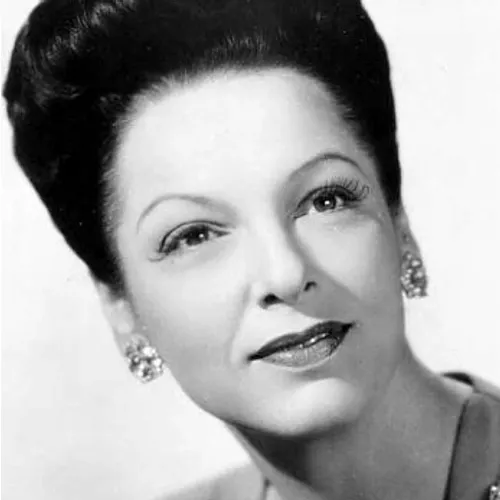
Gale Sondergaard
An American actress. Sondergaard began her acting career in theater, and progressed to films in 1936. She was the first recipient of the Academy Award for Best Supporting Actress for her film debut in Anthony Adverse (1936). She played supporting roles in various films during the late 1930s and early 1940s, including The Cat and the Canary (1939), The Mark of Zorro (1940) and The Letter (1940).
In the vibrant landscape of mid-20th century broadcasting, Gale Sondergaard emerged as a versatile and compelling radio performer, whose rich vocal talents and dramatic range captivated audiences across the United States. Her career spanned multiple mediums, but her contributions to radio drama remain a significant chapter in her artistic legacy.
Early Life and Theatrical Roots
Born in 1899 in Minnesota, Gale Sondergaard began her performance career on stage before transitioning to radio and film. Her theatrical training provided her with a powerful foundation for audio performance, allowing her to create vivid characters through voice alone. Her ability to convey complex emotions and nuanced characters would become her hallmark in radio broadcasting.
Radio Performance and Notable Productions
Sondergaard quickly became a sought-after performer in the golden age of radio drama. She appeared in numerous prestigious radio programs that defined the era's entertainment landscape. CBS Columbia Presents Corwin became one of her most frequent platforms, where she demonstrated her remarkable interpretative skills. Her performances were not limited to entertainment; she also used her platform for political engagement, participating in a Democratic National Committee radio program in 1944 alongside other Hollywood luminaries like Judy Garland and Humphrey Bogart. Her radio repertoire was impressively diverse, spanning multiple genres and production styles. She was a regular performer on Fletcher Markle's Studio One, Ford Theatre Radio Drama, NBC Mystery Theatre, and Arch Obeler's Radio Hall of Fame. Each of these programs showcased her ability to bring scripts to life through her nuanced vocal performances.
Broadcasting Style and Significance
What set Sondergaard apart was her ability to create fully realized characters without visual representation. Her vocal technique allowed listeners to imagine complex personalities, shifting effortlessly between dramatic and subtle emotional registers. In an era before television, radio performers like Sondergaard were the primary storytellers, painting entire worlds through sound and intonation.
Legacy in Radio and Beyond
While Sondergaard is often remembered for her Oscar-winning film performances, her contributions to radio drama were equally significant. She helped establish radio as a serious dramatic medium, proving that audio performance could be as compelling and sophisticated as stage or screen acting. Her work bridged the worlds of theater, radio, and film, making her a true multimedia artist of her time.
Conclusion
Gale Sondergaard's radio career represents a fascinating chapter in the evolution of American entertainment. Her performances not only entertained but also helped shape the narrative possibilities of radio drama, influencing generations of performers who would follow.
Works and Appearances
Radio
- CBS Columbia Presents Corwin - Regular performer
- Fletcher Markle's Studio One - Dramatic performances
- Ford Theatre Radio Drama - Multiple dramatic roles
- NBC Mystery Theatre - Dramatic series appearances
- Arch Obeler's Radio Hall of Fame - Featured performer
- Democratic National Committee Program (1944) - Political radio event
Film
- Anthony Adverse (1936) - Academy Award for Best Supporting Actress
- The Letter (1940) - Nominated for Best Supporting Actress
- Anna and the King of Siam (1946)
Stage
- Various theatrical productions prior to and during her radio and film career
