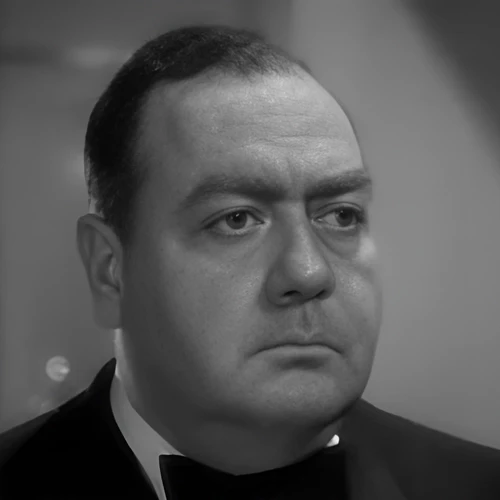
Eugene Pallette
Eugene William Pallette (July 8, 1889 – September 3, 1954) was an American actor. He appeared in over 240 silent era and sound era motion pictures between 1913 and 1946. After an early career as a slender leading man, Pallette appeared for decades as very obese with a large stomach and deep, gravelly voice, probably best-remembered for comic character roles such as Alexander Bullock, Carole Lombard's father, in My Man Godfrey (1936), as Friar Tuck in The Adventures of Robin Hood (1938) starring Errol Flynn, and his similar role as Fray Felipe in The Mark of Zorro (1940) starring Tyrone Power.
Early life and career He was born in Winfield, Kansas, the son of William Baird Pallette (1858–?) and Elnora "Ella" Jackson (1860–1906). His sister was Beulah L. Pallette (1880–1968). Pallette attended Culver Military Academy in Culver, Indiana. He then began his acting career on the stage in stock company roles, appearing for a period of six years. Silent pictures Pallette began his silent movie career as an extra in about 1911. His first credited appearance was in the one-reel short western/drama The Fugitive(1913) which was directed by Wallace Reid for Flying "A" Studios at Santa Barbara. The star was Edward Coxen. Quickly advancing to featured status, Pallette appeared in many westerns. He worked with D.W. Griffith on such famous films as The Birth of a Nation (1915) and Intolerance (1916). At this time, he had a slim, athletic figure, a far cry from the portly build that would gain him fame later in his career. After gaining a substantial amount of weight, Pallette gained status as a recognizable character actor. In 1927, he signed as a regular for Hal Roach Studios and was a reliable comic foil in several early Laurel and Hardy movies. In later years, Pallette's weight may have topped out at 300 pounds (136 kg).
Eugene Pallette, Mischa Auer and Alice Brady inMy Man Godfrey
Sound pictures The advent of the talkies proved to be the second major career boost for Pallette. His inimitable rasping gravel voice (described as "half an octave below anyone else in the cast") made him one of Hollywood's most sought-after character actors in the 1930s and 1940s. The typical Pallette role was the comically exasperated head of the family (as in My Man Godfrey and The Lady Eve), the cynical backroom sharpy (as in Mr. Smith Goes to Washington), or the gruff detective. However, Pallette's best known role may be as Friar Tuck in The Adventures of Robin Hood, and his similar appearance in The Mark of Zorro. BBC commentator Dana Gioia gave this extensive description of Pallette's onscreen appeal:
"Pallette could anchor a scene just by walking downstairs. When he enters Preston Sturges's The Lady Eve (1941), trotting down to breakfast singing a merry ballad, he embodies all the small human hopes that screwball comedy exists to shatter.... The mature Pallette character is a creature of provocative contradictions—tough-minded but indulgent, earthy but epicurean, relaxed but excitable. His grit and gravel voice sounds simultaneously tough and comic. Even his corpulence is two-sided. In his best films Pallette made his fatness seem like a sign of moderation and common sense. As Friar Tuck in The Adventures of Robin Hood (1938) or Fray Felipe in The Mark of Zorro (1940), he shows that a fat priest is no heartless zealot but understands the sins of the flesh. Play
