Ernest Hemingway
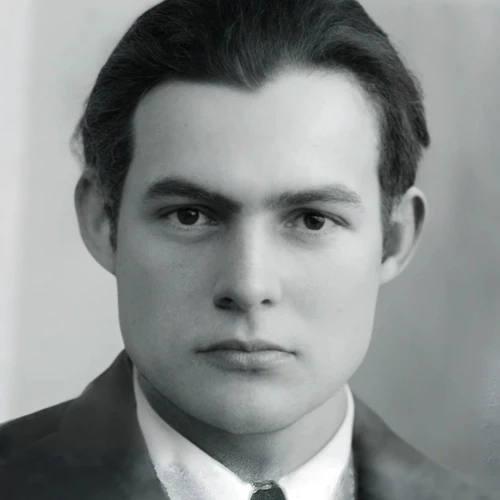
Early life Ernest Miller Hemingway was born on July 21, 1899, in Oak Park, Illinois, a suburb of Chicago. His father, Clarence Edmonds Hemingway, was a physician, and his mother, Grace Hall-Hemingway, was a musician. Both were well-educated and well-respected in the conservative community of Oak Park, a community about which resident Frank Lloyd Wright said, "So many churches for so many good people to go to". For a short period after their marriage, Clarence and Grace Hemingway lived with Grace's father, Ernest Hall, who eventually became their first son's namesake. Later Ernest Hemingway would say that he disliked his name, which he "associated with the naive, even foolish hero of Oscar Wilde's play The Importance of Being Earnest". The family eventually moved into a seven-bedroom home in a respectable neighborhood with a music studio for Grace and a medical office for Clarence. Hemingway's mother frequently performed in concerts around the village. As an adult, Hemingway professed to hate his mother, although biographer Michael S. Reynolds points out that Hemingway mirrored her energy and enthusiasm. Her insistence that he learn to play the cello became a "source of conflict", but he later admitted the music lessons were useful to his writing, as is evident in the "contrapuntal structure" of For Whom the Bell Tolls.The family owned a summer home called Windemere on Walloon Lake, near Petoskey, Michigan, where as a four-year-old he learned from his father to hunt, fish, and camp in the woods and lakes of Northern Michigan. His early experiences in nature instilled a passion for outdoor adventure and living in remote or isolated areas. From 1913 until 1917, Hemingway attended Oak Park and River Forest High School where he took part in a number of sports, namely boxing, track and field, water polo, and football. He excelled in English classes and performed in the school orchestra with his sister Marcelline for two years. In his junior year, he took a journalism class, taught by Fannie Biggs, which was structured "as though the classroom were a newspaper office". The better writers in class submitted pieces to The Trapeze, the school newspaper. Hemingway and Marcelline both had pieces submitted to The Trapeze; Hemingway's first piece, published in January 1916, was about a local performance by the Chicago Symphony Orchestra. He continued to contribute to and to edit the Trapeze and the Tabula (the school's newspaper and yearbook), for which he imitated the language of sportswriters, and used the pen name Ring Lardner, Jr.—a nod to Ring Lardner of the Chicago Tribune whose byline was "Line O'Type". Like Mark Twain, Stephen Crane, Theodore Dreiser and Sinclair Lewis, Hemingway was a journalist before becoming a novelist; after leaving high school he went to work for The Kansas City Star as a cub reporter. Although he stayed there for only six months, he relied on the Star's style guide as a foundation for his writing: "Use short sentences. Use short first paragraphs. Use vigorous English. Be positive, not negative." World War I Early in 1918, Hemingway responded to a Red Cross recruitment effort in Kansas City and signed on to become an ambulance driver in Italy. He left New York in May and arrived in Paris as the city was under bombardment from German artillery. By June, he was at the Italian Front. It was probably around this time that he first met John Dos Passos, with whom he had a rocky relationship for decades. On his first day in Milan, he was sent to the scene of a munitions factory explosion, where rescuers retrieved the shredded remains of female workers. He described the incident in his non-fiction book Death in the Afternoon: "I remember that after we searched quite thoroughly for the complete dead we collected fragments". A few days later, he was stationed at Fossalta di Piave. On July 8, he was seriously wounded by mortar fire, having just returned from the canteen bringing chocolate and cigarettes for the men at the front line. Despite his wounds, Hemingway assisted Italian soldiers to safety, for which he received the Italian Silver Medal of Bravery. Still only 18, Hemingway said of the incident: "When you go to war as a boy you have a great illusion of immortality. Other people get killed; not you ... Then when you are badly wounded the first time you lose that illusion and you know it can happen to you." He sustained severe shrapnel wounds to both legs, underwent an immediate operation at a distribution center, and spent five days at a field hospital before he was transferred for recuperation to the Red Cross hospital in Milan. He spent six months at the hospital, where he met and formed a strong friendship with "Chink" Dorman-Smith that lasted for decades and shared a room with future American foreign service officer, ambassador, and author Henry Serrano Villard. While recuperating, he fell in love, for the first time, with Agnes von Kurowsky, a Red Cross nurse seven years his senior. By the time of his release and return to the United States in January 1919, Agnes and Hemingway had decided to marry within a few months in America. However, in March, she wrote that she had become engaged to an Italian officer. Biographer Jeffrey Meyers states that Hemingway was devastated by Agnes' rejection, and in future relationships, he followed a pattern of abandoning a wife before she abandoned him. Toronto and Chicago Hemingway returned home early in 1919 to a time of readjustment. Not yet 20 years old, he had gained from the war a maturity that was at odds with living at home without a job and with the need for recuperation. As Reynolds explains, "Hemingway could not really tell his parents what he thought when he saw his bloody knee. He could not say how scared he was in another country with surgeons who could not tell him in English if his leg was coming off or not." In September, he took a fishing and camping trip with high school friends to the back-country of Michigan's Upper Peninsula. The trip became the inspiration for his short story "Big Two-Hearted River", in which thesemi-autobiographical character Nick Adams takes to the country to find solitude after returning from war. A family friend offered him a job in Toronto, and with nothing else to do, he accepted. Late that year he began as a freelancer, staff writer, and foreign correspondent for the Toronto Star Weekly. He returned to Michigan the following June and then moved to Chicago in September 1920 to live with friends, while still filing stories for the Toronto Star. In Chicago, he worked as an a