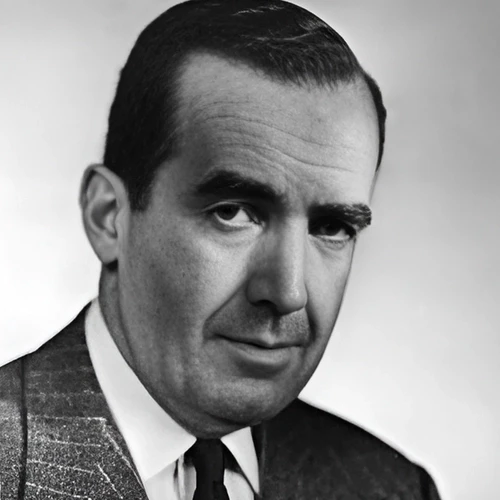
Edward R. Murrow
An American broadcast journalist. He first came to prominence with a series of radio news broadcasts during World War II, which were followed by millions of listeners in the United States.
In the annals of American broadcasting, few names resonate as powerfully as Edward R. Murrow. A pioneering journalist who transformed radio and television news, Murrow became synonymous with integrity, courage, and the highest standards of reporting during one of the most tumultuous periods of the 20th century.
Early Life and Roots of Journalism
Born Egbert Roscoe Murrow on April 25, 1908, in a humble log cabin in Polecat Creek, North Carolina, Murrow's early life was marked by modest beginnings. The youngest of four brothers, he grew up in a family of Scottish, Irish, English, and German descent, experiencing the challenges of rural farm life. When Murrow was six, his family moved to Washington state, where he would begin to shape the foundations of his future career. During his high school years in Skagit County, Murrow demonstrated early signs of his future prowess. He was president of the student body, excelled on the debate team, and was even a member of the championship basketball team. These experiences would prove instrumental in developing the communication skills that would later define his career.
The Path to Broadcasting
Murrow's journey into broadcasting began with his education at Washington State College (now University), where he majored in speech and became actively involved in college politics. Interestingly, it was during his college years that he transitioned from Egbert to Edward, a name that would become legendary in journalism. In 1929, while attending a student convention, Murrow delivered a speech urging college students to become more engaged with national and world affairs. This passionate address led to his election as federation president, foreshadowing his future role as a public communicator. After earning his bachelor's degree in 1930, he moved to New York, where his broadcasting career would soon take shape.
Pioneering War Reporting
Murrow's most iconic period came during World War II, where he revolutionized radio journalism. Joining CBS in 1935, he quickly became the director of talks and education. In 1937, he was sent to London, where he would make his most significant mark on journalism. His live broadcasts during the Blitz became legendary, always beginning with his signature phrase, "This is London". Murrow's reporting brought the raw reality of war directly into American homes, making distant conflicts feel immediate and personal. He flew on 25 Allied combat missions, providing unprecedented on-the-ground reporting that electrified radio audiences.
Challenging McCarthy and Television Journalism
In the 1950s, Murrow transitioned to television, using the medium as a powerful tool for social commentary. His most famous moment came with his See It Now program, where he courageously challenged Senator Joseph McCarthy during the height of the anti-communist hysteria. This broadcast is widely credited with helping to diminish McCarthy's influence and demonstrating television's potential as a medium for serious journalism.
Legacy and Impact
Edward R. Murrow passed away on April 27, 1965, leaving an indelible mark on journalism. He was more than a reporter; he was a crusader for truth, using media as a platform for social change. His commitment to journalistic integrity inspired generations of reporters and transformed how news was reported and understood.
Works and Appearances
Radio
- Hear It Now (1951-1955)
- This I Believe (1951-1955)
- Various World War II broadcasts from London
Television
- See It Now (1951-1955)
- Person to Person (1953-1959)
- Harvest of Shame (1960)
Film
- Prologue Narrator, Around the World in 80 Days (1956)
- Appeared as himself in Sink the Bismarck! (1960)
Awards and Honors
- Multiple Emmy Awards
- Inducted into the Television Hall of Fame (1984)
- Numerous posthumous honors, including the Edward R. Murrow Awards for journalism excellence