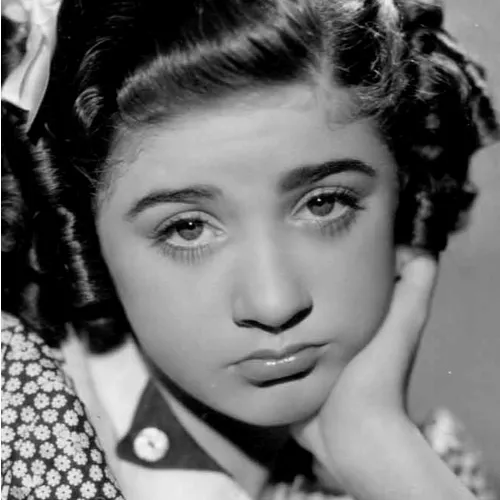
Edith Fellows
Edith Marilyn Fellows (May 20, 1923 – June 26, 2011) was an American actress who became a child star in the 1930s. Best known for playing orphans and street urchins, Fellows was an expressive actress with a good singing voice. She made her screen debut at the age of five in Charley Chase's film short Movie Night (1929). Her first credited role in a feature film was The Rider of Death Valley (1932). By 1935, she had appeared in over twenty films. Her performance opposite Claudette Colbert and Melvyn Douglas in She Married Her Boss (1935) won her a seven-year contract withColumbia Pictures, the first such contract offered to a child. Fellows appeared in a series of leading roles for Columbia, including Tugboat Princess (1936), Little Miss Roughneck (1938), and The Little Adventuress (1938). Her performance as the precocious orphan alongside Bing Crosby in Pennies from Heaven (1936) won her critical acclaim. In 1942, she appeared in two Gene Autry films, Heart of the Rio Grande and Stardust on the Sage, which highlighted her fine singing voice. Her acting career was interrupted in the 1940s by serious personal problems, her own life becoming more Dickensian than the characters she portrayed on screen. In the 1980s, she returned to acting with sporadic roles in television series. Between 1929 and 1995, Fellows appeared in over seventy films and television programs.
Early years Edith Marilyn Fellows was born on May 20, 1923 in Boston, Massachusetts, the only child of Willis and Harriet Fellows. Her mother abandoned her a few months after her birth. At the age of two, she moved to Charlotte, North Carolina with her father and paternal grandmother, Elizabeth Fellows. As a toddler, she took dancing lessons to correct her pigeon-toed walk. At the age of four, she was spotted by a talent scout who arranged a Hollywood screen test for fifty dollars. She and her grandmother traveled to Hollywood by train to discover they had been swindled. While her grandmother worked as a housecleaner, Edith stayed with a local family whose son worked as an extra in movies. Edith accompanied him to the studio one day. Without being asked, she began dancing and singing in front of the bemused director. When the boy became ill a few days later, the studio sent a message, "Send the girl." She was soon cast in comedian Charley Chase's film short Movie Night (1929), playing Charley's brat daughter on a family outing to the movies. Additional screen roles soon followed, including Daddy Long Legs (1931), The Rider of Death Valley (1932), two Our Gang comedies, Shivering Shakespeare (1930) and Mush and Milk (1933), and Jane Eyre (1934) for Monogram Pictures in which she played Mr. Rochester's ward, a precocious matchmaker trying to bring together her guardian and Jane. That same year, Fellows appeared with WC Fields in Mrs Wiggs of the Cabbage Patch playing Australia Wiggs, one of five children being brought up in a shanty town by their poverty-stricken mother whose husband had deserted her. By 1935, she had made over twenty films and was ready for a breakthrough. Child star
Edith Fellows and Bing Crosby in Pennies from Heaven (1936)
In 1935, Fellows appeared in Gregory La Cava's She Married Her Boss (1935) as Melvyn Douglas's deceitful daughter who is tamed when Claudette Colbert "spanks the daylight out of her" with a hairbrush. Her performance landed her a seven-year contract with Columbia Pictures and she became a star at the age of twelve. With her first Columbia films—One-Way Ticket, And So They Were Married, and Tugboat Princess—she continued to be typecast as the orphan or street urchin. In the fall of 1936, her popularity was helped significantly by her co-starring role opposite Bing Crosby inPennies from Heaven, playing a tough precocious orphan protected by Crosby's singing vagabond. Wherein previous films her robust character was tamed by a swift spanking, in this film she is "soothed by the crooning of Crosby, particularly the title song sung to her during a thunderstorm." In his review in The New York Times, Frank S. Nugent singled out Fellows' performance writing:
The chief honors properly belong to little Miss Fellows. Hers really is an exceptional performance for a youngster, skirting the perils of bathos in her tender scenes and playing
