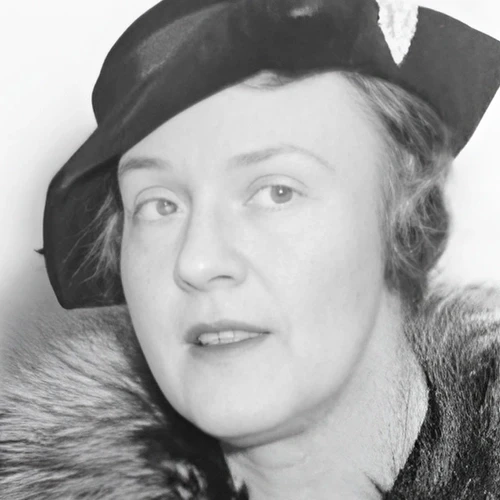
Dorothy Thompson
In the tumultuous landscape of mid-20th century broadcasting, Dorothy Thompson emerged as a pioneering journalist whose radio voice became a powerful instrument of truth and social commentary. More than just a broadcaster, she was a fearless chronicler of global events, a woman who used the airwaves to challenge fascism and shape public opinion during one of history's most critical periods.
The Making of a Pioneering Journalist
Born in Lancaster, New York in 1893, Dorothy Thompson's journey to becoming a groundbreaking radio commentator was shaped by her early commitment to social justice. After graduating from Syracuse University in 1914, she felt a profound social obligation to fight for progressive causes, particularly women's suffrage. Her early work in advertising and contributing op-eds to various publications set the stage for her remarkable career in journalism. Thompson's international perspective began to take shape when she traveled to Europe in 1920, quickly establishing herself as a foreign correspondent. Her breakthrough came after interviewing the Irish independence leader Terence MacSwiney, which led to her appointment as Vienna correspondent for a major newspaper. By 1925, she had become the Chief of the Central European Service for the Public Ledger, and later headed the Berlin bureau of the New York Herald Tribune.
Confronting the Rise of Nazism
Thompson's most significant journalistic work occurred in Germany during the early 1930s. She was one of the first international journalists to recognize and publicly warn about the dangers of Adolf Hitler. In her landmark book I Saw Hitler, she provided critical insights into the emerging Nazi threat. Her bold reporting ultimately led to her becoming the first American journalist expelled from Nazi Germany in 1934, an event that transformed her into an international symbol of resistance against fascism. Her radio broadcasts became a crucial platform for her anti-fascist messaging. From 1936 to 1938, she was a prominent news commentator, with her NBC Radio broadcasts becoming some of the most popular in the United States. When Nazi Germany invaded Poland in 1939, Thompson was on the air for fifteen consecutive days and nights, providing critical commentary to millions of listeners.
A Pioneering Voice in Broadcasting
By 1939, Thompson had become one of the most influential women in American media. Time magazine featured her on its cover, declaring her influence comparable to Eleanor Roosevelt. Her syndicated newspaper column "On the Record" was read by over ten million people and carried by more than 170 papers, running uninterrupted for 22 years. Thompson's broadcasting style was characterized by her direct, uncompromising approach to complex global issues. She was not afraid to challenge prevailing narratives and used her platform to advocate for humanitarian causes, including support for Jewish refugees and later, Palestinian rights.
Legacy and Lasting Impact
Dorothy Thompson's legacy extends far beyond her radio broadcasts. She was a complex figure who challenged political orthodoxies and paid a professional price for her outspoken views, particularly regarding Zionism and Israeli policies. Despite facing significant backlash, she remained committed to her principles of speaking truth to power. Her influence on journalism was profound. She is often referred to as the "First Lady of American Journalism" and was recognized by her contemporaries as a transformative media figure. In 2023, the Library of Congress selected recordings of her NBC Radio commentary for preservation, acknowledging her historical significance.
Works and Appearances
Radio
- NBC Radio News Commentator (1936-1938)
- Regular radio broadcasts on global politics and World War II events
Publications
- I Saw Hitler! (1932)
- Dorothy Thompson's Political Guide (1938)
- Let the Record Speak (1939)
- Regular syndicated newspaper column "On the Record" (1936-1958)
Books
- The New Russia (1928)
- Refugees: Anarchy or Organization? (1938)
- To Whom Does the Earth Belong? (1944)
Dorothy Thompson passed away in 1961, leaving behind a remarkable legacy of journalistic courage and commitment to truth. Her life serves as a testament to the power of media in shaping public understanding during critical historical moments.